
Which Sport Is More Physical — Football or Basketball?
There is no universal answer. Soccer dominates aerobic distance, basketball dominates jump load, and American football dominates collision intensity. We compare the three sports with GPS data, contact frequency, and effective work time per match.
 Tap to enlarge
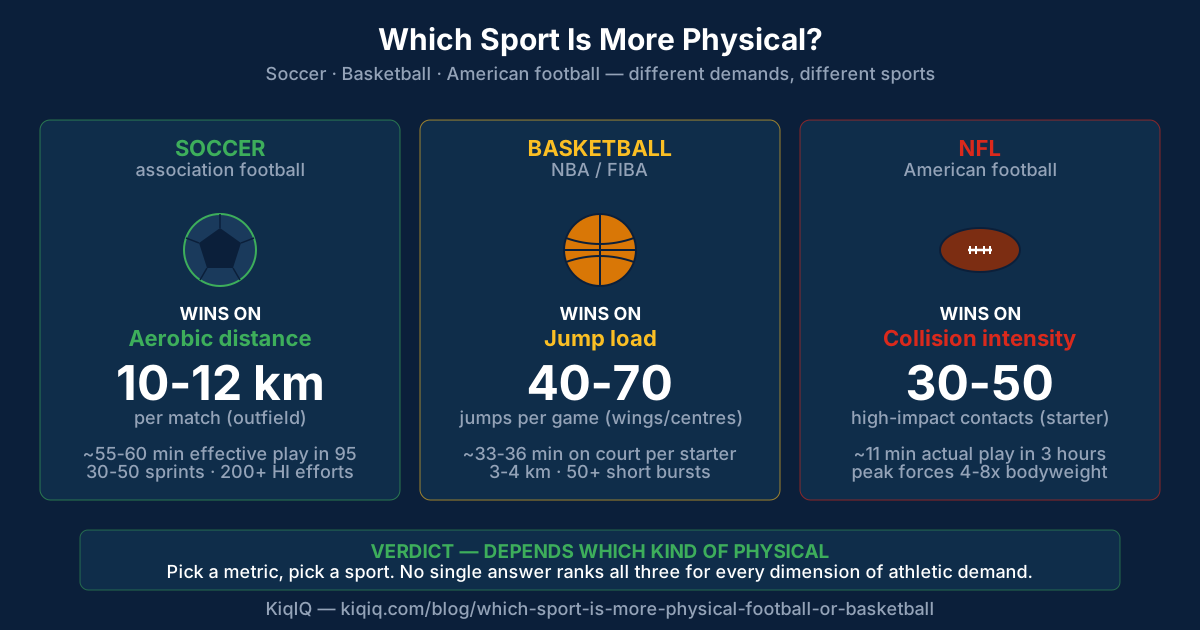
There is no universal answer. Soccer wins on aerobic distance and sustained running — outfield players cover 10-12 km per match. Basketball wins on jump load and lateral repetition — NBA wings record 40-60 jumps and 50+ short sprints per game. American football wins on collision intensity — a starter can take 30-50 high-impact contacts per game with peak forces an order of magnitude beyond what soccer or basketball produce. Pick a metric, pick a sport — but do not pick "more physical" without saying which kind of physical you mean.
Why the question doesn't have a clean answer
Asking "which sport is more physical" treats *physicality* as a single dimension. It isn't. Performance scientists measure athletic demand across at least five dimensions, and each sport peaks on a different one.
- Aerobic load — total distance covered, sustained heart rate, time spent in moderate-to-high zones.
- Anaerobic load — sprints, accelerations, decelerations, repeated high-intensity efforts.
- Mechanical / impact load — collisions, tackles, jumps, and the ground reaction forces from each.
- Cognitive / decision load — frequency of fast pattern-recognition decisions under physical fatigue.
- Time on task — actual minutes of work versus the clock duration of the contest.
Catapult, STATSports, and Polar GPS units are now standard at NFL, EPL, and NBA training facilities. The numbers below are drawn from publicly disclosed match data from those systems.
Distance covered — soccer dominates by a wide margin
Soccer is the longest-distance team sport played at high intensity. Premier League outfield players average 10-12 km per match, with central midfielders frequently exceeding 12 km and full-backs in the 11-12 km range. Goalkeepers sit at 4-5 km.
NBA players cover 3-4 km per game of actual on-court time. Wings tend higher, centres lower. Across a 48-minute game with TV timeouts and rotations, on-court time per starter is around 33-36 minutes, so distance per minute on court is broadly comparable to soccer — but total per-match distance is far lower because basketball games include rest.
NFL players cover 1-2 miles (1.6-3.2 km) per game of *playing* distance, but actual time-on-task is roughly 11 minutes of clock-stopped play in a three-hour broadcast. Per-second distance during plays is high; total cumulative distance is the lowest of the three.
Sprints and high-speed running
Anaerobic profile per match:
- Soccer — 30-50 sprints per match (defined as runs above 25 km/h) for outfield players, with 200-300 high-intensity efforts above 19 km/h. Total sprint distance: 250-400 m per match.
- Basketball — 50+ short bursts per game per wing player (court is short, sprints are short). NBA Second Spectrum tracking puts max speeds at 18-20 mph (28-32 km/h), but the duration of each sprint is 1-3 seconds.
- NFL — Position-dependent. A wide receiver running deep routes can hit 21-22 mph (33-35 km/h) — among the highest peak speeds in any team sport — but only on 30-40 plays per game. A lineman almost never reaches 15 mph but exerts maximum force on every snap.
Jumps — basketball wins outright
Basketball is by far the most jump-intensive team sport. NBA forwards and centres record 40-70 vertical jumps per game between rebounds, contested shots, blocks, and tip-offs. Catapult IMU data published by basketball performance labs places the average jump-load per game at 4-5x what soccer produces.
Soccer outfield players average 8-15 jumps per match, mostly aerial duels for centre-backs and centre-forwards. Wide players record fewer.
NFL depends on position. Receivers and defensive backs jump 4-8 times for contested catches; offensive and defensive linemen jump rarely outside training. The position-by-position spread is very wide.
Contact and collision — NFL is in a different league
Collision intensity is where American football separates from the other two sports. NFL Catapult-published data shows a starting linebacker or running back absorbs 30-50 high-impact contacts per game, with peak ground reaction forces during line collisions estimated at 4-8x bodyweight per impact. Cumulative impact load over a game is multiples of what either soccer or basketball produces.
Soccer generates 20-40 duels per match per outfield player — tackles, aerial challenges, shoulder-to-shoulder battles. Peak forces are real (a 50/50 challenge on hard ground produces 3-4x bodyweight) but the cumulative collision load is well below NFL.
Basketball has 5-15 incidental contact events per starter per game — boxing out, screens, charges, contested shots. Floor impact from landing after a jump is an underrated load source: 50+ landings at 4-6x bodyweight per game adds up to a meaningful musculoskeletal stress.
Effective work time — football looks bigger than it is
If you measure actual time on task per broadcast hour, the ranking flips:
- Soccer — ~55-60 minutes of effective play in a 95-100 minute broadcast (clock runs continuously; ball is in play roughly two-thirds of the elapsed time).
- Basketball — ~48 minutes of game clock in a 2-2.5 hour broadcast (clock stops on most whistles; effective on-court time per starter is 33-36 minutes).
- American football — ~11 minutes of actual play in a 3-3.25 hour broadcast (clock stops between every play; the rest is huddles, referee resets, and TV timeouts).
The 11-minute figure for NFL active play comes from a 2010 Wall Street Journal analysis that has been replicated multiple times. It does not include pre-snap motion or huddles.
Position matters more than sport
A central midfielder, a basketball point guard, and an NFL running back are not three samples of "a soccer player", "a basketball player", and "a football player". They are three players whose position dictates more about their physical demand than the sport's category does.
- Soccer central midfielder — peak aerobic load. 12+ km per match, 250+ high-intensity efforts.
- Soccer centre-forward — peak collision and jump for soccer. Lower distance, more aerial duels and box pressure.
- NBA wing (small forward) — peak total load for basketball. 4 km, 50+ sprints, 40+ jumps, plus contested rebounds.
- NFL running back / linebacker — peak collision load across all team sports. 30-50 high-impact plays per game.
- NFL kicker / quarterback — among the lowest physical loads in elite team sport. Quarterbacks rarely take collision damage if the offensive line holds; kickers run a cumulative ~200 m per game.
So — which sport is more physical?
Pick a verdict by metric:
- Most aerobic and most distance → Soccer. Nothing else comes close on cumulative running.
- Most jumps and most lateral reps → Basketball. NBA wings produce a jump-load profile far above soccer or NFL.
- Highest collision intensity per play and per game → American football. The cumulative impact load on a starter is multiples of what either other sport produces.
- Most fatigue-induced cognitive load → soccer and basketball roughly tied, both far above NFL where decisions are made in 4-7 second discrete plays.
- Most consecutive time without rest → Soccer. Outfield players have no clock stoppages, no substitution back, and one 15-minute break in 95 minutes of clock.
Frequently asked questions
- Is soccer or basketball more physically demanding?
- It depends on the metric. Soccer produces the highest aerobic demand — outfield players cover 10-12 km per match, more than any other team sport. Basketball produces a much higher jump load and more lateral cuts per minute on court. Soccer wins on cumulative distance and sustained heart rate; basketball wins on impact landings, jumps, and short-burst repetitions per minute of actual play.
- Is American football more physical than soccer?
- American football has higher collision intensity per play than soccer. A starting NFL linebacker or running back absorbs 30-50 high-impact contacts per game with peak ground reaction forces 4-8x bodyweight. Soccer produces lower-intensity but more frequent duels and far more total running distance. NFL cumulative impact load is the highest of any team sport; soccer cumulative aerobic load is the highest. Different kinds of physical.
- How far does an NBA player run per game?
- NBA players cover roughly 3-4 km per game of actual on-court time, according to NBA Second Spectrum and Catapult data. Wing players (small forwards, shooting guards) tend to cover the most; centres the least. Per-minute distance on court is broadly similar to soccer, but total per-match distance is much lower because basketball games include rotations, timeouts, and rest periods that soccer matches do not.
- How long is the actual play time in an NFL game?
- Actual play time in an NFL game is approximately 11 minutes — the time the ball is in play between snap and whistle. This figure was first reported by a 2010 Wall Street Journal analysis and has been replicated several times since. The remainder of a roughly three-hour NFL broadcast is huddles, pre-snap motion, referee resets, replay reviews, and TV timeouts.
- Which sport has the highest peak running speed?
- American football has the highest peak running speeds among the three sports. Wide receivers and defensive backs running deep routes regularly hit 21-22 mph (33-35 km/h), and elite players have been clocked above 23 mph in straight-line situations. Soccer wingers and full-backs reach 20-21 mph (32-34 km/h) in match conditions. NBA players peak at 18-20 mph (28-32 km/h) due to the shorter court length.
References
- Catapult — Performance metrics in elite football — Catapult Sports
- NBA — Second Spectrum tracking overview — NBA
- Wall Street Journal — 11 Minutes of Action in an NFL Game — Wall Street Journal (Jan 2010)
- Premier League — Match performance data overview — Premier League
- STATSports — Sport science research — STATSports
Key terms in this article
Ask KiqIQ a follow-up
Get a live, data-driven answer powered by api-football + KiqIQ's Poisson model. Try one of these prompts or write your own.
Part of pillar
Performance Science
See every article in this knowledge pillar →
Related
Reviewed by a KiqIQ editor before publication. Spotted an error? Email editor@kiqiq.com — we follow our Corrections Policy.