
Drill Design Is the Physical Stimulus: Why Most Football Conditioning Is Already Built Into the Session
Most football coaches reach for extra conditioning blocks too quickly. The reality is that pitch size, player numbers and transition rules already determine the physical demand. Align the coaching objective with the physical aim and the extra work usually isn't needed.
 Tap to enlarge
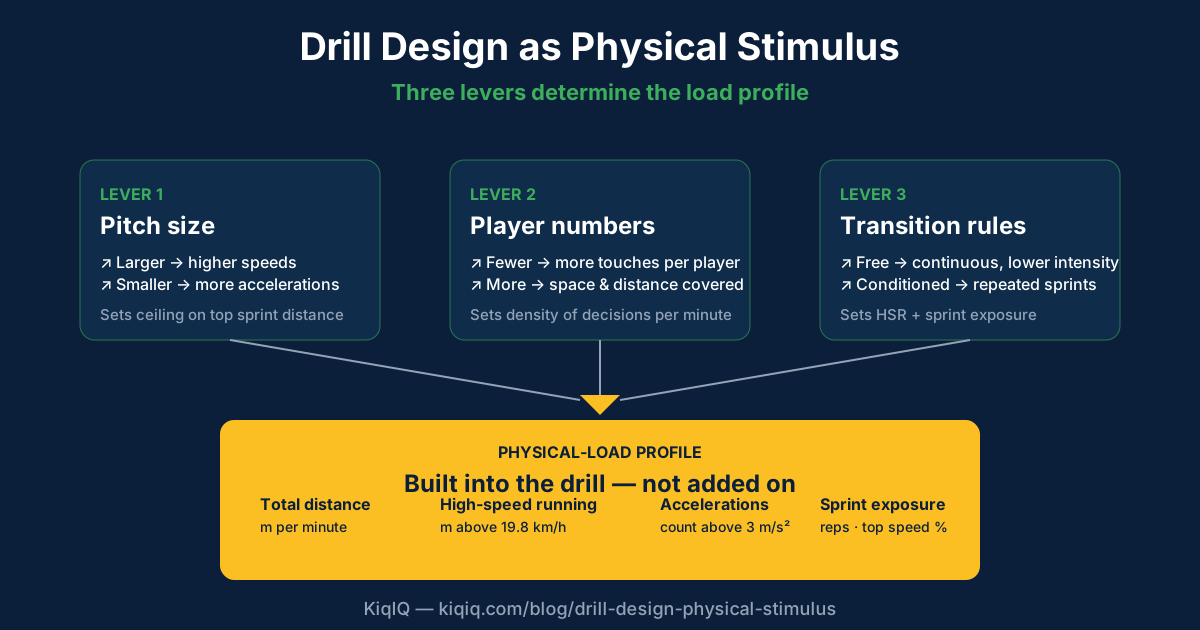
A common coaching reflex when a session feels physically light is to bolt on a finishing conditioning block — eight-by-30-second efforts, or a shuttle ladder, or a 10-minute run. Sport-science research over the last decade has been quietly arguing against this default. The physical demand of a training session is mostly decided when the drill is designed, not at the end. Pitch size, player numbers, transition rules — these three variables determine the heart-rate profile, the high-speed running exposure, and the deceleration count the players will accumulate. Align the coaching objective with the physical aim and the extra work is usually unnecessary.
Pitch size changes running demands
The single biggest lever on the physical profile of a small-sided game is pitch size. Larger pitches mean more space per player, which means more high-speed running, more sprinting, and longer rest periods between high-intensity efforts. Smaller pitches mean shorter, more frequent efforts, more accelerations and decelerations, lower top speeds but higher repeat-effort density.
A 4v4 on 30 × 20 metres looks the same on paper as a 4v4 on 50 × 35 metres but produces fundamentally different physical stimuli. The first develops anaerobic capacity through repeated short efforts; the second develops aerobic-power and high-speed running exposure. Most coaches intuit this when they design the drill but underestimate how much of the conditioning effect is already baked in.
Player numbers change involvement
The second lever is the number of players per side. Fewer players per side increases individual involvement — more ball touches, more decisions, more high-intensity efforts. More players per side reduces individual involvement and shifts the work-rest ratio toward more rest. A 3v3 demands close to full physical engagement from every player on the pitch; an 8v8 has stretches where individual players coast.
For a coach trying to build aerobic conditioning, fewer-players-per-side at larger pitches per player produces a higher individual physical load than larger-team formats. For a coach trying to develop tactical decision-making, the smaller format also raises the rate of decisions made under pressure — the same drill variable serves both aims.
Transition rules change speed exposure
The third lever is what the rules say about transition. A rule that requires the defending team to recover behind the ball before they can press changes the speed profile completely — every turnover triggers a maximum-effort run from one or both teams. A rule that allows immediate press-back keeps players within a tighter speed band. A rule that gives a bonus goal for scoring within seconds of a turnover incentivises high-speed transitional running on both sides.
These rule choices are often described as "tactical" by coaches, but they're simultaneously physical. The team that's playing under transition incentives is accumulating high-speed running exposure as a side-effect of the tactical work. The conditioning block at the end of the session becomes redundant — the session already delivered the high-speed work.
When the coaching objective and physical aim align
The cleanest training sessions are the ones where the coaching objective (a tactical pattern the coach wants to develop) and the physical aim (the load profile the players need for the week) point at the same drill design. A coach who wants high-speed-running exposure and possession-based build-up can design a 6v6+2 on a longer-than-wide pitch with transition rules that incentivise quick attacks — and tick both boxes from the same drill.
When the two don't align, the session is doing two jobs in series rather than parallel. That's sometimes the right call — pre-season fitness blocks, for example, are deliberately conditioning-led with tactical content secondary. But during the in-season weekly cycle, alignment is usually possible and produces better training-load distribution than bolting conditioning on at the end.
Pitch size + player numbers + transition rules already determine 80% of a session's physical demand. The remaining 20% is whether the coach adds explicit conditioning. Most sessions don't need the explicit add-on.
A practical heuristic for session design
Three questions before designing a drill: what tactical pattern is the session targeting (the coaching objective)? What load profile do the players need this week (the physical aim)? Can pitch size, player numbers and transition rules be tuned to deliver both at once? If yes, the drill design carries the physical work and no bolt-on is needed. If the two diverge — for example, a tactical session on detailed positional play that requires lower physical intensity in a week where the players still need high-speed exposure — then a short conditioning add-on is appropriate, but framed as a deliberate gap rather than a habit.
The shift in mindset is from "conditioning is something I add after the tactical work" to "the drill IS the conditioning, designed deliberately to deliver both aims". Coaches at the top of the sport have been working this way for years; the new academic literature is catching up by quantifying the load profiles that different drill variables produce.
- Pitch size — larger = more high-speed running; smaller = more accel/decel.
- Player numbers — fewer = more individual involvement, higher per-player load.
- Transition rules — incentivising fast transitions adds high-speed running as a tactical side-effect.
- Alignment — when coaching objective + physical aim point at the same drill, no bolt-on is needed.
- The shift — from "conditioning after tactical work" to "the drill IS the conditioning".
Frequently asked questions
- Do football players need separate conditioning sessions?
- In most weeks, no. The physical demands of training are largely determined by drill design — pitch size, player numbers, and transition rules collectively account for most of the load profile. Aligning the coaching objective with the physical aim usually delivers both from the same drill. Separate conditioning is appropriate when the tactical week requires low intensity but the physical week requires high-speed exposure.
- What pitch size produces the most high-speed running?
- Larger pitches with fewer players per side produce more high-speed running per player. A 4v4 on 50 × 35 metres exposes individual players to high-speed running more than a 4v4 on 30 × 20. The rule of thumb is roughly 100-150 m² of pitch per player for high-speed work; less than 80 m² shifts the load toward repeated accelerations.
- How do transition rules change training load?
- Rules that incentivise quick attacks after turnovers produce high-speed running on both teams — the team in possession sprints forward, the team out of possession sprints to recover. Rules that require defending teams to recover behind the ball before pressing trigger maximum-effort runs at every turnover. These tactical rules are simultaneously physical stimuli.
- When should a coach add a conditioning block to a session?
- When the tactical content the coach is prioritising for that session is low-intensity (e.g. positional play, set-piece drilling) but the player's weekly physical aim still requires high-intensity exposure. Treat it as a deliberate gap rather than a habit — most weeks, drill design can carry both aims and the bolt-on isn't necessary.
References
- Hammami et al. (2018) — Effects of small-sided games on physical demands — Frontiers in Physiology
- The Football Scientist — Newsletter on training design — The Football Scientist
Key terms in this article
Ask KiqIQ a follow-up
Get a live, data-driven answer powered by api-football + KiqIQ's Poisson model. Try one of these prompts or write your own.
Part of pillar
Performance Science
See every article in this knowledge pillar →
Related
Reviewed by a KiqIQ editor before publication. Spotted an error? Email editor@kiqiq.com — we follow our Corrections Policy.