
Half-Time Re-Warm-Ups in Football: What the Research Says Actually Works
The performance drop after half-time is well-documented. The 2016 review by Hammami et al. summarises which re-warm-up strategies offset it, and which are common practice without an evidence base.
 Tap to enlarge
Goals scored in the first five minutes of the second half are one of football's more reliably weird statistical patterns. The receiving team is disproportionately vulnerable; the scoring team is disproportionately efficient. Sport-science research has been pointing for over a decade at the physiological mechanism behind it: a passive half-time interval causes core body temperature to drop, neuromuscular activation to decline, and the first minutes after the restart to be played at lower physical output than the first half closed at. Half-time re-warm-ups are the standard mitigation, and the 2016 review by Hammami et al. is the canonical evidence base for which versions work.
The physiology behind the second-half drop
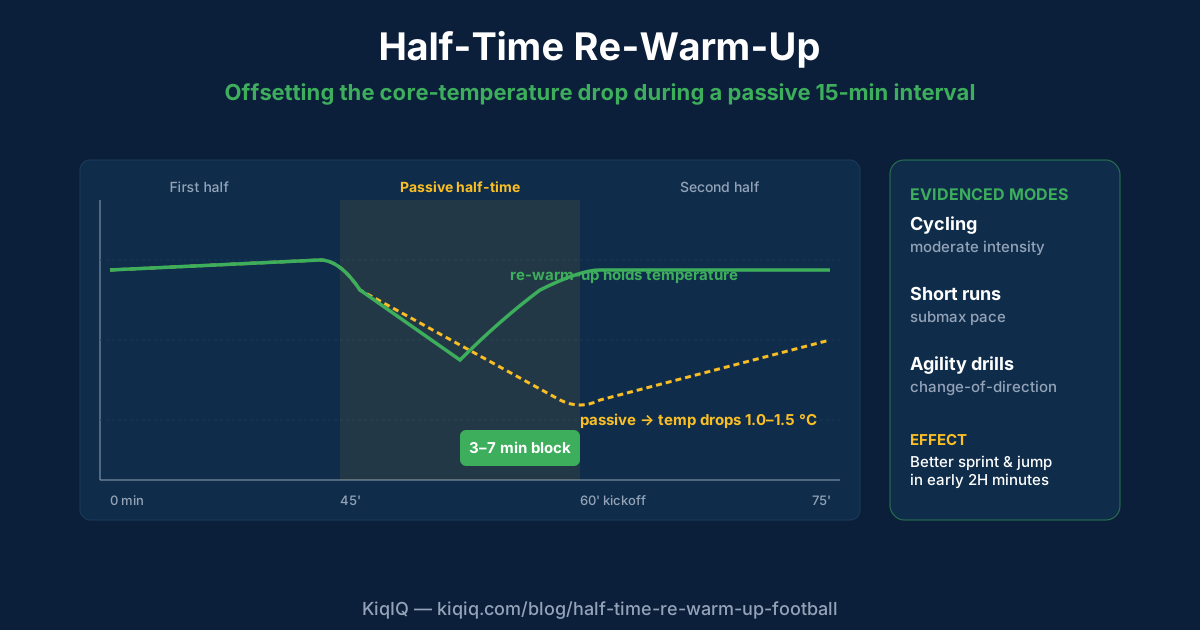
During the first half, core body temperature rises to roughly 38-39°C in match conditions. Neuromuscular activation is high; tissue compliance and metabolic activity are tuned to the pace of the game. A 15-minute passive half-time interval reverses all three trends. Core temperature falls toward resting levels. The muscle-spindle activation that allowed reactive cutting and accelerating during the first half decays. The cardiovascular system shifts back toward parasympathetic-dominant rest physiology.
When the second half kicks off, players who haven't intervened against this drop start the half closer to their pre-warm-up state than to their first-half-end state. The performance cost shows up as slower starts, lower repeat-sprint capacity in the opening 10-15 minutes, and slightly impaired technical execution under speed. The cumulative effect (across many matches and many leagues) is the early-second-half goal-conceding asymmetry.
A 15-minute passive half-time interval drops core body temperature, decays neuromuscular activation, and shifts cardiovascular state back toward rest. Re-warm-ups exist to counter all three.
What the 2016 Hammami et al. review found
The Hammami et al. (2016) review summarised studies on re-warm-up effectiveness and identified three intervention types with usable evidence bases: brief cycling during half-time, short runs immediately before the restart, and agility drills before kickoff of the second half. Each counteracts the core-temperature drop and neuromuscular decline by adding low- to moderate-intensity activity during the rest window.
The headline finding is that the specific form of activity matters less than three properties: it has to be football-specific (or at least involve dynamic full-body movement), it has to be intense enough to keep core temperature elevated (low-intensity strolling doesn't cut it), and it has to avoid adding fatigue that would hurt the second-half performance the warm-up is meant to preserve. Short, sharp, and stopping before fatigue accumulates is the recipe.
What good re-warm-up design looks like
A well-designed re-warm-up runs roughly four to six minutes immediately before the second-half kickoff. It combines low-intensity movement (jogging, dynamic stretching) with a short block of higher-intensity efforts, multiple short sprints, agility-pattern movements, or rapid reactive runs. Almere City in the Eredivisie uses a re-warm-up of multiple short sprints before the second-half kickoff for exactly this purpose: re-activate the neuromuscular system and lift core temperature back toward first-half-end levels.
The opposite of well-designed: a re-warm-up that's long enough to accumulate fatigue (more than 10-15 minutes), or that involves heavy loading (extended high-intensity efforts), or that the coach uses to deliver tactical instructions standing still for five minutes. Each of these defeats the purpose. The re-warm-up has to be a physical intervention, not a delivery vehicle for the team talk.
The operational constraints coaches manage around
Even where the evidence is clear, applying it has practical limits. Half-time is 15 minutes by competition rule. That window must accommodate the team talk, individual feedback, tactical adjustments, kit changes, recovery nutrition, and the re-warm-up. A coach who runs an eight-minute team talk and a six-minute warm-up has one minute of buffer; in practice many teams compress the warm-up to two or three minutes because the talk overruns or the manager wants more individual feedback.
The pragmatic compromise is a re-warm-up that's short enough to fit consistently and intense enough that the brevity still produces an effect. Three to four minutes of dynamic movement with one short burst of speed work toward the end can deliver most of the temperature-preservation benefit. The choice isn't between an ideal re-warm-up and none at all; it's between a brief but effective one and a longer one that gets cut on a routine basis when the team talk runs over.
- Physiological mechanism: passive half-time drops core temperature + neuromuscular activation.
- Effective interventions: cycling, short runs, agility drills before the restart.
- Three properties: football-specific, intense enough to lift core temperature, short enough to avoid fatigue.
- Practical duration: 4-6 minutes is typical; 2-3 minutes is achievable when the team talk overruns.
- Operational constraint: 15-minute half-time has to cover talk, feedback, nutrition, and the warm-up.
Frequently asked questions
- Why do teams concede goals in the first 5 minutes of the second half?
- Because a passive 15-minute half-time drops core body temperature, decays neuromuscular activation and shifts the cardiovascular system back toward resting physiology. Players start the second half closer to their pre-warm-up state than to their first-half-end state, producing slower starts and lower repeat-sprint capacity in the opening 10-15 minutes. Cumulatively this shows up as an early-second-half goal-conceding pattern across leagues.
- What is a half-time re-warm-up?
- A brief, structured physical activity during the latter part of half-time designed to maintain core body temperature and neuromuscular activation before the second-half kickoff. Typical forms include cycling on stationary bikes, short runs in the tunnel or on the pitch, and dynamic agility drills with sprint bursts.
- How long should a half-time re-warm-up be?
- The literature supports 4-6 minutes as a typical effective duration. The warm-up has to be long enough to elevate core temperature without accumulating fatigue. In practice many teams compress to 2-3 minutes when the team talk overruns. A short but consistently-applied warm-up beats a longer one that gets cut routinely.
- Do half-time re-warm-ups really improve performance?
- The 2016 Hammami et al. review summarised the evidence base and found that cycling, short runs and agility drills before the second-half restart all offset the performance drop from a passive half-time interval. The size of the effect varies between studies but the direction is consistent, players who re-warm up at half-time start the second half closer to first-half intensity than players who don't.
References
- Hammami et al. (2016), Effects of warm-up on physical performance — Journal of Sports Sciences
Ask KiqIQ a follow-up
Get a live, data-driven answer powered by api-football + KiqIQ's Poisson model. Try one of these prompts or write your own.
Part of pillar
Performance Science
See every article in this knowledge pillar →
Related
Reviewed by a KiqIQ editor before publication. Spotted an error? Email editor@kiqiq.com — we follow our Corrections Policy.