
What Is a Set Piece in Football? Definition and Types
A set piece in football is any restart of play from a stationary ball — corners, free-kicks, throw-ins, goal kicks, and penalties. We define each type and explain why set pieces account for ~25-30% of goals.
 Tap to enlarge
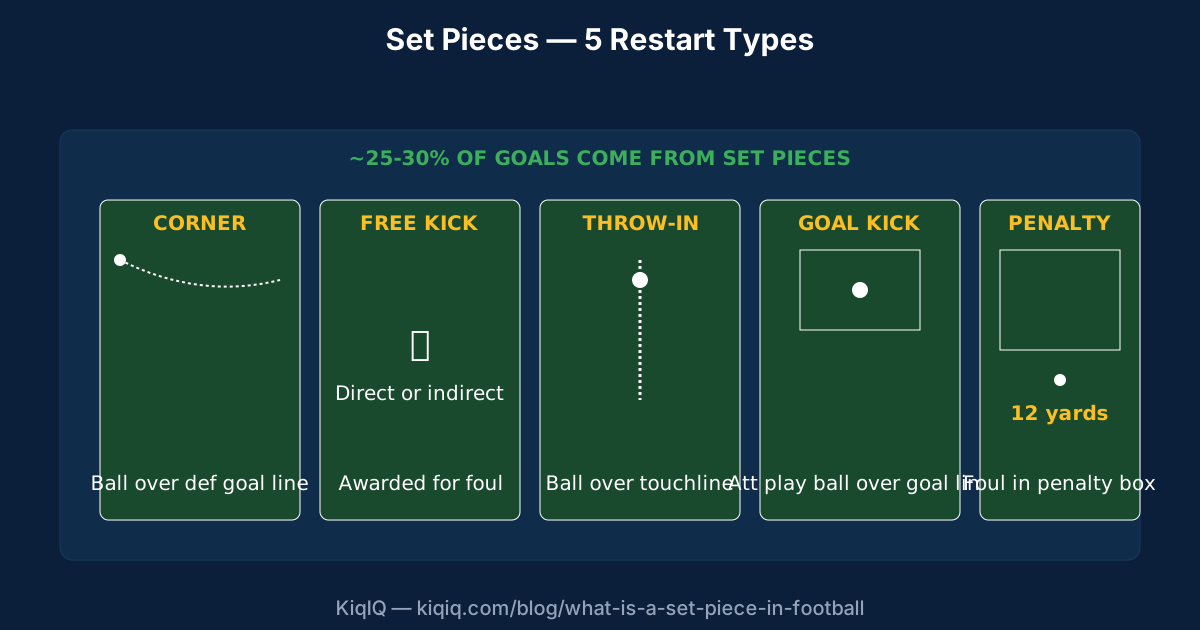
A set piece in football is any restart of play from a stationary ball — corner kicks, free-kicks (direct and indirect), throw-ins, goal kicks, and penalties. Set pieces account for approximately 25-30% of goals in elite football. They're the most controllable scoring opportunities because the starting position is fixed and the routine can be rehearsed; modern clubs employ dedicated set-piece coaches.
The five set-piece types
- Corner kick. Awarded when the defending team plays the ball over their own goal line. Taken from the corner arc nearest where the ball went out.
- Direct free-kick. Can be scored directly. Awarded for fouls (kicking, tripping, holding, handball) and most physical infringements.
- Indirect free-kick. Cannot be scored directly — must touch a second player. Awarded for technical infringements (offside, dangerous play, GK holding ball >6 seconds).
- Throw-in. Awarded when the ball goes over the touchline. Taken with both feet on the ground, two hands on the ball, ball delivered from behind and over the head.
- Goal kick. Awarded when the attacking team plays the ball over the goal line (without scoring). Taken from inside the 6-yard box.
- Penalty kick. A special direct free-kick taken from 12 yards (penalty spot). Awarded for fouls / handballs inside the defending team's penalty area.
Some lists exclude penalties from "set pieces" because penalties are a special case. Most modern coaches and analysts include them, since the routine + preparation logic is identical.
Why set pieces matter so much
- Higher conversion than open play. ~8-12% of corners produce a shot and ~2-3% produce a goal. Cumulative, this adds up.
- Trainable. Starting position is fixed; every routine can be rehearsed exactly.
- Equaliser at any quality level. A weaker team can score from a set piece against a stronger team.
- Modern specialism. Premier League clubs employ dedicated set-piece coaches (Nicolas Jover at Arsenal, Bernardo Cueva at Brentford). Clubs that score 15+ goals from set pieces in a season often gain 8-12 league points from them.
Common set-piece routines
- Inswinging corner. Ball curls toward goal — favours scoring directly or via headed flick-on at the near post.
- Outswinging corner. Ball curls away from goal — favours headed finishes from far-post runs.
- Short corner. Pass to a stationary attacker outside the box for a low cross or shot.
- Direct free-kick over the wall. From 25-30m out, a direct shooting attempt.
- Direct free-kick crossed. From wider angles, treated like a corner setup.
- Long throw. Specialist long throws (Rory Delap-style) treated as a corner equivalent.
How set-piece defending works
- Zonal marking. Defenders position in pre-allocated zones; pioneered by Rafa Benítez at Liverpool.
- Man-marking. Each defender tracks one specific attacker.
- Hybrid. A blend — zonal at the front-post and 6-yard box plus man-marking on dangerous aerial threats. The dominant modern approach.
Set-piece data and metrics
- Set-piece xG. Expected goals generated from set-piece situations.
- Conversion rate. Goals / set-pieces taken.
- Aerial duel win rate from set pieces. Scouting input for centre-backs and forwards.
- Defensive set-piece xG conceded. Mirror metric on the defensive side.
Frequently asked questions
- What is a set piece in football?
- A set piece is any restart of play from a stationary ball — corner kicks, free-kicks (direct and indirect), throw-ins, goal kicks, and penalties. Set pieces account for approximately 25-30% of goals in elite football and are the most-controllable scoring opportunities because the starting position is fixed.
- What are the types of set pieces?
- Five primary types: (1) corner kick — when defenders put the ball over their own goal line; (2) direct free-kick — can be scored directly; (3) indirect free-kick — must touch a second player; (4) throw-in — when ball goes over the touchline; (5) goal kick — when attackers put the ball over the goal line. Penalties are a special case of direct free-kick.
- Why are set pieces so important?
- Three reasons: (1) higher conversion rate than open play (8-12% of corners produce a shot, 2-3% a goal); (2) trainable — starting position is fixed and routines can be rehearsed; (3) equaliser effect — weaker teams can score against stronger teams from set pieces. Modern Premier League clubs employ dedicated set-piece coaches.
- What is the difference between zonal marking and man-marking?
- Zonal marking: each defender stands in a pre-allocated zone and defends balls coming into that zone. Man-marking: each defender tracks a specific opponent. Most modern teams use a hybrid — zonal at the front-post / 6-yard box plus man-marking on dangerous aerial threats.
References
- IFAB Laws of the Game — Restarts — IFAB
- Wikipedia — Set Piece — Wikipedia
- StatsBomb — Set-Piece Analysis — StatsBomb
- The Coaches' Voice — Set-Piece Tactics — Coaches' Voice
Key terms in this article
Ask KiqIQ a follow-up
Get a live, data-driven answer powered by api-football + KiqIQ's Poisson model. Try one of these prompts or write your own.
Part of pillar
Fundamentals
See every article in this knowledge pillar →
Related
Reviewed by a KiqIQ editor before publication. Spotted an error? Email editor@kiqiq.com — we follow our Corrections Policy.