
What Is a Hat-Trick in Football? Definition, Origin, and Variants
A hat-trick is when a single player scores three goals in one football match. We explain the definition, its cricket origin, the perfect hat-trick, and the famous match-ball tradition.
 Tap to enlarge
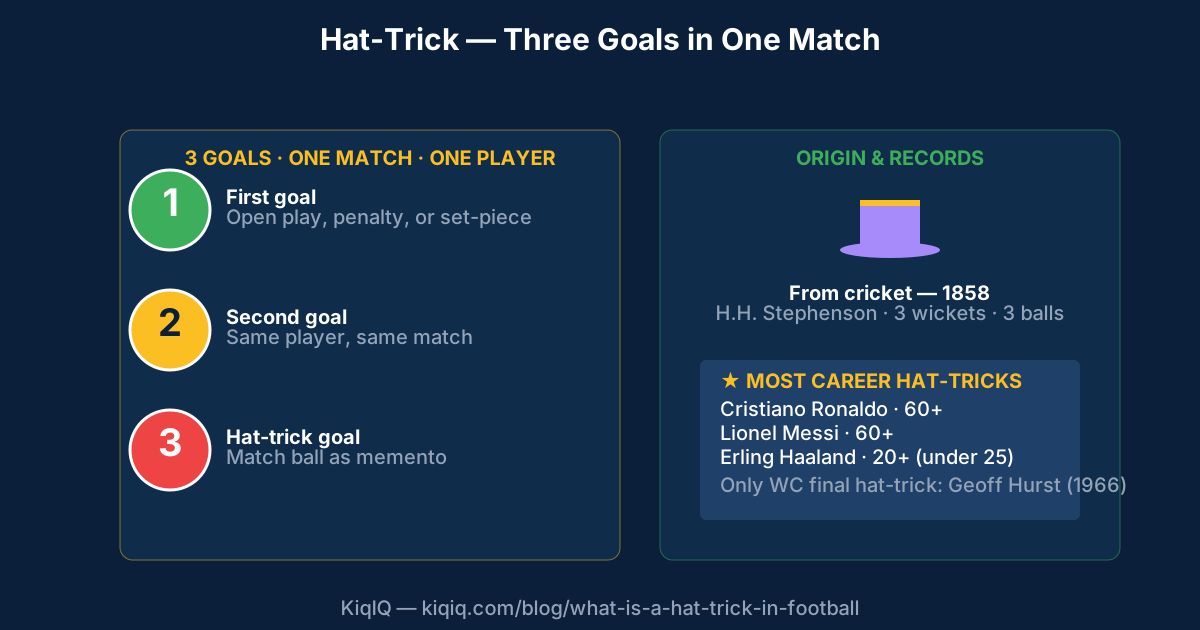
A hat-trick in football is when a single player scores three goals in the same match. The term comes from cricket — specifically, a 1858 cricket match where H.H. Stephenson took three wickets in three balls and was awarded a hat by the crowd. The football tradition since the 1870s is for the player to keep the match ball as a memento. Variants include the perfect hat-trick (one with each foot + a header) and the consecutive hat-trick.
The exact definition
A hat-trick has three components:
- One player. All three goals must be scored by the same individual.
- One match. The goals must come in a single match — not aggregated across multiple games.
- Three goals. Penalties, free-kicks, and open play all count. Own-goals do NOT count toward a hat-trick.
If a player scores three goals in 90 minutes plus extra time, that still counts as a hat-trick. Goals scored in penalty shoot-outs (after extra time) typically do NOT count.
Where the term comes from
The term originated in cricket, not football:
- 1858 origin. English cricketer H.H. Stephenson took three wickets in three consecutive balls in a match. The crowd collected money to buy him a hat as a reward.
- Cricket adoption. "Hat-trick" became a standard cricket term for three wickets in three balls.
- Football transfer. By the 1870s, football clubs in England had adopted the term for three goals in one match.
- Match-ball tradition. The match ball is given to the player who scores the hat-trick — a tradition that started in the late 19th century.
Hat-trick variants
Modern football recognises several hat-trick variants:
- Perfect hat-trick. One goal with the right foot, one with the left foot, and one header. Considered the most technically accomplished form.
- Pure / consecutive hat-trick. Three goals scored consecutively — without any other player from either team scoring in between.
- Flash hat-trick. Three goals scored within 5 minutes of each other.
- Cup-final hat-trick. Famously rare — the only player to score a hat-trick in a Champions League final was Sergio Mora in 1960 (Real Madrid vs Eintracht Frankfurt; Puskás scored 4, Di Stefano 3).
- Solo hat-trick. All three goals scored from the player's own attacking moves, not just penalties or free-kicks.
Famous hat-tricks
Hat-tricks that became part of football lore:
- Geoff Hurst (1966 World Cup Final). The only hat-trick scored in a World Cup Final. England 4-2 West Germany at Wembley — including the disputed "ghost goal" off the crossbar.
- Lionel Messi (multiple). 50+ career hat-tricks; the most prolific hat-trick scorer in football history.
- Cristiano Ronaldo (multiple). 60+ career hat-tricks across club and country — typically slightly more than Messi.
- Erling Haaland (multiple). Has scored 20+ hat-tricks before age 25; on track to break records.
- Sergio Aguero — 5 goals in one match (2015). Manchester City vs Newcastle. Not a hat-trick but a "five-spot" — beyond the hat-trick category.
Hat-trick records
Notable hat-trick records in football:
- Most career hat-tricks (men). Cristiano Ronaldo and Lionel Messi (60+ each).
- Most career hat-tricks (women). Marta of Brazil and Christine Sinclair of Canada are widely cited.
- Fastest hat-trick. Recorded as fast as ~90 seconds in some lower-league matches.
- Most hat-tricks in a single season. Lionel Messi scored 9 hat-tricks in 2011-12 La Liga — La Liga record.
- Most hat-tricks in international football. Cristiano Ronaldo with 10+ for Portugal.
Why hat-tricks matter
Three reasons hat-tricks have outsized cultural value:
- Match-deciding. A hat-trick almost always wins the match (and often by a comfortable margin).
- Memorable. Three goals in 90 minutes is a vivid, replay-friendly performance — easily remembered by fans.
- Match-ball trophy. The physical match-ball tradition turns a hat-trick into a tangible career artefact for the player.
Frequently asked questions
- What is a hat-trick in football?
- A hat-trick is when one player scores three goals in the same match. Penalties, free-kicks, and open-play goals all count, but own-goals do not. The term comes from a 1858 cricket match where H.H. Stephenson took three wickets in three balls and was rewarded with a hat. The football tradition since the 1870s gives the match ball to the player who scores the hat-trick.
- What is a perfect hat-trick?
- A perfect hat-trick is three goals scored using all three primary methods: one with the right foot, one with the left foot, and one with the head. It's considered the most technically accomplished form of hat-trick because it demonstrates ambidextrous and aerial ability. Players who specialise in one foot rarely score perfect hat-tricks.
- Who has scored the most hat-tricks in football?
- Cristiano Ronaldo and Lionel Messi each have 60+ career hat-tricks across all competitions, making them the most prolific hat-trick scorers in football history. Erling Haaland has 20+ before age 25 and is on track to challenge those records. The first World Cup hat-trick was scored by Bert Patenaude (USA) in 1930.
- Why does the hat-trick scorer keep the match ball?
- It's a long-standing football tradition dating to the late 19th century. The match-ball gift signals that scoring three goals in a single match is a significant individual achievement worth physically commemorating. It mirrors the original cricket tradition where Stephenson received a hat for his three-wicket feat in 1858.
References
Ask KiqIQ a follow-up
Get a live, data-driven answer powered by api-football + KiqIQ's Poisson model. Try one of these prompts or write your own.
Part of pillar
Fundamentals
See every article in this knowledge pillar →
Related
Reviewed by a KiqIQ editor before publication. Spotted an error? Email editor@kiqiq.com — we follow our Corrections Policy.