
Weak Foot in Football: Why Two-Footed Players Win More
Two-footed players in football have a measurable competitive advantage. We explain weak-foot ratings, the metric, the exemplars (Modrić, Saka, Bellingham), and how to train it.
 Tap to enlarge
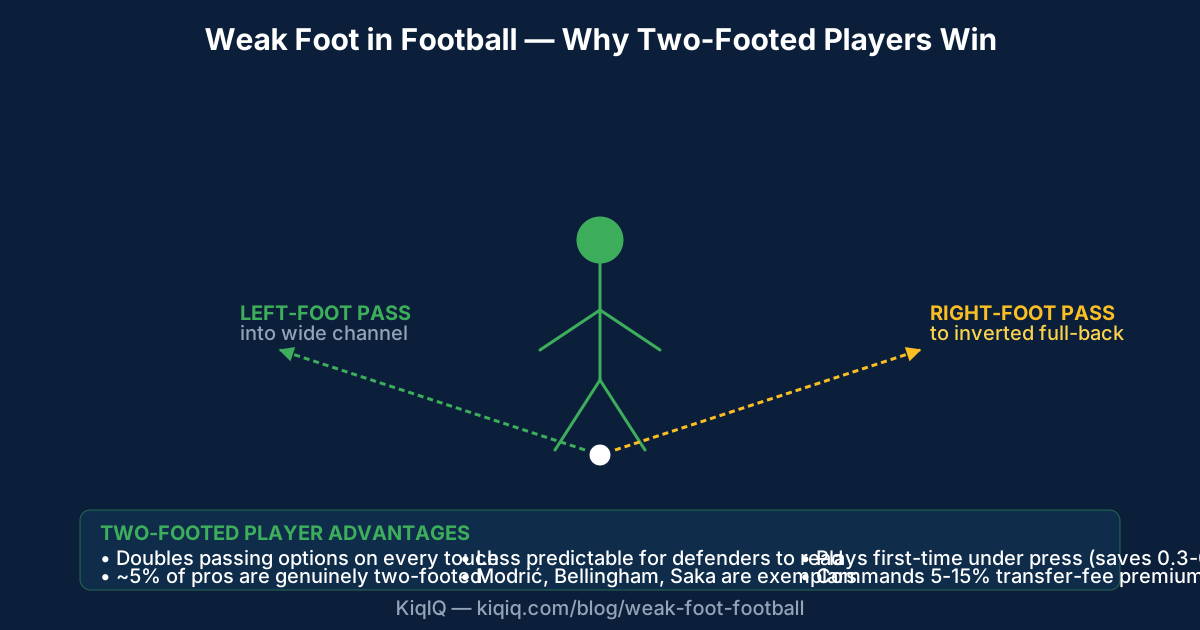
A player's weak foot in football is the foot they don't naturally favour for passing, shooting, dribbling, or controlling the ball. Most players strongly prefer one foot — typically 70-80% of touches go through the dominant foot. Players with a strong weak foot can be considered "two-footed". The data shows two-footed players double their passing options, complete more passes under pressure, and command higher transfer fees.
Defining the weak foot
Every footballer has a dominant foot — the one they naturally favour for kicking. Most players are right-footed (~75% of professionals); ~20% are left-footed; ~5% are genuinely two-footed (no clear dominance).
A "weak foot" is the non-dominant foot. The relevant question for development is not whether you have a weak foot (everyone does) but how usable that weak foot is. Three levels:
- Weak foot only for short passes. The minimum standard for senior football. About 70% of professionals fall here.
- Weak foot for medium-range passes + shots. Above-average. Players in this category can be played in either flank role, take corners with either foot, etc. About 25% of pros.
- Two-footed. The ~5% who can pass, shoot, cross, and dribble nearly equally with both feet. Disproportionately represented in elite midfielders.
The advantage isn't binary. Even moving from "weak foot for short passes only" to "weak foot for medium-range" doubles your tactical flexibility under pressure.
How weak-foot ability is measured
Three measurement approaches exist:
- Touch ratio. Percentage of touches taken with each foot during a match. Professional matches typically split 70-80% dominant / 20-30% weak. Two-footed players hover near 50/50.
- Pass-accuracy gap. Difference in pass completion percentage between the two feet. A 3-5% gap is two-footed; 10-15% is typical; > 20% indicates a weak foot that opposition can exploit.
- Football Manager / FIFA / EA Sports ratings. Both games rate players from 1-5 stars on weak-foot quality. While the ratings are subjective, they correlate strongly with measured pass-accuracy gaps from match data.
Why two-footed players have an advantage
Three structural reasons:
- Doubles passing options. A player receiving with body shape open right has only right-foot pass options if right-footed only. Two-footed players can pass left or right with equal weight and accuracy.
- Reduces predictability. Defenders can pre-position knowing a one-footed player must shift the ball to their dominant foot. Two-footed players remove this read.
- Resilience under pressure. When pressed quickly, the body must use whichever foot the ball arrives at. One-footed players who try to shift first lose 0.3-0.5 seconds — the time the press wins the ball back. Two-footed players can play first-time.
Famous two-footed players
Modern football has notable two-footed examples:
- Luka Modrić — the most famously two-footed midfielder of his generation. Equally comfortable passing, shooting, and crossing with either foot.
- Cristiano Ronaldo — historically right-footed but has scored ~100+ headers and 50+ left-foot goals across his career.
- Bukayo Saka — left-footed but capable of finishing and crossing with the right.
- Jude Bellingham — among the most genuinely two-footed of the current generation.
- Vinícius Júnior — ambidextrous in finishing, particularly across the body.
- Trent Alexander-Arnold — primarily right-footed but with measurable left-foot range.
How to train the weak foot
Four practical drills, ordered from foundational to advanced:
- Wall passing — weak foot only. 5 minutes daily. Inside-foot passes against a wall, weak foot only. Builds basic touch and rhythm.
- Triangle passing with constraint. Three players, triangle drill, weak-foot only. Forces decision-making with the weak foot under no pressure.
- 1v1 dribbling — weak foot only. Short dribbling course; players must control and protect the ball using only weak-foot touches.
- Match-condition shadow play. Play a small-sided game where each player must use weak foot for first touch (any foot to pass after). Builds match-state weak-foot reflex.
Why most players still don't bother
Two reasons:
- Coaching priority. Most amateur and youth coaches focus on team tactics and let players develop their dominant foot more. Weak-foot work is often the player's personal responsibility.
- Visible-return delay. A player who works on their weak foot for six months may see no immediate match advantage — but the gain emerges in higher-pressure environments later. Most amateur players prefer drills that produce visible match wins now.
How clubs value two-footed players
Recruitment data shows that a player with two-footed capability commands a 5-15% transfer-fee premium over a one-footed player with otherwise-similar metrics. Clubs explicitly track weak-foot ratings during scouting. Several Premier League sides specifically prioritise two-footed full-backs because the inverted-full-back role demands both-feet utility.
Frequently asked questions
- What does "weak foot" mean in football?
- A player's weak foot is the foot they don't naturally favour for passing, shooting, dribbling, or controlling the ball. Most players take 70-80% of their touches with their dominant foot. The smaller the gap in usage and accuracy between the two feet, the stronger the weak foot — and the more two-footed the player.
- Are two-footed players really better?
- Yes — measurably. Two-footed players double their passing options on every touch, are less predictable for defenders to read, and play first-time more often under pressure (saving 0.3-0.5 seconds per action). Recruitment data shows two-footed players command 5-15% transfer-fee premiums over one-footed peers with otherwise-similar profiles.
- Who are the most two-footed players in football?
- Luka Modrić is the canonical example — equally comfortable passing, shooting, and crossing with either foot. Other notable cases: Jude Bellingham, Vinícius Júnior (across-body), Bukayo Saka (right-foot crossing despite being left-footed), Cristiano Ronaldo (extensive left-foot scoring), Trent Alexander-Arnold (left-foot range).
- How do you train your weak foot?
- Four progressive drills: daily 5 minutes of inside-foot wall-passing with weak foot only; triangle passing drills constrained to weak-foot only; 1v1 dribbling with weak-foot-only touches; small-sided games with a weak-foot-first-touch rule. Visible match returns take 4-6 months of consistent practice; advantage compounds in higher-pressure environments.
References
- Two-Footedness in Elite Football — Journal of Sports Sciences
- StatsBomb — Touch Distribution Analysis — StatsBomb
- Transfermarkt — Weak Foot and Player Valuations — Transfermarkt
- UEFA Coaching Curriculum — Weak Foot Development — UEFA
Key terms in this article
Ask KiqIQ a follow-up
Get a live, data-driven answer powered by api-football + KiqIQ's Poisson model. Try one of these prompts or write your own.
Part of pillar
Fundamentals
See every article in this knowledge pillar →
Related
Reviewed by a KiqIQ editor before publication. Spotted an error? Email editor@kiqiq.com — we follow our Corrections Policy.