
How to Improve Passing Accuracy in Football: Drills, Technique, Decisions
Passing accuracy is technique + decision + scanning. We break down the four pass types, the body mechanics behind each, and the drills that build accuracy under pressure.
 Tap to enlarge
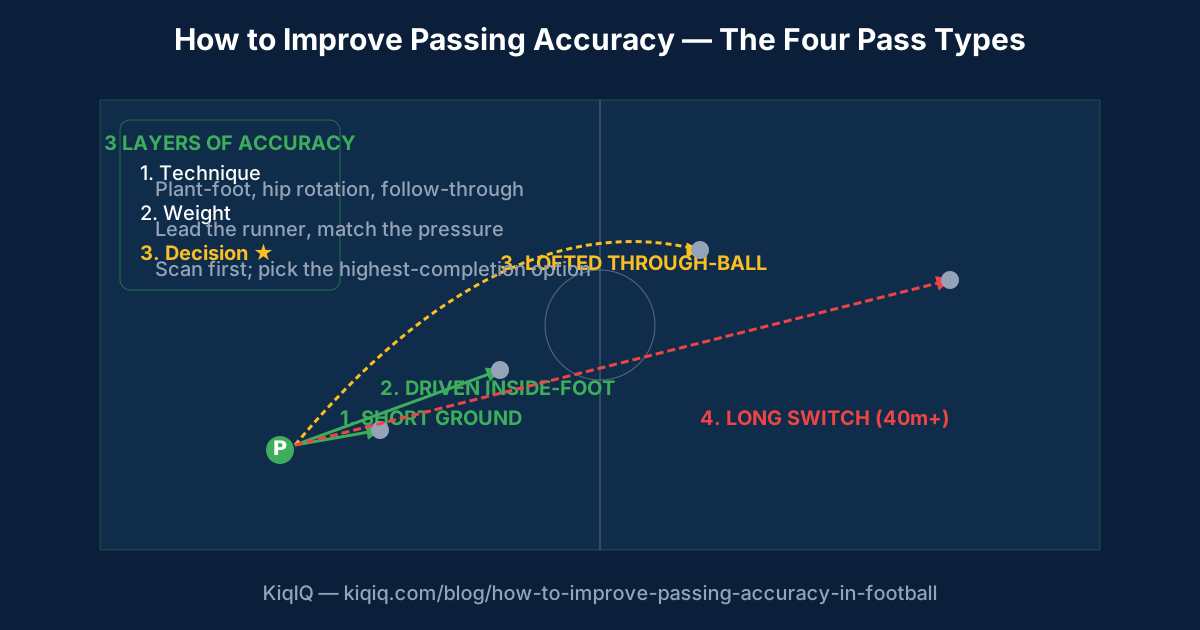
Improving passing accuracy in football starts with three layers — the technique of the foot strike, the weight given to the pass, and the decision quality before the pass leaves the boot. Most amateur players overweight the first; professionals know decision quality contributes more to accuracy than mechanics. Scanning before receiving the ball is the single biggest accuracy unlock.
The four core pass types
Football passes fall into four core types, each with its own technique:
- Short ground pass (push pass). Inside of foot, ball stays low, used for short combinations. Most-used pass in football.
- Driven inside-foot pass. Inside of foot, but with more pace and lift, for 15-30m progressive passes.
- Lofted pass. Underside contact, ball lifted over a defender or line. Used for through-balls and switching.
- Long pass (instep drive). Top of foot (laces), 40+ metres. The "switch the play" or "diagonal to the winger" pass.
Inside-of-foot passes are the workhorse — 70%+ of professional passes use this surface. Master it before working on long-range range.
Body mechanics for accurate passing
Three mechanics dominate passing accuracy across all four pass types:
- Plant-foot direction. Plant foot points where you want the ball to go. The ball follows the plant foot in 80%+ of cases.
- Hip rotation. Body weight transfers from the planted side toward the target. Static hips = inaccurate passes.
- Follow-through control. Boot continues toward the target after contact, not across the body. Cross-body follow-through = ball slices off-line.
Why decision quality matters more than technique
Two things separate professional and amateur passing:
- Pre-touch scanning. Pros scan over the shoulder before receiving the ball. They know who is open before the ball arrives. Amateurs receive, look, then pass — losing 1-2 seconds and creating inaccuracy windows.
- Easy-pass selection. Pros pick the highest-completion-probability pass given the pressure context. Amateurs reach for the spectacular pass that works once in five tries. Cumulative completion rate suffers.
Drills that build passing accuracy
Four drills that disproportionately improve passing across age groups:
- Wall passing. Stand 3-5m from a wall, pass continuously inside-foot for 5 minutes. Builds touch and rhythm.
- Triangle passing (3 players). Triangle 8-10m apart; ball circulates one-touch. Forces good first touch + accurate weight.
- Pressured rondos (5v2 or 6v3). Outside players pass-and-move under pressure from inner defenders. Replicates match conditions.
- Long-pass switch drill. 40m pass to a target between two cones. Repeat 20 times each foot. Builds long-pass weight and accuracy.
Scanning — the underrated skill
Scanning means quick checks over the shoulder before receiving the ball. Top players scan 6-10 times per minute on the ball; weaker players 1-2 times. Each scan gives a snapshot of where teammates and pressure are — making the next pass faster and more accurate.
Practical drill: while doing wall passes, deliberately turn the head to look at a chosen spot 2-3m to the side every other touch. The habit transfers to match play.
Pass weight — the overlooked variable
A pass that arrives at the right place but with the wrong weight is a failed pass. Three weight rules:
- Lead the runner. Pass to where they will be, not where they are.
- Match the pressure. Pressed receiver = firmer pass; open receiver = softer.
- Match the surface. Wet pitch = firmer; dry hard pitch = softer.
Tracking your pass-completion rate
FBref and other public data sources publish per-90 pass-completion percentages. Use them as a benchmark:
- Centre-back: 85-92% completion is solid. 92%+ for a top ball-playing CB.
- Defensive midfielder: 87-92%. Below 85% in heavy-press systems is a concern.
- Attacking midfielder: 75-85%. Lower because of higher progression risk.
- Striker: 65-78%. Lowest because of poor receiver options under pressure.
Common mistakes that undermine accuracy
Three patterns that erode passing:
- Looking down at the ball during contact. Eyes should be on the receiver before contact, returning to ball briefly only at the moment of strike.
- Receiving with the wrong body angle. Open hips toward the target before the ball arrives. Closed hips = forced sideways pass.
- Skipping the weak foot. Players who only use their dominant foot are passers with half their toolkit. Daily wall-pass work with the weak foot is the fastest fix.
Frequently asked questions
- How do I improve my passing accuracy in football?
- Three layers: technique (plant foot direction, hip rotation, follow-through), weight (lead the runner, match the pressure, match the surface), and decision quality (scan before receiving, pick the highest-completion pass). Decision quality contributes more to accuracy than mechanics in most cases. The fastest individual unlock is pre-touch scanning.
- What's the best drill for passing accuracy?
- Pressured rondos (5v2 or 6v3) come closest to match conditions. The outside players must pass-and-move under pressure from defenders, replicating receiving + decision-making + accurate weight all at once. For solo work, wall passing for 5 minutes daily builds touch and rhythm. For long passing, the 40m switch drill between two cones, 20 reps each foot.
- What's a good pass-completion rate?
- Centre-back 85-92% solid, 92%+ elite. Defensive midfielder 87-92%. Attacking midfielder 75-85% (lower because of higher progression risk). Striker 65-78%. Below 80% in any pre-progression position is a concern; below 90% for a CB in a possession side is a concern.
- How does scanning improve passing?
- Scanning means quick over-the-shoulder checks before receiving the ball. Pros scan 6-10 times per minute on the ball; weaker players 1-2 times. Each scan gives a positional snapshot. Players who scan know who is open before the ball arrives, can pass faster, and pick higher-completion options.
References
- Pre-Touch Scanning Research — Geir Jordet — Sports Performance Research
- Pass Completion Metrics — FBref — FBref
- UEFA Coaching Curriculum — Passing Technique — UEFA
- Rondo Drill Methodology — The Athletic
Key terms in this article
Ask KiqIQ a follow-up
Get a live, data-driven answer powered by api-football + KiqIQ's Poisson model. Try one of these prompts or write your own.
Part of pillar
Fundamentals
See every article in this knowledge pillar →
Related
Reviewed by a KiqIQ editor before publication. Spotted an error? Email editor@kiqiq.com — we follow our Corrections Policy.