
Premier League SCR and SSR Explained: How Clubs Will Be Regulated From 2026/27
The Premier League is replacing PSR with Squad Cost Ratio (SCR) and Squad Spending Ratio (SSR). The new system enforces in-season, separates football spend from infrastructure, and stress-tests for revenue shocks.
 Tap to enlarge
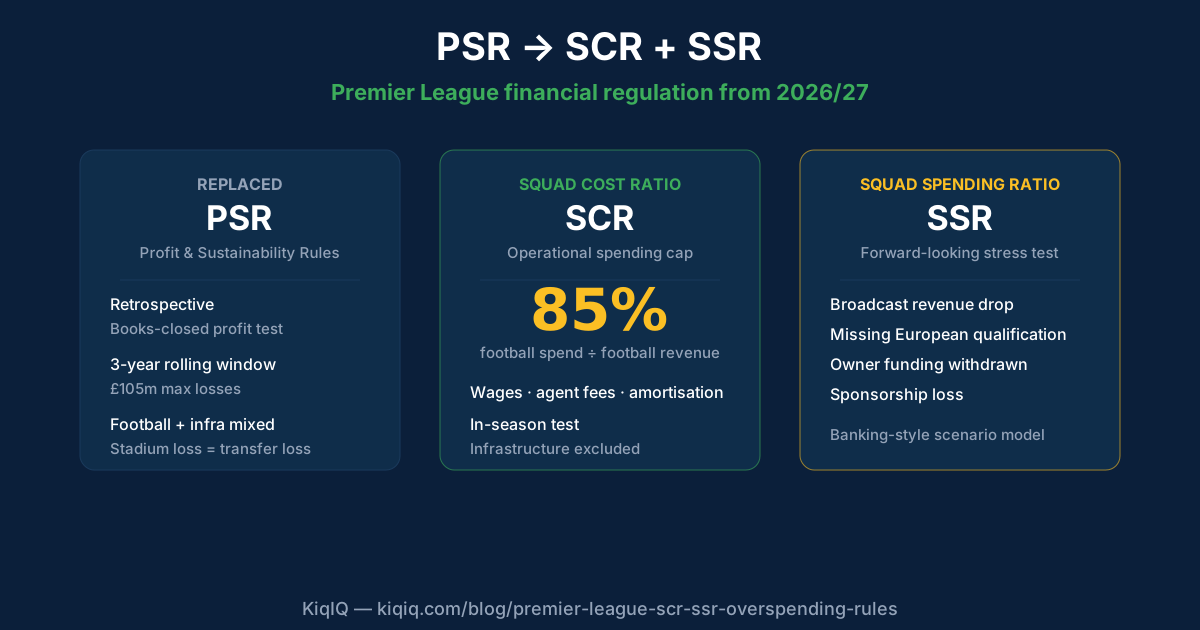
The Premier League is replacing the Profit and Sustainability Rule (PSR) with a two-part framework from the 2026/27 season: the Squad Cost Ratio (SCR) and the Squad Spending Ratio (SSR). The shift isn't cosmetic. PSR was a backwards-looking profit-and-loss check; SCR and SSR are forward-looking operational tests applied during the season. The change resolves three of PSR's recurring problems — late enforcement, conflated spending categories, and the gameability of accounting choices — but it introduces a new operational discipline that boards and recruitment teams will have to manage in real time.
What PSR did and where it broke
The Profit and Sustainability Rule, introduced in 2013 and tightened through the late 2010s, capped a Premier League club's accumulated pre-tax losses at £105m over a rolling three-season window. Compliance was assessed retrospectively after the financial year closed and accounts were finalised — typically 12-18 months after the period the rule was measuring.
That delay produced two recurring problems. First, sanctions landed long after the behaviour that caused them, sometimes after the manager who oversaw the spending had left and after the squad had been restructured. Everton and Nottingham Forest were the highest-profile cases — points deductions imposed for prior-season behaviour that the current squad had no part in. Second, PSR's "profit over time" framing made it easy to game with accounting choices — capitalising stadium upgrades, amortising transfer fees over long contracts, or timing player sales just before the cut-off.
SCR — the operational cap on football spending
The Squad Cost Ratio caps a club's football spending — wages, agent fees, and the amortisation of transfer fees — as a proportion of football revenue. The likely threshold sits around 85% for clubs in European competition (aligning with UEFA's parallel framework) and slightly higher for clubs that aren't. Clubs that exceed the ratio face escalating sanctions, but crucially the test is applied during the season, not in retrospect after the books close.
In-season monitoring is the structural change. Clubs will report financial position to the Premier League at multiple points across the year and will know whether they're tracking against compliance before the next transfer window opens. A manager pushing for a January signing will be told whether the headroom exists; a board considering a wage increase for a star player will know whether it will breach the ratio. The decisions are made when they still matter, not after the damage is done.
SCR caps football spending (wages, agent fees, transfer-fee amortisation) as a proportion of football revenue. The likely threshold is around 85% for UEFA-competition clubs, slightly higher for clubs outside European football.
SSR — the financial stress test
The Squad Spending Ratio is a stress-test framework. It models the club's financial position against several adverse scenarios: a drop in broadcast revenue, missing out on European qualification, owner funding being withdrawn, or commercial sponsorship deals being lost. Clubs that can't survive a reasonable adverse scenario at their current spending profile fail SSR even if SCR is technically met.
SSR is closer to a banking-regulator framework than a football-regulation one. It treats clubs as ongoing financial entities whose survival has to be tested against shocks, not just measured against historical profit. For wealthy owner-backed clubs the SSR check is the more meaningful constraint — they can typically meet SCR with owner funding but failing SSR forces them to demonstrate the funding is committed enough to survive a future change in owner appetite.
What separates football spend from infrastructure
A persistent criticism of PSR was that it lumped on-pitch spending (wages, transfer fees) into the same pot as infrastructure investment (stadiums, training grounds, fan-experience capital projects). A club that took a £100m loss because it built a new training ground was penalised the same way as one that took a £100m loss on transfer-fee overspend, even though the long-term effect on competitiveness is opposite.
SCR + SSR explicitly separates the two. Football spending sits under SCR; capital investment in long-life infrastructure is excluded from the ratio. Boards can pursue large stadium-rebuild projects without the spending counting against the football-cost cap, which mirrors how UEFA's parallel rules treat the same question. The expected effect is that ground redevelopment projects (currently constrained at clubs running close to PSR limits) become structurally easier to greenlight.
What changes day-to-day for boards, managers and players
For boards, the operational discipline shifts from year-end accounting decisions to in-season planning. Quarterly financial-position reporting, wage-strategy modelling, and transfer-window scenario planning move from "useful to have" to "required to satisfy SCR mid-season test". The CFO's role becomes more central to football decisions; the previous separation between financial and football operations narrows.
For managers, the realistic effect is fewer surprise constraints. A manager planning a January signing will know in real time whether the SCR headroom is available, instead of discovering retrospectively that summer headroom was eaten by an unexpected wage settlement. For players, the effect is more subtle — wage negotiations will compress slightly because every contract increase is tested against the SCR in real time, and squads that are running close to the ratio will have less flexibility to reward over-performing players mid-season.
- SCR — caps football spending as a proportion of football revenue (~85% for UCL clubs).
- SSR — stress-tests financial survival against adverse scenarios (revenue drop, missed Europe, owner withdrawal).
- In-season — monitoring + reporting through the year, not retrospective post-accounts.
- Infrastructure carve-out — stadium / training-ground capex excluded from the football-cost cap.
- Effective — from 2026/27 season, replacing PSR. Sanctions framework escalates from financial penalty to transfer embargo to points deduction.
Frequently asked questions
- What is the Premier League SCR?
- SCR is the Squad Cost Ratio — a cap on football spending (wages, agent fees, transfer-fee amortisation) as a proportion of football revenue. The likely threshold is around 85% for clubs in UEFA competition (aligning with UEFA's parallel framework) and slightly higher for clubs outside European football. It replaces PSR from the 2026/27 season.
- What is the Premier League SSR?
- SSR is the Squad Spending Ratio — a forward-looking stress test that checks whether a club can survive adverse revenue scenarios at its current spending profile. Scenarios include broadcast revenue drops, missing European qualification, and owner funding being withdrawn. SSR works alongside SCR; both must be met.
- How is SCR different from PSR?
- PSR was a backwards-looking profit-and-loss check applied 12-18 months after the relevant period. SCR is a forward-looking, in-season operational cap. PSR conflated football and infrastructure spending; SCR explicitly carves out stadium / training-ground capex. PSR was gameable with accounting choices; SCR is harder to game because it measures real-time spending against real-time revenue.
- When does SCR + SSR replace PSR?
- From the 2026/27 season. PSR continues to apply to the historical periods it was measuring, but new behaviour from 2026/27 onwards is regulated under SCR + SSR.
References
- Premier League — Profit and Sustainability Rules — Premier League
- UEFA — Financial Sustainability Regulations — UEFA
Ask KiqIQ a follow-up
Get a live, data-driven answer powered by api-football + KiqIQ's Poisson model. Try one of these prompts or write your own.
Part of pillar
Football Business
See every article in this knowledge pillar →
Related
Reviewed by a KiqIQ editor before publication. Spotted an error? Email editor@kiqiq.com — we follow our Corrections Policy.