
The Richest Football Clubs in the World: Deloitte Money League 2026
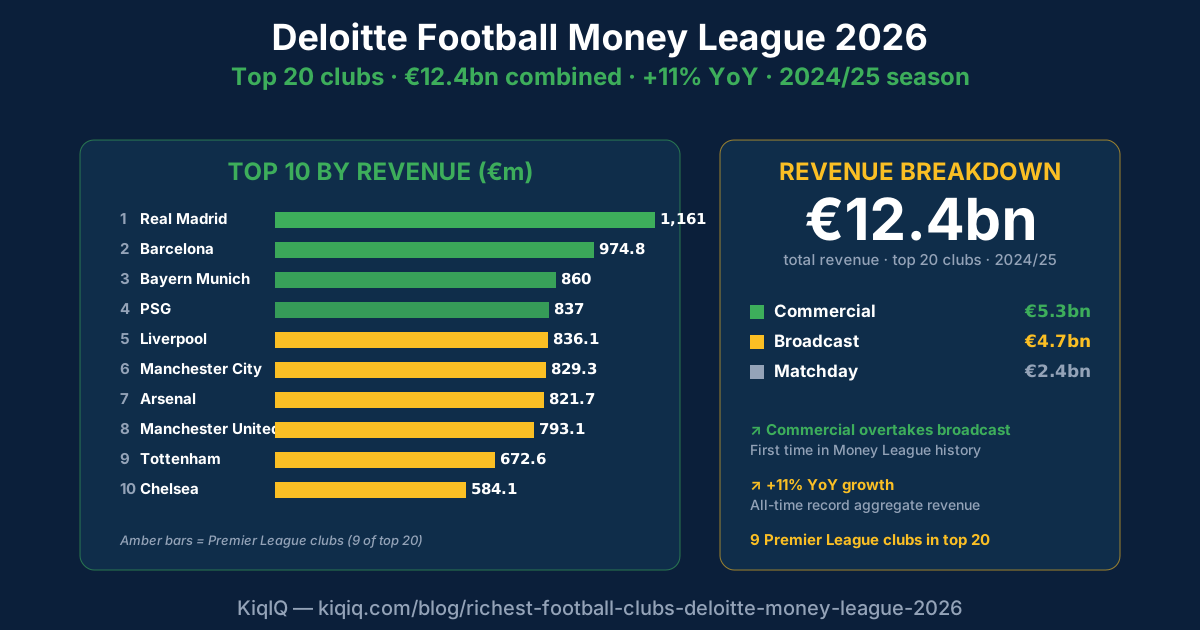
Real Madrid lead Deloitte's Football Money League for the third year running, with €1.16bn in revenue. The top 20 clubs combined banked €12.4bn — an 11% jump. Here's what the 2024-25 numbers say.
 Tap to enlarge
Deloitte's annual Football Money League ranks the 20 highest-revenue clubs in world football and is the single best snapshot of where the money in the sport sits. The 2026 edition covers the 2024-25 season and the headline numbers are blunt: Real Madrid extended their lead for a third consecutive year at €1.161 billion, the top 20 collectively banked a record €12.4 billion, the Premier League placed nine clubs in the table, and commercial revenue overtook broadcast as the largest single revenue source for the first time. The underlying shape of the table tells you who is pulling away, who is closing in, and where the next inflection points sit.
Real Madrid lead for the third year running
Real Madrid generated €1.161 billion across the 2024-25 season, putting them at the top of the Money League for the third year in a row. The commercial line on their P&L is the eye-catching number: roughly €594 million from sponsorship, merchandising and partnerships alone. That single revenue stream — sponsors, kit deals, retail, partnership activations — would, taken on its own, place Real Madrid inside the top 10 of the entire Money League table. The rebuilt Santiago Bernabéu and the multi-year stadium-utilisation strategy (events, retail, concerts on non-matchdays) are doing exactly what the financial pitch deck said they would do.
The gap to second place is meaningful. Barcelona reported €974.8 million, which keeps them comfortably ahead of any non-Spanish club but ~€186m short of Real Madrid. A €186m gap at the top of the Money League is structurally large — equivalent to the entire annual revenue of clubs sitting around 19th or 20th in the same table. For context, only two clubs in world football have ever cleared the €1 billion mark in a single Money League cycle, and Real Madrid have now done it twice.
The 2026 Money League sets a new all-time record: €12.4 billion across the top 20, up 11% on the prior year. Commercial overtakes broadcast as the dominant revenue line for the first time.
Commercial revenue passes broadcast — the structural shift
Three revenue streams underpin every Money League entry: commercial (sponsorship, merchandise, partnerships, non-matchday stadium use), broadcast (the share of domestic and continental TV rights paid through to the club), and matchday (tickets, hospitality, in-stadium spend). For the 2024-25 cycle, the aggregate split across the top 20 broke as follows: commercial €5.3 billion, broadcast €4.7 billion, matchday €2.4 billion.
That commercial figure is the structural story. It is the largest absolute commercial line ever recorded in the Money League and the first time it has been the dominant revenue source for the cohort. Two forces are pulling commercial higher: globally distributed sponsorship deals (clubs are increasingly closing region-specific partner activations rather than one master kit-shirt deal), and the conversion of stadium estate into year-round commercial real estate (concerts, retail, tours, conferences). Broadcast revenue is up too — €4.7 billion is also a record — but it is growing more slowly because the underlying domestic rights markets are saturating in most Western European leagues.
Matchday revenue jumped to €2.4 billion on the back of more frequent fixtures (expanded continental formats, the new Club World Cup), higher ticket pricing across most top-tier clubs, and increased premium-hospitality yields. Matchday is the smallest of the three lines for almost every club above the bottom of the table, but its growth rate this cycle was the fastest of the three.
The Premier League places nine clubs in the top 20
The Premier League is the dominant national league in the table: nine of the top 20 are English. Liverpool lead the English contingent at €836.1 million (5th overall), narrowly ahead of Manchester City, Arsenal and Manchester United, with Tottenham, Chelsea, Aston Villa, Newcastle and West Ham completing the nine. The rest of the top 20 is split across three Italian clubs, three German, three Spanish, one French (Paris Saint-Germain) and one Portuguese (Benfica).
The notable English entries below the established Big Six are Aston Villa (14th, €450.2m) and Newcastle (17th, €398.4m). Both clubs broke into the table on the back of Champions League and continental-football revenues that previously sat with the Big Six exclusively. Villa's 2024-25 Champions League run is the biggest single driver of their jump up the table; Newcastle's rise is steadier and reflects sustained domestic revenue growth alongside European football. The arithmetic of the Premier League's broadcast distribution mechanism means even non-European-football English clubs sit on a revenue base that lower-mid clubs in other big-five leagues struggle to match — West Ham at €276m round out the top 20 and would rank higher than several mid-table La Liga and Bundesliga sides.
- 1. Real Madrid (Spain) — €1,161m
- 2. Barcelona (Spain) — €974.8m
- 3. Bayern Munich (Germany) — €860.0m
- 4. Paris Saint-Germain (France) — €837.0m
- 5. Liverpool (England) — €836.1m
- 6. Manchester City (England) — €829.3m
- 7. Arsenal (England) — €821.7m
- 8. Manchester United (England) — €793.1m
- 9. Tottenham (England) — €672.6m
- 10. Chelsea (England) — €584.1m
- 11. Inter Milan (Italy) — €537.5m
- 12. Borussia Dortmund (Germany) — €531.3m
- 13. Atlético Madrid (Spain) — €454.5m
- 14. Aston Villa (England) — €450.2m
- 15. AC Milan (Italy) — €410.4m
- 16. Juventus (Italy) — €401.7m
- 17. Newcastle (England) — €398.4m
- 18. Stuttgart (Germany) — €296.3m
- 19. Benfica (Portugal) — €283.4m
- 20. West Ham (England) — €276.0m
What the Money League does — and does not — measure
The Money League ranks clubs by reported revenue. That is a clean, comparable metric but it deliberately leaves out three things every reader should hold in mind. First, it does not measure profit or wage-to-revenue health. A club generating €450 million but spending €430 million on wages is in a structurally worse position than one earning €300 million on a €170 million wage bill, and the Money League ranking treats them identically. Second, it does not net out debt: highly-leveraged clubs sit on the same table line as debt-light clubs at the same revenue level. Third, it does not capture state ownership subsidies, owner equity injections or off-balance-sheet sponsorship inflation — concerns that have shaped recent UEFA financial-sustainability and Premier League PSR cases.
For comparing club commercial scale, the Money League is the right tool. For assessing club financial health, treat it as the first data point and pair it with each club's most recent annual accounts (wage bill, net debt, financial fair play status) to get a complete picture. KiqIQ's own analytical surfaces stay focused on the on-pitch consequences of these revenue gaps — squad valuation, market spend, transfer-window patterns — rather than the financial accounts themselves, but the Money League is the standard external reference point we link out to.
Frequently asked questions
- Who is the richest football club in the world in 2026?
- Real Madrid are the richest football club in the world by revenue for the third year running, generating €1.161 billion across the 2024-25 season according to Deloitte's Football Money League 2026. Barcelona are second at €974.8m and Bayern Munich third at €860m.
- How many Premier League clubs are in the top 20 richest?
- Nine Premier League clubs sit in the Deloitte Football Money League top 20 for 2026: Liverpool (5th), Manchester City, Arsenal, Manchester United, Tottenham, Chelsea, Aston Villa, Newcastle and West Ham. The remaining 11 places are split across Spanish, Italian, German, French and Portuguese clubs.
- What is the Deloitte Football Money League?
- The Deloitte Football Money League is an annual ranking of the 20 highest-revenue football clubs in the world, published each year by Deloitte's Sports Business Group. It uses reported revenue from each club's most recent full season — commercial, broadcast and matchday combined.
- What was the combined revenue of the top 20 clubs?
- The top 20 richest football clubs collectively generated €12.4 billion in the 2024-25 season — the highest aggregate revenue in Money League history and an 11% increase on the previous year. Commercial revenue passed broadcast as the largest single source for the first time.
- Does the Money League measure profit or just revenue?
- The Money League ranks clubs by reported revenue only. It does not measure profit, wage-to-revenue ratio, net debt, or financial-fair-play health. A high Money League ranking signals commercial scale; assessing financial sustainability requires the club's annual accounts alongside the Money League position.
References
- Deloitte Football Money League — Deloitte
- Top 20 Richest Football Clubs in the World 2026 — Finance Football (Feb 2026)
Ask KiqIQ a follow-up
Get a live, data-driven answer powered by api-football + KiqIQ's Poisson model. Try one of these prompts or write your own.
Part of pillar
Football Business
See every article in this knowledge pillar →
Related
- Premier League prize money: TV share, merit, facility fees →
- How Financial Fair Play and PSR actually work →
- How Premier League prize money is distributed →
- How Premier League prize money works →
- How football clubs make money →
- Football TV rights deals explained →
- Premier League hub →
- La Liga hub →
- Most successful English football clubs →
- Pillar: Data and Systems →
Reviewed by a KiqIQ editor before publication. Spotted an error? Email editor@kiqiq.com — we follow our Corrections Policy.