
Most Successful English Football Clubs — Trophy Rankings
Manchester United and Liverpool sit at the top of the English game by major-trophy count, both above 60. We rank the leaders by domestic, cup, and European honours and explain how the methodology changes the order.
 Tap to enlarge
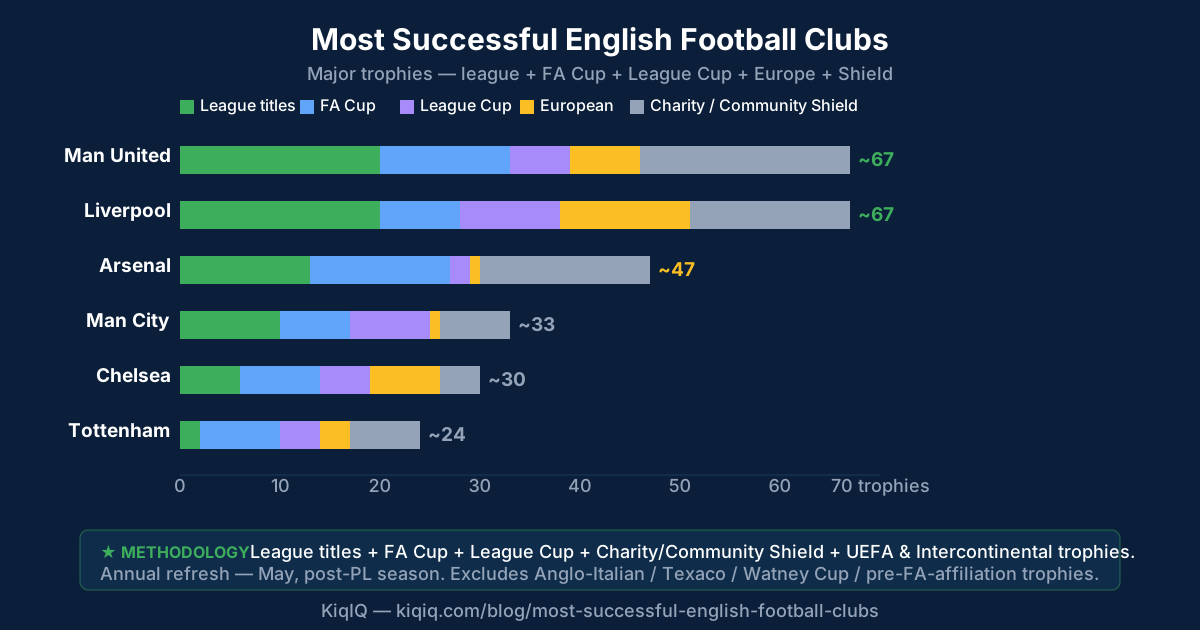
Manchester United and Liverpool are the two most successful English football clubs by major-trophy count, both above 60 honours when First Division / Premier League titles, FA Cups, League Cups, FA Charity / Community Shields, and European trophies are tallied. Arsenal sits third on FA Cups (a record 14), Chelsea climbs the table fastest in the post-2003 Abramovich era, and Manchester City has compiled a record-breaking honours run since 2008. The order shifts depending on which trophies you count and how you weight European success against domestic.
How we rank — and why the methodology matters
Ranking English clubs by "success" is sensitive to three editorial choices: which trophies count, whether the Charity / Community Shield is included, and how European trophies are weighted against domestic ones.
The mainstream convention — used by The FA, BBC Sport, and most published lists — counts five categories of major honour: First Division / Premier League titles, FA Cup, League Cup (EFL Cup / Carabao Cup), Charity / Community Shield, and major European trophies (European Cup / Champions League, UEFA Cup / Europa League, Cup Winners' Cup, Super Cup, Intercontinental / Club World Cup).
Some lists exclude the Charity Shield as a glorified pre-season fixture; others exclude the Inter-Cities Fairs Cup (the Europa League's pre-1971 forerunner) as not a UEFA competition; others include defunct trophies like the Anglo-Italian Cup or the Texaco Cup. Different choices move clubs by 5-10 trophies. Below we present the inclusive methodology and footnote the choices that change the order.
Methodology used here: top-flight league titles + FA Cup + League Cup + Charity/Community Shield + European trophies (UEFA + Intercontinental). Club World Cup counted; Anglo-Italian / Texaco / Watney Cup excluded.
The top of the table — Manchester United and Liverpool
Manchester United lead the historical English ledger by total trophies on most accepted methodologies. The headline numbers: 20 First Division / Premier League titles (a joint English record alongside Liverpool), 13 FA Cups (one short of Arsenal's record), 6 League Cups, plus the European honours from the Sir Matt Busby and Sir Alex Ferguson eras (3 European Cup / Champions League titles in 1968, 1999, 2008).
Liverpool are level on First Division / Premier League titles (20) and have the better European record — 6 European Cups / Champions League titles (1977, 1978, 1981, 1984, 2005, 2019) versus United's three, plus 3 UEFA Cups / Europa Leagues and a Club World Cup. Liverpool's FA Cup haul (8) and League Cup haul (10, a joint record) round out a portfolio that is competitive with United's on totals and arguably ahead on European trophies.
The two clubs sit roughly 65-67 major trophies each depending on methodology — well clear of the chasing pack.
The chasing pack — Arsenal, Chelsea, Manchester City
Three clubs sit in the second tier of English-football honours:
- Arsenal — 13 First Division / Premier League titles, a record 14 FA Cups (no other English club has more), 2 League Cups, 17 Community Shields, 1 European Cup Winners' Cup (1994). The FA Cup record is a defining legacy.
- Chelsea — 6 First Division / Premier League titles (5 since the Abramovich takeover in 2003), 8 FA Cups, 5 League Cups, 2 Champions Leagues (2012, 2021), 2 Europa Leagues. The fastest-rising club in the rankings between 2003 and 2023.
- Manchester City — 10 league titles (8 since 2008 under Sheikh Mansour's Abu Dhabi United Group), 7 FA Cups, 8 League Cups, plus the 2023 Champions League. Won an unprecedented four consecutive Premier League titles between 2020-21 and 2023-24.
The historic giants — Aston Villa, Everton, Tottenham
Three clubs whose totals reflect long histories with most success concentrated in earlier eras:
- Aston Villa — 7 First Division titles (most pre-1925), 7 FA Cups, 1 European Cup (1982), 1 European Super Cup. One of only five English clubs to win the European Cup.
- Everton — 9 First Division titles, 5 FA Cups, 1 European Cup Winners' Cup (1985). Founder member of the Football League. Most success concentrated in the 1980s and pre-WWII eras.
- Tottenham Hotspur — 2 First Division titles, 8 FA Cups, 4 League Cups, 2 UEFA Cups (1972, 1984) plus the 1963 Cup Winners' Cup (first English club to win a major European trophy). Strong cup pedigree relative to league titles.
European-only honours — the five English Cup winners
Only five English clubs have ever won the European Cup / Champions League. The full list:
- Liverpool — 6 (1977, 1978, 1981, 1984, 2005, 2019). The most by any English club.
- Manchester United — 3 (1968, 1999, 2008). Including the 1968 win that made United the first English winner.
- Nottingham Forest — 2 (1979, 1980). Back-to-back under Brian Clough — perhaps the most remarkable feat in English football history given Forest were a Second Division club only two years before the first win.
- Aston Villa — 1 (1982). Beat Bayern Munich 1-0 in Rotterdam, Peter Withe scoring.
- Chelsea — 2 (2012, 2021). Both wins from the post-Abramovich era.
- Manchester City — 1 (2023). The most recent English winner, completing a domestic-treble season.
How the count looks if you change the methodology
Three alternative tabulations and how they move the order:
- League titles only. Manchester United and Liverpool tied at 20. Arsenal third (13). Everton fourth (9). Manchester City fifth (10 in modern era — would actually push them above Everton).
- FA Cups only. Arsenal first (14). Manchester United second (13). Chelsea third (8). Tottenham (8) and Liverpool (8) tied on the same count.
- European trophies only. Liverpool first (with 6 European Cups + 3 UEFA Cups + Super Cups). Manchester United second. Chelsea third. Tottenham fourth (2 UEFA Cups + 1 Cup Winners' Cup). Arsenal fifth (1 Cup Winners' Cup).
- Trophies-per-decade since 1992. Manchester United dominate the early Premier League era; Manchester City dominate the 2010s and 2020s. The all-time order privileges United's historical depth; the post-1992 order shifts toward City and Chelsea.
The clubs just outside the top group
Below the seven clubs above (United, Liverpool, Arsenal, Chelsea, City, Aston Villa, Everton, Tottenham), the next tier is meaningfully thinner:
- Newcastle United — 4 league titles (all pre-1928), 6 FA Cups, 1 Inter-Cities Fairs Cup (1969).
- Sunderland — 6 First Division titles (pre-1936), 2 FA Cups.
- Wolves — 3 league titles (1950s peak), 4 FA Cups, 2 League Cups, 1 UEFA Cup runner-up.
- Leeds United — 3 league titles (1969, 1974, 1992), 1 FA Cup, 1 League Cup, 2 Inter-Cities Fairs Cups.
- Nottingham Forest — 1 league title (1978) and 2 European Cups give Forest a unique honours profile despite a smaller overall total.
Refresh notes — what changes year to year
This article is on an annual May refresh cadence, triggered the week the Premier League season ends. Three things move the count between editions:
- Premier League title. Adds one trophy to the winner's tally. Manchester City and Liverpool have been the modern accumulators.
- FA Cup + League Cup finals. Played in May / late February respectively. Two more trophies on the board each year.
- Champions League / Europa League finals. The English winner (if any) adds a European trophy and almost always reorders the top two.
Frequently asked questions
- Who is the most successful English football club?
- Manchester United and Liverpool are the two most successful English clubs by total major trophies, both above 60 honours. Manchester United lead on FA Cups within that pair (13 to Liverpool's 8) and on League Cups (united with the joint record alongside Liverpool at the top). Liverpool lead on European trophies — six European Cups / Champions Leagues to United's three. The all-time order between them depends on methodology.
- Which English club has won the most league titles?
- Manchester United and Liverpool are tied at 20 First Division / Premier League titles each — the joint English record. Arsenal are third on 13. Everton fourth on 9. Manchester City have 10 (with eight of those since 2008). Aston Villa hold seven, all pre-1925. The top-flight title count is the most-cited single measure of historical success in English football.
- Which English club has won the most FA Cups?
- Arsenal have won the FA Cup a record 14 times — more than any other English club. Manchester United are second on 13, Chelsea third on 8, Tottenham and Liverpool tied on 8. The FA Cup is the world's oldest national football competition (founded 1871-72) and Arsenal's 14 wins is the defining record of the trophy. Their most recent win was in 2020.
- How many English clubs have won the European Cup?
- Five English clubs have won the European Cup / Champions League: Liverpool (6 — 1977, 1978, 1981, 1984, 2005, 2019), Manchester United (3 — 1968, 1999, 2008), Nottingham Forest (2 — 1979, 1980), Aston Villa (1 — 1982), Chelsea (2 — 2012, 2021), and Manchester City (1 — 2023). That makes six clubs in total when City's 2023 win is included; the count was five before then.
- Has Manchester City passed Manchester United in trophies?
- No, not by total. Manchester City have closed dramatically since 2008 under Sheikh Mansour's ownership — winning eight Premier League titles, multiple FA Cups, eight League Cups, and the 2023 Champions League — but City's all-time total (around 35-40 major trophies) still trails United's 65+ on the inclusive methodology. By trophies-per-decade since 2010, however, City have surpassed United comfortably.
References
- The FA — English football honours and competition history — The Football Association
- Premier League — Hall of Fame and historical season records — Premier League
- UEFA — Champions League / European Cup historical winners — UEFA
- EFL — League Cup and EFL competition records — English Football League
Ask KiqIQ a follow-up
Get a live, data-driven answer powered by api-football + KiqIQ's Poisson model. Try one of these prompts or write your own.
Part of pillar
Football Culture
See every article in this knowledge pillar →
Related
Reviewed by a KiqIQ editor before publication. Spotted an error? Email editor@kiqiq.com — we follow our Corrections Policy.