
Multi-Club Ownership in Football: Why the Model Is Fragile Without a Champions League Anchor
The popular narrative around multi-club ownership focuses on shared scouting and player pathways. The financial reality is different — most networks rely on one club generating the revenue, and UEFA's rules now constrain what counts as a network.
 Tap to enlarge
Buying one football club is operationally complex. Buying ten introduces a different category of financial and governance challenge. The popular narrative around multi-club ownership (MCO) emphasises the visible upside — shared scouting, centralised data infrastructure, player pathways across leagues, group-level sponsorship leverage. Those elements exist. They're rarely the core economic driver. In most MCO networks, one team carries the financial weight, and the model's fragility scales with how dependent the rest of the portfolio is on that anchor.
The anchor-club economics
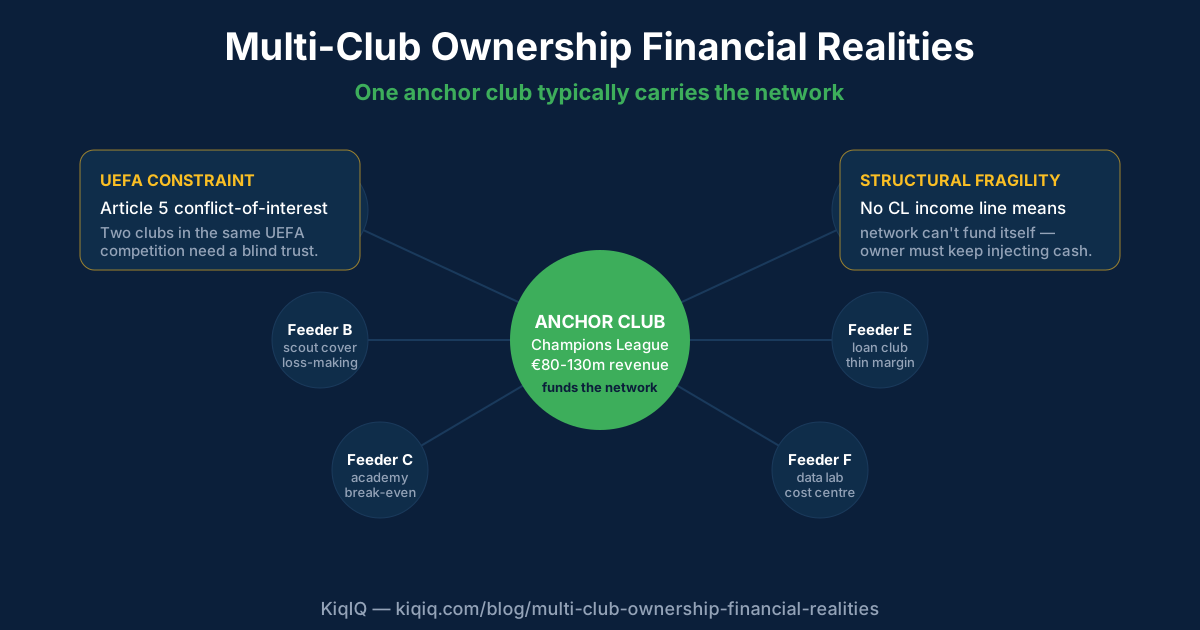
Most MCO networks have one club that generates the major broadcast income, the global sponsorship value, and — if things go well — Champions League prize money and matchday revenue from European nights. The rest of the portfolio typically operates on thinner margins, relying heavily on player trading between group clubs to balance the model. The narrative of "we share scouting, we develop players together, we move them up the network" is real, but the economics rarely work without one club generating the bulk of the cash.
City Football Group is the example most often used to demonstrate that the model can scale commercially. Their long-term global partnership with Puma reportedly covers 13 clubs and is valued at around £650m — a deal no individual club outside the European elite could land on its own. The leverage is real. But CFG's economics rest on Manchester City's Champions League income line; remove that and the rest of the network's commercial proposition compresses substantially.
When UEFA rules intervene
UEFA's multi-club ownership regulations restrict two clubs under common control from competing in the same UEFA competition simultaneously. The rule has been in place for decades but enforcement has tightened as the number of MCO networks has grown. The headline 2024 case involved John Textor's ownership group, with Lyon and Crystal Palace both qualifying for European competition through their domestic seasons; UEFA's compliance deadline forced a resolution that ultimately moved Palace into the Conference League.
The rule's effect is structural rather than disciplinary. It means an MCO network that wants to operate at the European level has to choose which club fronts the qualifying campaign each season. The flexibility of "we can rotate which club competes" doesn't exist — once both clubs qualify, one is moved or sold out of the group. For networks with two genuinely competitive anchor clubs, that's a tax on the model's upside.
UEFA's multi-club ownership rules block two clubs under common control from competing in the same UEFA competition simultaneously. Networks that want European football have to choose which club fronts the qualifying campaign each season.
Why some MCOs collapse
The collapse of 777 Partners in 2024 demonstrated the cascading-failure risk inherent in the model. 777 owned or partly owned Genoa, Standard Liège, Vasco da Gama, Hertha BSC, Red Star FC, Melbourne Victory and Sevilla, among others. When the group's parent-level financial position unravelled, every club in the portfolio was exposed simultaneously to the consequences. Some recovered with new ownership; others were sold out of the network at distressed valuations.
The systemic vulnerability is that capital costs are increasing globally and clubs without a top-of-table broadcast contract have thin margins for shock absorption. MCO groups concentrate financial risk by operating multiple thin-margin clubs from a single ownership balance sheet. When that balance sheet is stressed, the contagion is faster and broader than single-club ownership would produce.
Where MCO does work
Three conditions correlate with MCO networks that succeed financially. First, an anchor club that consistently performs at the level where Champions League income is reliable. Second, a regulatory environment in the anchor club's league that doesn't penalise multi-club commercial deals (a problem some Premier League cases have highlighted around fair-market-value sponsorships from owner-linked entities). Third, a player-trading model that's structurally beneficial — pathways from smaller-league clubs to the anchor, then onward sales at premium fees.
Pacific Media Group's portfolio, including Barnsley and Nancy, has illustrated how difficult the model can be without strong central revenues. Smaller networks without a Champions League-level anchor face a much tougher financial equation than the headline MCO narratives suggest. The next question — as regulation tightens and capital costs rise — is whether mid-sized ownership groups can sustain multiple clubs without one consistently performing at the top of European football.
- Anchor club — the network needs one consistently top-table revenue generator.
- Player pathway — the operational value is in onward sales from feeder clubs.
- UEFA rules — two clubs under common control can't play the same UEFA competition simultaneously.
- Cascading risk — parent-level failure (cf. 777 Partners) affects every club at once.
- Commercial leverage — group-level sponsorships (e.g. CFG's £650m Puma deal) require the anchor to make the network commercially marketable.
Frequently asked questions
- What is multi-club ownership in football?
- Multi-club ownership (MCO) is when a single ownership entity controls two or more football clubs across different leagues or countries. The model emerged in the late 1990s and has expanded rapidly in the 2020s. The visible benefits are shared scouting, player pathways, group sponsorship deals, and operational efficiencies; the financial reality typically depends on one club generating the bulk of network revenue.
- Can two clubs under the same owner play in the Champions League?
- No. UEFA's multi-club ownership regulations block two clubs under common control from competing in the same UEFA competition simultaneously. If both qualify, one club is moved to a different UEFA competition or sold out of the network before the compliance deadline. The 2024 Lyon / Crystal Palace situation was the most prominent recent application.
- Why did 777 Partners collapse?
- 777 Partners' multi-club portfolio failed at the parent-group financial level rather than at any individual club's operating level. When the parent's balance sheet became distressed in 2024, every club in the portfolio (Genoa, Standard Liège, Vasco da Gama, Hertha BSC and others) was exposed simultaneously. The episode demonstrated the cascading-failure risk that MCO models concentrate.
- What is the biggest multi-club ownership network in football?
- City Football Group, owned by Abu Dhabi-based investors, operates the largest network — 13 clubs across multiple confederations as of 2026. Their commercial scale supports a long-term Puma partnership reportedly valued at around £650m across the group. The model rests on Manchester City as the revenue anchor.
References
- UEFA — Multi-club ownership integrity rules — UEFA
- CIES Football Observatory — Multi-club ownership networks — CIES Football Observatory
Ask KiqIQ a follow-up
Get a live, data-driven answer powered by api-football + KiqIQ's Poisson model. Try one of these prompts or write your own.
Part of pillar
Football Business
See every article in this knowledge pillar →
Related
Reviewed by a KiqIQ editor before publication. Spotted an error? Email editor@kiqiq.com — we follow our Corrections Policy.