
Head Coach Contracts in Football: The Clauses That Decide Who Actually Controls the Club
Most modern head coach contracts ring-fence transfers, staff appointments and playing philosophy away from the head coach. Knowing exactly which clauses are present (and what "reasonable instruction" really means) decides whether the relationship survives the first real disagreement.
 Tap to enlarge
The most visible disputes in modern football management, coach versus sporting director, coach versus medical department, coach versus owner over a transfer veto, are rarely personality clashes in the way the press frames them. They're contractual structures playing out in real time. Most modern head coach contracts ring-fence key decisions away from the head coach: transfers, staff appointments, playing philosophy, even sometimes substitution autonomy. Understanding which clauses are typically present, what the legal language actually means, and where the breakdowns happen is what separates a productive coach-club relationship from one that ends in lawyers.
The four ring-fencing clauses
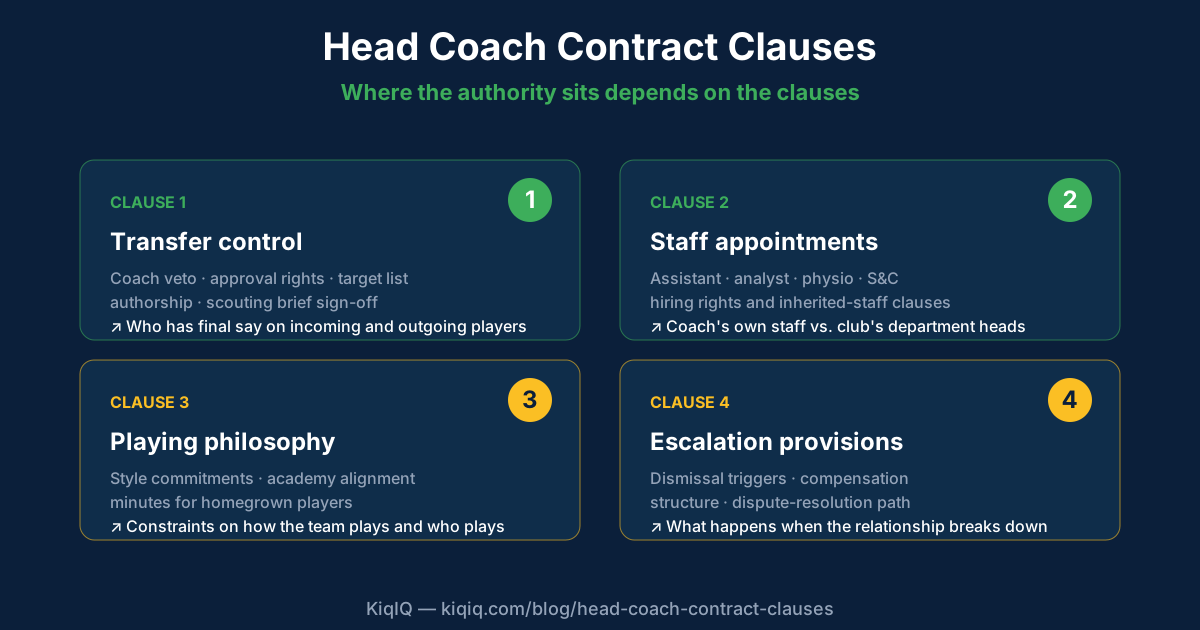
Standard modern head coach contracts include four clause types that move authority away from the coach. Transfer control typically reads something like: "The Head Coach shall not agree to appoint or engage any Player without the express prior approval of the Board / Sporting Director." Translation: the coach can recommend, but the sporting director and board make the call.
Staff appointments: "The Head Coach shall not engage in negotiations or carry out employment or dismissal of coaching or administrative staff without express prior approval." Translation: you want to bring your trusted assistant coach? Not without board approval. Playing philosophy: "The Head Coach shall implement and work in accordance with the Company's game model and any associated football philosophy as directed by the Sporting Director." Translation: you're executing the club's style, not installing your vision. Medical / load management: increasingly common as a standalone clause, requiring the coach to follow the medical department's player-minutes recommendations.
Standard ring-fencing clauses cover transfers, staff appointments, playing philosophy and (increasingly) medical-led load management. Where the contract puts the final word decides where the next real disagreement gets resolved.
Why clubs use this structure
It's not about undermining the head coach, it's about institutional sustainability. The sporting director model means that when a manager leaves, the club doesn't need to rip up the entire football operation and start again. Recruitment continues; youth development follows a consistent philosophy; the club's identity survives managerial changes. The cost of head-coach autonomy across multiple cycles is unstable institutional knowledge and a series of forced restarts every time a coach is hired or fired.
The model has visible success stories. Arsenal's Mikel Arteta moved from "Head Coach" with constrained authority in 2019 to "Manager" with significantly more transfer and football-strategy say by 2026. Aston Villa's Unai Emery followed a similar arc. The pattern: prove yourself within the constraints, earn trust, get elevated to a role with genuine autonomy. The contract structure is the trust-building scaffolding rather than the permanent ceiling.
Where the model breaks
The structure fails when there's genuine disagreement about football matters and the contract doesn't define how the disagreement gets resolved. If the medical team says a player can't play more than 60 minutes and the head coach thinks that's costing results, who wins? Under most contracts, the club structure wins, every time. That's not necessarily wrong; medical departments use data and expertise to protect long-term player health. But it limits a head coach's operational autonomy in ways that can become untenable if the coach feels their on-pitch results are being constrained by off-pitch decisions they can't override.
The Enzo Maresca situation at Chelsea in early 2026 became a case study. Sources close to Maresca reported frustration with constant medical-department recommendations about player minutes, a classic example of the modern football power-structure friction. The contract probably gave the club's structure the final word; the coach's practical position was to accept that or leave. Many do leave.
What clubs should write into the contract
For clubs negotiating these contracts, the recommended practice is to be explicit about reporting lines rather than relying on vague boilerplate. Don't just say "reports to Sporting Director", spell out who has final say on team selection, medical recommendations, training schedules, transfer recommendations. Define "reasonable instructions" so the phrase isn't a perennial dispute. Specify the decision-making process for known friction points: if medical recommends 60 minutes maximum and the head coach wants 90, who decides? Put it in writing.
Include the playing philosophy as a contractual schedule rather than a free-floating phrase. "Possession-based football" means different things to different sporting directors. If the contract requires adherence to a specific style, attach a written description of what that style entails, pressing trigger principles, build-up structure, defensive-block target zones. The clearer the schedule, the fewer the disagreements about whether the coach is "implementing the philosophy."
What head coaches should negotiate into the contract
For the coach side, four negotiation points consistently produce better outcomes. First, understand what "express prior approval" really means: what's the timeline, who specifically approves, can they overrule entirely? These aren't administrative details. They're the coach's actual influence.
Second, clarify consultation rights even where final authority sits elsewhere: "The Head Coach shall be consulted on all player acquisitions and shall provide written recommendations" gives the coach a documented voice in the process. Third, define success metrics carefully. If the coach is being judged on results but doesn't control squad investment, ask for "Performance targets shall be adjusted to reflect actual squad investment versus budgeted investment". Fourth, negotiate escalation provisions. What happens when the coach fundamentally disagrees with a football decision? Build in a mechanism (board review, independent mediation) so the option isn't binary between compliance and resignation.
The collaborative-structure direction
The modern game is moving toward collaborative structures rather than coach-led autonomy. That direction isn't reversible in the short term, the data, the financial regulations (SCR / SSR, PSR), and the institutional-stability arguments all favour multi-stakeholder decision-making. The right question for a coach considering a role isn't whether they'll have the autonomy of a 1990s manager, they won't, but whether the specific structure they're joining has clarity, escalation paths, and consultation rights that match how they want to operate.
Both sides need brutal honesty about expectations before anyone signs. The breakdowns that show up in the press six months later are almost always the result of clauses neither party paid enough attention to at the contracting stage. Good contracts don't prevent disagreements; they decide in advance how disagreements get resolved.
- Transfer control: explicit prior approval typically required.
- Staff appointments: coach's own staff hires subject to board sign-off.
- Playing philosophy: contract-anchored, often as a schedule.
- Medical / load management: increasingly its own clause; usually wins on disagreement.
- Escalation: define how disagreements get resolved before they happen.
Frequently asked questions
- Who actually controls transfers at a modern football club?
- Under most modern head coach contracts, the sporting director and board control transfers. Standard contract language typically reads "the Head Coach shall not agree to appoint or engage any Player without the express prior approval of the Board / Sporting Director". The coach can recommend, but the final call sits with the structure.
- Why don't head coaches pick their own assistant coaches?
- Most modern head coach contracts include a clause requiring board approval for staff appointments. "The Head Coach shall not engage in negotiations or carry out employment or dismissal of coaching or administrative staff without express prior approval" is standard. Bringing trusted assistants is possible but requires sporting-director and board agreement, which is often part of the original contract negotiation.
- What is a "playing philosophy" clause?
- A contractual provision requiring the head coach to implement the club's pre-defined game model rather than installing their own. Modern contracts often attach the philosophy as a schedule, a written description of build-up principles, pressing triggers, defensive-block targets. The clearer the schedule, the fewer disagreements about whether the coach is "implementing the philosophy".
- What should a head coach negotiate into their contract?
- Four points: understand what "express prior approval" really means in practice; clarify consultation rights even where final authority sits elsewhere; define success metrics that adjust for actual squad investment versus budgeted investment; negotiate escalation provisions so disagreements have a defined resolution path rather than collapsing into compliance-or-resignation.
References
- Premier League, Owners' Charter and rules — Premier League
- FIFPro, Coaches' contracts and employment — FIFPro
Key terms in this article
Ask KiqIQ a follow-up
Get a live, data-driven answer powered by api-football + KiqIQ's Poisson model. Try one of these prompts or write your own.
Part of pillar
Football Business
See every article in this knowledge pillar →
Related
Reviewed by a KiqIQ editor before publication. Spotted an error? Email editor@kiqiq.com — we follow our Corrections Policy.