
Football Governance Act 2025: Commencement No. 3 Regulations 2026
The third commencement order under the Football Governance Act 2025 activated the next tranche of the Independent Football Regulator's powers. Here's what it does, when each provision bites, and what it means for English clubs.
 Tap to enlarge
The Football Governance Act 2025 was the largest piece of UK football legislation in a generation, creating the Independent Football Regulator (IFR) and giving it statutory powers over the financial sustainability, ownership suitability and heritage protection of clubs in the top five tiers of English men's football. The Act passed in stages — Royal Assent in 2025, the IFR established in early 2026, and the operational powers brought in via successive commencement orders. The Commencement No. 3 Regulations 2026 are the third such order: they activate the licensing regime that turns the IFR from a body that exists into a body that regulates.
What a "commencement regulation" actually is
When an Act of Parliament passes, the individual sections of the Act don't all become legally operative on the same date. Parliament typically gives Ministers the power to "commence" specific sections by statutory instrument (an SI), allowing the implementation to be staggered while regulators, courts, or affected parties prepare. The Football Governance Act 2025 followed exactly this pattern — its substantive sections needed Ministerial commencement orders to take effect.
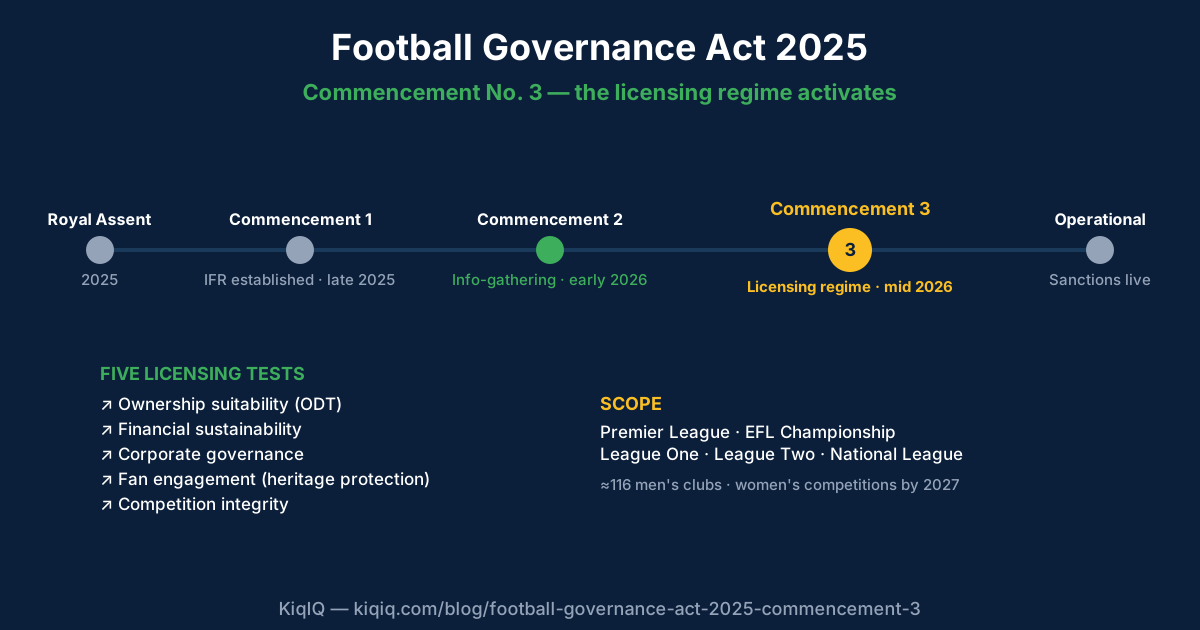
Commencement No. 1 (late 2025) established the IFR as a legal entity and brought in its appointment and standing-up provisions. Commencement No. 2 (early 2026) activated the IFR's information-gathering and consultation powers. Commencement No. 3 (mid-2026) is the operational milestone — it brings the actual licensing regime, financial regulation provisions, and enforcement powers into force.
A commencement regulation does not change the law that Parliament passed. It activates parts of that law that were already enacted but waiting for an effective date.
What Commencement No. 3 activates
The headline activation is the club licensing framework. From the effective date set in the SI, every club operating in the top five tiers of English men's football is required to hold an operating licence issued by the IFR. The application process, the conditions attached to the licence, and the IFR's power to refuse or revoke a licence are all now operative law rather than future intent.
Alongside the licensing framework, Commencement No. 3 activates the IFR's financial regulation powers — the ability to set financial sustainability requirements, audit compliance, and intervene in clubs whose accounts indicate distress. The owners' and directors' test (ODT) provisions and the heritage protection provisions (kit, badge, ground, club name) also come into force from the same date.
How the licensing regime works in practice
Each licensed club must satisfy the IFR on five tests: ownership suitability (the ODT), financial sustainability (forward-looking solvency, not just historical compliance), corporate governance (board composition, decision-making safeguards), fan engagement (formalised consultation on heritage and ticket-pricing decisions), and competition integrity (compliance with competition-organiser rules — i.e. the Premier League and the EFL).
The IFR has the power to attach licence conditions to any club that meets the tests with reservations. Conditions can require additional reporting, board-level changes, or escrow arrangements on owner funding commitments. Non-compliance with conditions, or material breach of the underlying tests, triggers escalating enforcement — informal direction, formal direction, financial penalty, and in extremis licence suspension or revocation.
What changes for clubs the day the regulation bites
For most clubs, the day-one practical effect is that the licence application has to be filed within whatever transitional window the SI specifies (typically 90-180 days from commencement). Clubs that meet the substantive tests on existing operations will pass through this without major operational change — what matters most is having the documentation, governance papers, and ownership disclosures organised to satisfy the IFR's evidentiary standard.
For clubs with reservations against any of the five tests, the regime is more material. The board may need to update structure or processes; the owner may need to evidence funding commitments more formally than before; the heritage decisions that the club historically made unilaterally (kit colours, badge changes, ground moves) now have a fan-engagement obligation attached. Several clubs have begun the work pre-emptively to avoid a rushed application.
Why the staged commencement was structured this way
The Act's framers were explicit that the regulator should "walk before it ran". Setting up the IFR as a legal entity, recruiting its staff, building its information systems, and consulting with clubs and competition organisers all had to happen before the licensing regime could be activated. A simultaneous commencement of every section would have produced an unenforceable Act — the regulator wouldn't have had the operational capacity to issue licences against a credible standard.
The staged approach also gave clubs a usable runway. Each commencement order signalled which specific powers would activate next, allowing clubs to prepare governance papers, audit committees, and fan-engagement frameworks in advance. By the time Commencement No. 3 activated the licensing regime, the majority of clubs had been engaged with the IFR's draft framework for over a year.
- Scope: top five tiers of English men's football (Premier League, EFL Championship / League One / League Two, National League).
- Licensing tests: ownership suitability, financial sustainability, corporate governance, fan engagement, competition integrity.
- Enforcement: informal direction → formal direction → financial penalty → licence conditions → suspension / revocation.
- Heritage protection: kit, badge, ground move and club name changes now require fan-engagement processes.
- Effective date: set in the commencement SI itself, with a transitional window for licence application.
Frequently asked questions
- What is the Football Governance Act 2025?
- The Football Governance Act 2025 is the UK statute that established the Independent Football Regulator (IFR) and gave it statutory powers over the financial sustainability, ownership suitability, corporate governance, fan engagement and heritage protection of clubs in the top five tiers of English men's football.
- What does the Commencement No. 3 Regulations 2026 do?
- It brings into force the operational licensing regime created by the Act. From the effective date, every club in the top five tiers of English men's football is required to hold an IFR-issued operating licence. The Regulations also activate the IFR's financial regulation powers, the owners' and directors' test provisions, and the heritage protection provisions.
- Which clubs are covered by the IFR licensing regime?
- The Premier League, EFL Championship, EFL League One, EFL League Two and the National League. That covers approximately 116 men's clubs across the top five tiers of English football. Women's competitions are not currently in scope; expansion would require separate legislation.
- What happens if a club fails the IFR licensing test?
- The IFR's enforcement escalates through informal direction, formal direction, financial penalty, licence conditions, and ultimately licence suspension or revocation. A revoked licence prevents the club from operating in its current league. In practice, the IFR is expected to work through conditions and direction in the vast majority of cases rather than immediate suspension.
References
- Football Governance Act 2025 — full text — UK Government Legislation
- Independent Football Regulator — official site — UK Government
Ask KiqIQ a follow-up
Get a live, data-driven answer powered by api-football + KiqIQ's Poisson model. Try one of these prompts or write your own.
Part of pillar
Football Business
See every article in this knowledge pillar →
Related
- FA Rule N workforce diversity reporting →
- Premier League SCR + SSR explained →
- Pillar: Football Culture →
- The Richest Football Clubs in the World: Deloitte Money League 2026 →6 min read
- Football TV Rights Deals Explained: Big-5 Leagues + Streaming Entrants →8 min read
- How Premier League Prize Money Works: The Real Pound Breakdown →7 min read
Reviewed by a KiqIQ editor before publication. Spotted an error? Email editor@kiqiq.com — we follow our Corrections Policy.