
Single-Stack, Best-of-Breed, or Build-Your-Own: How Football Clubs Should Architect Their Tech
Most clubs never consciously choose their analytics tech architecture — they inherit it. The three real options have very different trade-offs on data ownership, flexibility, and strategic differentiation.
 Tap to enlarge
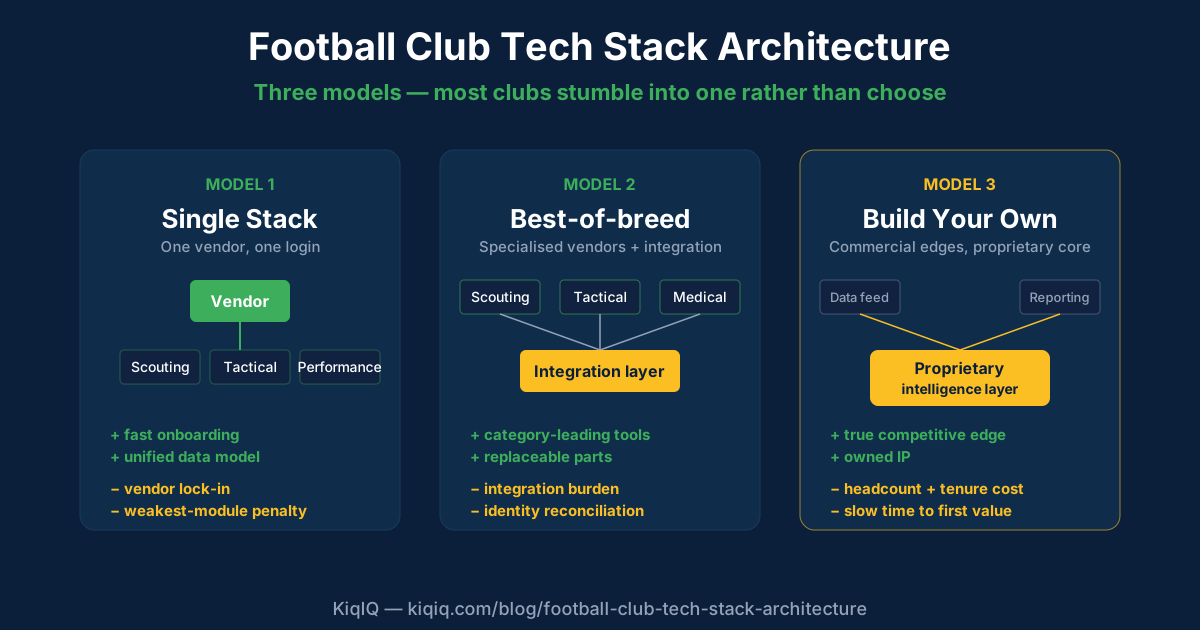
Every professional football club runs a tech stack — cameras, video analysis software, GPS providers, scouting databases, athlete management systems. Almost none of them consciously chose the architecture they ended up with. An analyst joined and brought a preference; a vendor made a compelling pitch; a federation recommended a platform; a sponsor included a technology package. Over five years the club has a stack that nobody designed, nobody fully understands, and nobody can easily change. The three real architectural options — single stack, best-of-breed, and build-your-own — have different trade-offs on data ownership, flexibility, and strategic differentiation, and most clubs have never been shown them side by side.
Model 1 — Single stack
One vendor. One ecosystem. One login. Video, analysis, GPS, scouting, athlete management — all from the same provider or family of products. The pitch is compelling: seamless integration, one support team, one invoice, one product roadmap. It's the dominant model right now and the one most vendors are building toward via acquisitions.
The advantages are real. Integration complexity is the lowest. The technical burden on club staff is small — there's a single account manager to call. For a club with limited digital capability, one ecosystem can feel like the only manageable option. The trade-off is what you give up. When everything runs through one provider, flexibility disappears. If the video module is excellent but the scouting tool is mediocre, swapping out the weak link threatens the whole system. Your data lives in their format, on their cloud, accessible on their terms. Contract renewal isn't just a price negotiation — it's a switching-cost negotiation, with embedded workflows, historical data and staff training all priced in.
The single-stack question to ask: if your provider was acquired tomorrow by a company with different priorities, what would happen to your operation? If the answer involves the word "hope," you have a single-stack problem.
Model 2 — Best-of-breed
Pick the best tool for each job. The best camera system. The best GPS provider. The best scouting platform. The best analysis software. Wire them together through integrations, APIs and data pipelines. Own the architecture. Control the connections.
A growing cohort of vendors are designing for this model rather than fighting it. Camera systems that produce open video files in standard formats: at the lower-cost end of the market, devices like auto-tracking AI football cameras for grassroots and academy use give academies and amateur clubs a single-tripod capture solution whose MP4 output drops straight into whatever analysis platform the club already owns. Tactical analysis platforms that accept footage from any camera, including mobile phones. Match-analytics services that ingest any feed and emit structured event data + reports. Video scouting databases that focus narrowly on the scouting workflow without bundling unrelated modules. The common mindset: do one thing exceptionally well and make it easy to work alongside others.
A representative example on the tactical-analysis side: a platform that accepts footage from any source (broadcast feed, mobile-phone capture, club camera) and emits frame-accurate clip-tag-overlay outputs into a cloud workspace any analyst on the staff can open. A professional tier serves elite clubs; an academy and amateur tier offers the same workflow without the elite-club bundle. Either way the platform sits as one cleanly-replaceable component in the best-of-breed stack rather than locking the club into a closed ecosystem.
Best-of-breed requires more internal capability than single-stack. Someone at the club needs to own the architecture, manage the integrations, and ensure data flows between systems. It's more work. The trade-off is strategic freedom — you can upgrade any component independently, negotiate from a position of strength (you can walk away), and own your data in formats and locations you control.
Model 3 — Build your own
Some clubs are going further. Rather than relying entirely on external platforms for analysis and decision-making, they build internal data pipelines, custom BI dashboards, and proprietary analytical tools. The logic is sound: the most valuable part of the digital value chain is the layer between data capture and decision, so why outsource the layer that creates the most competitive advantage?
Build comes with real risks. It requires dedicated technical staff. It creates a different kind of dependency — on internal people rather than external vendors. If the data engineer who built the pipeline leaves, the club faces the same single-point-of-failure problem the single-stack model has, except now it's the club's own code that nobody else understands. The pattern that works in practice is hybrid: commercial tools for capture and basic processing (cameras, GPS, scouting databases), proprietary code for the intelligence layer where unique competitive value is created.
Where your data physically lives
One dimension of the choice that deserves explicit attention: where does your data physically reside? If video lives exclusively on a vendor's cloud, you access it on their terms. If tracking data is stored in a proprietary platform, your export options are whatever the vendor chooses to offer. If the scouting database is a SaaS product with no offline capability, your institutional recruitment knowledge exists only as long as the subscription does.
On-premise storage with cloud capabilities is a different proposition. The data sits on the club's infrastructure. You can back it up, export it, and access it independently of any vendor relationship. Cloud features add convenience — remote access, sharing, collaboration — without removing control. This isn't anti-cloud; it's about being deliberate. Where your data lives should be a conscious strategic decision, not an accident of whichever vendor was signed first.
Making the choice deliberately
There's no universal right answer. A semi-professional club with one part-time analyst has different needs from a Champions League organisation with a dedicated data department. But the choice should be conscious. If you choose single-stack, do it with your eyes open — negotiate data portability, insist on export rights in standard formats, build contractual protections against price escalation and feature degradation, know your exit plan before you sign.
If you choose best-of-breed, invest in the connective tissue — someone at the club must own the architecture and cross-functional digital literacy matters more in this model than any other. If you choose to build, start small — don't replace commercial tools where they work well; build where you can create unique advantage; document everything so the investment survives staff turnover. The worst option is the one most clubs take — no choice at all. A stack that assembled itself over five years of uncoordinated purchasing decisions, held together by one overworked analyst, with data scattered across platforms nobody fully controls. That's not a technology strategy. That's an accident waiting to become a crisis.
- Single-stack — lowest integration complexity, lowest flexibility, highest switching cost.
- Best-of-breed — highest flexibility, requires architectural ownership at the club, best for clubs with capable analyst teams.
- Build-your-own — highest potential differentiation, highest internal-staff dependency risk, works best when hybridised with commercial tools.
- Data residency — on-premise + cloud features beats cloud-only on every long-term portability axis.
- Worst option — no architectural choice at all; a stack assembled by uncoordinated purchasing over five years.
Frequently asked questions
- What is a single-stack architecture for a football club?
- A single-stack architecture sources all the club's tech — video, analysis, GPS, scouting, athlete management — from one vendor or a tightly-bundled family of products. Integration complexity is minimised, but flexibility and data portability are minimised too. Switching cost grows over the contract life.
- What is a best-of-breed football tech stack?
- Best-of-breed means picking the best tool for each job (the best camera system, GPS provider, scouting platform, analysis software) and connecting them through integrations, APIs and data pipelines. The club owns the architecture. Components can be replaced independently. It requires more internal architectural capability than single-stack but gives strategic freedom.
- When should a club build its own internal analytics tools?
- Build internally where it creates unique competitive value — custom analytics, proprietary models, dashboards that combine data from multiple sources in ways no off-the-shelf product can. Don't build where commercial tools work well (cameras, GPS hardware, scouting databases). The hybrid approach — commercial tools at the edges, proprietary intelligence at the centre — is the pattern that succeeds most often.
- Why does data residency matter for football clubs?
- If your data lives exclusively on a vendor's cloud, you access it on their terms. Export options, format choices, and continued access after contract end are all the vendor's call. On-premise storage with cloud features keeps the data on the club's infrastructure while still offering remote-access convenience. This protects the institutional knowledge embedded in years of accumulated video, tracking and scouting data.
References
Key terms in this article
Ask KiqIQ a follow-up
Get a live, data-driven answer powered by api-football + KiqIQ's Poisson model. Try one of these prompts or write your own.
Part of pillar
Football Business
See every article in this knowledge pillar →
Related
Reviewed by a KiqIQ editor before publication. Spotted an error? Email editor@kiqiq.com — we follow our Corrections Policy.