
How to Be a Useful Football Analyst: Seven Habits That Separate Reports From Noise
Coaches don't need more clips. They need sharper answers to sharper questions. Seven analyst habits that separate reports that change selection from reports nobody reads.
 Tap to enlarge
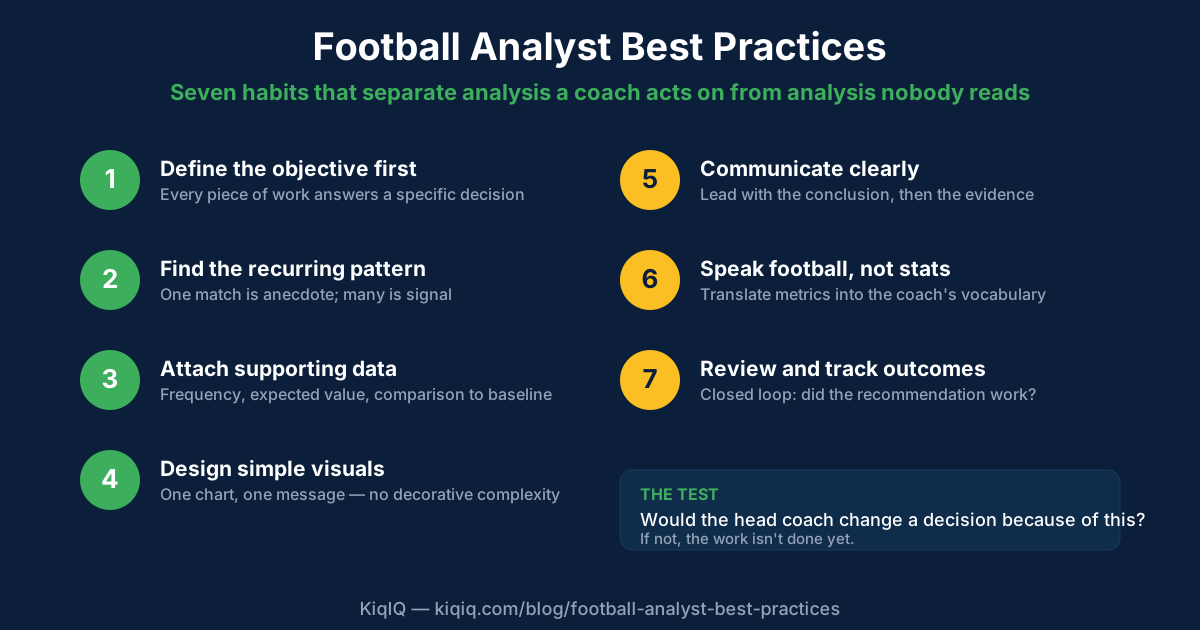
Every football analyst has been there. Hours of footage, gigabytes of data, and a head coach who looks at the report and asks "so what?" The volume of work isn't the differentiator. The discipline of the work is. Seven habits separate analysts whose reports change selection or training-ground emphasis from analysts whose reports get nodded at and filed. None require better tools — all are workflow choices anyone can adopt this week.
Habit 1 — Define the question before you clip anything
Don't sit down to "analyse the opponent". Sit down to answer "how do they build up against a high press?" A sharp question leads to a sharp answer. A vague question produces a 20-page report nobody reads. The most common failure mode in analyst work is starting the clipping process before the question has been narrowed enough to be answerable.
The question test: can the answer be summarised in one sentence the coach could use to brief a player? If yes, the question is sharp enough. If the only honest summary is "they're quite good in possession but sometimes struggle", the question wasn't specific enough. Re-narrow before you reach for the clipping tool.
Habit 2 — Find the recurring pattern, not the isolated incident
Don't grab the first example you see. Watch a full half before you clip anything. Look for behaviours that recur. If a tactical action only happens once in 45 minutes of footage, it's an anomaly. If it happens five times, it's a pattern. Patterns are what coaches can prepare for; anomalies are noise dressed as signal.
When the pattern is recurring, clip it from several matches rather than several moments in the same match. A pattern that holds across opponents and game-states is a pattern. A pattern that only appears against one particular shape is conditional on that shape — and the conditional is itself part of the finding.
Habit 3 — Attach data, but let the video tell the story
Video is the story. Data is the proof. The structure that works: show the clip first, then immediately back it up with one or two numbers. "Look at this concession — the left back was exposed by an underlap. That side has conceded 40% of their chances over the last five games." The clip shows what; the data shows that the what is structural, not lucky.
The failure mode is inverting the order — leading with a dashboard, hiding the clip on slide 18, and forcing the coach to reconstruct the story from numbers. Coaches think in moments. Numbers contextualise moments; they don't replace them.
The tool layer matters here. Most professional analyst rooms run on a clip-tag-cloud platform that lets you draw on frames, attach data overlays, and ship coach-ready bundles in minutes. Frame-accurate annotation, integrated tracking-data overlays, and multi-user cloud workspaces are the table stakes; an amateur-tier version covers the same clip-tag-overlay workflow without the elite-club price tag.
Habit 4 — Use simple visuals; throw away graphics that don't prove a point
A pass map with 400 arrows is impressive on Twitter and useless in a coaches' meeting. If a visual doesn't immediately prove the point you're making, delete it. The standard isn't "is the visual technically correct?" — it's "would the coach, glancing at this for three seconds, understand what they're looking at?"
The same applies to multi-axis charts, heatmaps that need a legend, and any visualisation where the analyst has to talk for two minutes to set up what the graphic means. Communicate clearly, not fancy. The default presentation style in elite football is plain — single-metric bar charts, simple zone maps with the relevant zone highlighted, side-by-side video frames with annotated arrows. Anything more sophisticated needs to earn its place.
Habit 5 — Communicate the message to the audience
Coaches don't read; they scan. Players want bullet points; they don't want a paragraph. Technical directors want trends; they don't want match-by-match detail. The same finding has to be packaged three different ways for three different audiences. Sending the coach's 30-page report to the manager's tablet wastes both their times.
Practically: one-page summary for the head coach (three bullet points, two key visuals), three-slide pre-match briefing for the players (the specific patterns they need to be aware of), trend chart for the technical director (how the pattern is evolving over a season). Same underlying analysis, three different artefacts.
Habit 6 — Translate the data into football language
Don't tell the coach: "their progressive pass volume drops 30% under high press." Tell them: "they struggle to get the ball forward when pressed because their lines are too far apart and the deepest midfielder isn't comfortable receiving with his back to play." That second version is something the coach can pass on to the press-trigger meeting tomorrow.
The translation skill is as important as the analytical skill. An analyst who understands the data but can't describe it in football terms ends up with reports the coach has to translate themselves — which usually means the coach won't bother. Speak human, in football terms.
Habit 7 — Close the loop
Analysis that doesn't lead to action is exercise. The week after a report, the analyst should be checking the next match's footage for whether the pattern was addressed — whether the player whose decision-making was flagged took the better option more often, whether the press trigger the team was prepped for was actually applied, whether the structural defensive gap got closed.
Tracking the follow-through serves two purposes. It tells the analyst which of their analyses are landing (and which are getting nodded at and ignored). And it gives the coach a closed feedback loop where their decisions are themselves measured. Analysis is a cycle, not a one-off task; the analysts who track the cycle become the ones the coach actually relies on.
- 1. Define the question first — sharp question, sharp answer.
- 2. Find recurring patterns — five instances, not one.
- 3. Video first, data second — clip the story, support with numbers.
- 4. Simple visuals — delete anything that doesn't immediately prove the point.
- 5. Audience-fit the output — coach, player, TD all need different packaging.
- 6. Translate into football language — speak human, in football terms.
- 7. Close the loop — check whether the analysis landed in the next match.
Frequently asked questions
- What does a football analyst actually do?
- A football analyst answers specific questions about a team's own performance, the next opponent's patterns, or individual player decisions, using video and data. The output ranges from pre-match briefings for the coach and players, to in-match live observations, to post-match reviews, to longer-term trend reports for the technical staff.
- How do football analysts present findings to coaches?
- Effectively: short, structured, video-led. A one-page summary for the head coach with three bullet points and two key visuals beats a 30-page report. Lead with the clip that demonstrates the pattern, follow with one or two numbers that prove the pattern is structural rather than lucky, and translate the conclusion into football language a coach can pass directly to a player.
- How do you know if a tactical pattern is real vs an anomaly?
- Frequency across matches. A behaviour that appears once in 45 minutes is an anomaly. A behaviour that appears five times across multiple matches against different opponents is a pattern. Patterns that only hold against one specific shape are conditional patterns — useful, but the conditional is part of the finding.
- What's the biggest mistake analysts make?
- Starting the clipping process before the question is narrow enough to be answerable. Sitting down to "analyse the opponent" produces a sprawling, unread report; sitting down to answer "how do they build up against a high press?" produces something the coach can act on. The discipline is in the question, not the volume of footage watched.
References
- Performance Football — Analyst workflow — Performance Football
- The Coaches' Voice — Analyst interviews — The Coaches' Voice
- Metrica Sports — video analysis platform (affiliate) — Metrica Sports
Key terms in this article
Ask KiqIQ a follow-up
Get a live, data-driven answer powered by api-football + KiqIQ's Poisson model. Try one of these prompts or write your own.
Part of pillar
Data and Systems
See every article in this knowledge pillar →
Related
- Football data providers compared: Opta, StatsBomb, SkillCorner, Wyscout →
- Automated defensive block detection →
- Club tech stack architecture →
- Pillar: Data and Systems →
- Tactalyse: How the Dutch Football Analytics Platform Actually Works →6 min read
- Football Shot Maps Explained: How to Read Them Like an Analyst →8 min read
Reviewed by a KiqIQ editor before publication. Spotted an error? Email editor@kiqiq.com — we follow our Corrections Policy.