
How Transfermarkt Market Values Are Calculated (and How Accurate They Really Are)
Transfermarkt market values are crowdsourced, not algorithmic, and they're not designed to predict transfer fees. Here's how the methodology works, what the academic research says about its accuracy, and how to use the numbers properly.
 Tap to enlarge
Transfermarkt is the single most-referenced player-valuation source in football. If a national newspaper quotes a player's market value, it almost always came from Transfermarkt; if a podcast cites how much a transfer "should" cost, the same. What people often don't realise is that Transfermarkt market values aren't algorithmically generated, aren't designed to predict transfer fees, and have a documented bias — they systematically underestimate high-end transfer fees and slightly overestimate fees at the lower end of the market. Knowing where the methodology comes from explains both why it works as well as it does and where it should not be trusted.
How the value gets set: the crowd, then the judges
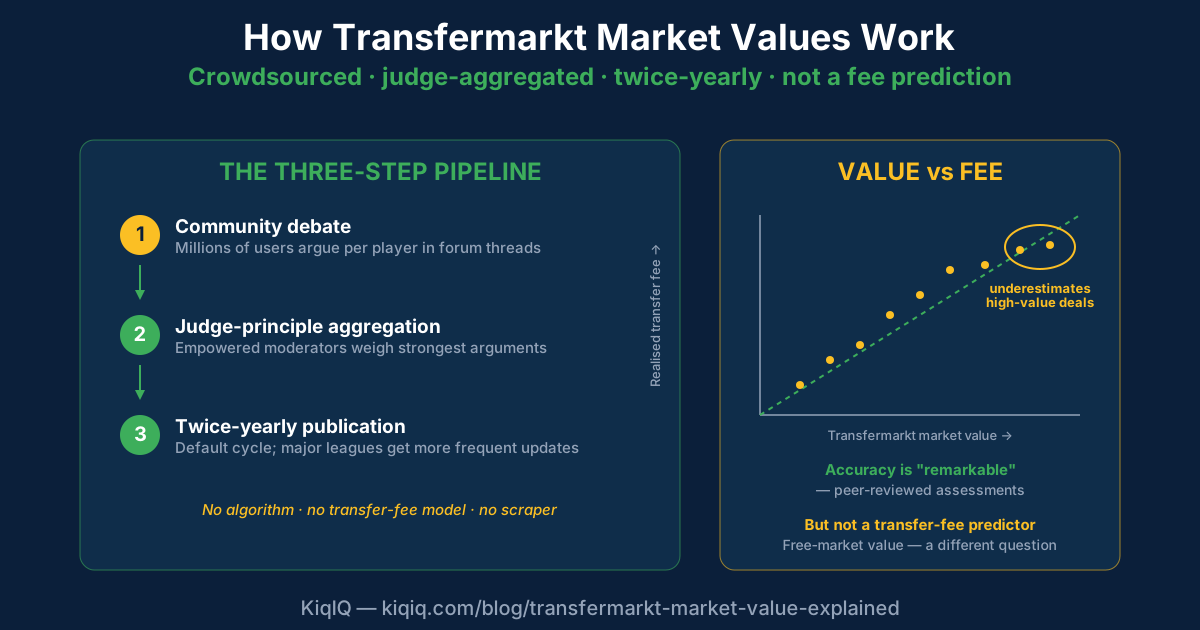
Transfermarkt does not run a regression on transfer-fee data, a machine-learning model on performance metrics, or any kind of automated scraping pipeline to arrive at its market-value figures. It runs a structured crowdsourcing process. Registered users — there are millions of them across the various country-specific Transfermarkt sites — argue in dedicated forum threads about whether a given player is worth more or less than their current listed value. They cite contract length, recent form, age, position scarcity, transfer fees paid for comparable players, and anything else they can muster as evidence. A platform veteran summarised the process well: "Transfermarkt addresses crowdsourcing challenges through a selective aggregation process known as the judge principle, where empowered community members make valuations."
The judge principle is the part most casual readers miss. Forum debate is the raw input, but the decision to actually move a player's value is made by a smaller cohort of experienced moderators and country-specific value managers. They weigh the strongest forum arguments, cross-reference recent transfers in similar bands, and apply a final number. This selective aggregation is why Transfermarkt produces tighter, more defensible numbers than a pure-vote-average would: it filters out the noise of bias, hometown favouritism, and ill-informed opinions.
"Transfermarkt market values are not to be equated with transfer fees, as the goal is not to predict a price but an expected value of a player in a free market." — the platform's own published methodology note.
How often values update — and why that matters
Each Transfermarkt market is updated twice per season as a baseline. The full bulk-update cycle lands once at the end of the season (usually June for European leagues) and again mid-season once enough competitive matches have been played to support a fresh round of valuations (typically December). For the bigger leagues, intermediate value updates happen more frequently — Premier League and Bundesliga players sometimes see three or four valuation movements a year, particularly when international tournaments, injury news, or contract situations shift the consensus mid-cycle.
The twice-a-season default rhythm has a side-effect users should understand: the number you see in October was probably set in June. For high-form young players whose value is rising fast, that means Transfermarkt is structurally lagging the market by months. The mid-cycle catch-up is meaningful — it's common to see €5-10m jumps for breakout players when their first in-season update lands.
How accurate are the values? — what the academic literature says
There are several peer-reviewed academic papers that have tested Transfermarkt values against realised transfer fees. The summary across them: the accuracy is "remarkable", in the language of one of the most-cited assessments, especially given common crowdsourcing pitfalls. Independent data-science blogs that have re-run the comparison reach similar conclusions: Transfermarkt values track realised fees well across the bulk of the market, but the fit is not uniform across price bands. Across the broad middle of the market, the consensus is that Transfermarkt values consistently land within roughly 30% of the eventual transfer fee — close enough to be a defensible reference point, far enough that you should not treat the number as a quoted price.
The systematic bias the literature flags most consistently is at the high end. Transfermarkt tends to underestimate high-value transfers. The €100m+ band is where the gap is widest — a €70m Transfermarkt value attached to a player who actually sells for €120m is not unusual, particularly when the buying club is one of a small number of state-owned or oligarch-backed institutions that pay an opportunity-cost premium rather than a market-fair price. At the lower end (€1-5m), the bias inverts mildly — Transfermarkt sometimes overstates value because the crowd hasn't fully priced in the depth of the supply of journeyman players at that band.
- Crowdsourced, not algorithmic. Forum debate filtered by a "judge principle" cohort of experienced moderators.
- Twice-a-season default updates. Major leagues see additional intermediate updates throughout the year.
- Designed to estimate free-market value, not transfer fee. The methodology is explicit about this.
- Accuracy is well-documented but biased. Tends to underestimate the €100m+ band and slightly overestimate the €1-5m band.
- Lags fast-moving valuations. Breakout young players see €5-10m+ jumps at the first mid-cycle update.
How to use Transfermarkt values properly
For most analytical use cases, Transfermarkt values work well as a relative-ordering tool: within a single position and league band, the player with the higher Transfermarkt value is, on average, the player a club would pay more for. That's genuinely useful — it's a free public proxy for squad valuation that updates faster than any peer-reviewed alternative.
Where the values stop being useful is as a predicted transfer fee for a specific upcoming deal. Two players with €40m Transfermarkt values can sell for €25m and €70m in the same summer window depending on contract length, the buying club's spending profile, and how desperate either selling club is to move the player. Anyone using Transfermarkt as a "should-cost" benchmark to score a transfer needs to caveat the comparison hard — and ideally pair it with a transfer-fee model that explicitly handles contract-length effects and the buying-club identity premium, which the crowd-sourced methodology cannot capture by design.
KiqIQ's position is the same as the academic literature: Transfermarkt is the best free public valuation dataset available, and using it as a benchmark for "expected free-market value" is defensible. Using it as a forecast for the next deal is not. The two questions are different and the methodology only answers one of them.
Quick question
Where does a Transfermarkt market value come from?
Frequently asked questions
- How does Transfermarkt calculate player market values?
- Transfermarkt market values are crowdsourced, not algorithmic. Registered users debate each player's value in dedicated forum threads citing form, age, contract, and comparable transfers. The final number is then set by experienced community moderators using a "judge principle" of selective aggregation — they weigh the strongest arguments rather than averaging every opinion.
- Are Transfermarkt market values the same as transfer fees?
- No. The platform is explicit that market values are not designed to predict transfer fees — they estimate the expected value of a player in a free market, which is a different question. Realised transfer fees include effects like contract length, buying-club premium, and selling-club urgency that the market-value figure does not attempt to capture.
- How accurate is Transfermarkt?
- Academic studies have repeatedly found Transfermarkt market values "remarkably" accurate as estimates of free-market value, especially given the inherent challenges of crowdsourcing. The most consistent bias: Transfermarkt underestimates high-value (€100m+) transfers and slightly overestimates fees in the €1-5m band.
- How often does Transfermarkt update market values?
- Each league is updated twice per season as a baseline — once at the end of the season (usually June) and once mid-season (usually December). Premier League, Bundesliga and other major leagues see additional intermediate updates throughout the year as form, injuries, and tournament results shift the consensus.
- When should I trust a Transfermarkt valuation?
- Trust the relative ordering: within a single position and league, the player with the higher Transfermarkt value is the player most clubs would pay more for. Don't trust the absolute number as a fee predictor for any specific upcoming transfer — contract length, buying-club identity, and selling-club urgency drive realised fees in ways the methodology can't capture.
References
- Transfermarkt Market Value explained · How is it determined? · Transfermarkt
- Beyond crowd judgments: Data-driven estimation of market value in association football · European Journal of Operational Research
- The debate behind the numbers: analyzing discussions about crowdsourced football player market valuations · Taylor & Francis — Sport in Society (Jan 2025)
- Testing Transfermarkt's Squad Market Values · Paul Johnson (May 2025)
Key terms in this article
Ask KiqIQ a follow-up
Get a live, data-driven answer powered by our live data feeds + KiqIQ's Poisson model. Try one of these prompts or write your own.
Part of pillar
Data and Systems
See every article in this knowledge pillar →
Related
Reviewed by a KiqIQ editor before publication. Spotted an error? Email editor@kiqiq.com. We follow our Corrections Policy.