
Opta Power Rankings: How They Work and What They Predict
Opta Power Rankings rate 13,000+ men's clubs globally on a 0-1000 scale. We explain the methodology, the inputs, what they predict, and how they compare to other rating systems.
 Tap to enlarge
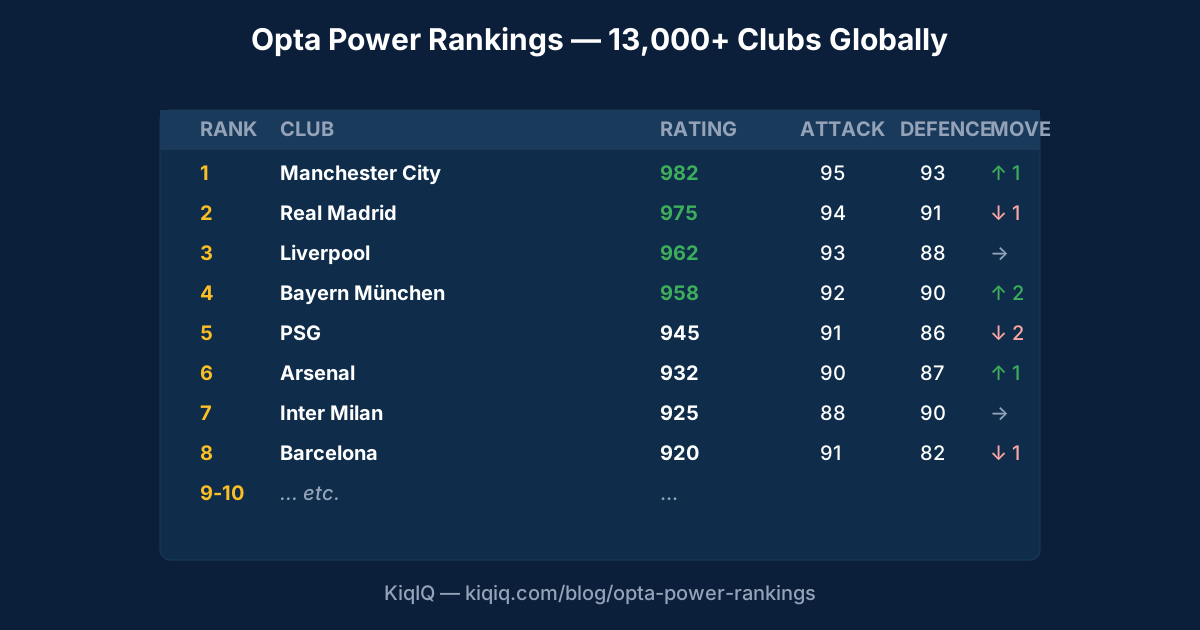
Opta Power Rankings rate every senior men's football club globally — 13,000+ teams across 250+ leagues — on a 0-1000 scale. The system uses an Elo-derived algorithm with goal-difference and competition-quality adjustments, updated after every match. Higher score = stronger team. The rankings are used for predictions, broadcast graphics, and as one input to bookmaker odds-setting models.
How the Power Rankings work
The Opta Power Rankings methodology has three principles:
- Elo-style updates. After each match, both teams' ratings adjust based on the result vs the expected result given the pre-match ratings.
- Goal-difference scaling. A 5-0 win is worth more rating points than a 1-0 win — but with diminishing returns above ~3 goal difference.
- Competition multiplier. Premier League matches are weighted more heavily than English non-league matches. The multiplier reflects average opposition quality.
- Three sub-ratings + overall. Each team has an Attack rating, Defence rating, and Overall rating (a weighted combination).
Top global clubs sit around 950-1000 in the Power Rankings. Mid-tier Premier League clubs sit around 850-900. Weaker non-league sides drop into the 200s.
What the rankings predict
Opta uses Power Rankings as one input to several predictive products:
- Match outcome probability. The probability that team A beats team B given their ratings. Used in broadcast graphics ("Liverpool 65% chance to win").
- Goal expectation. Expected goals scored by each side given their ratings + venue.
- Tournament progression. Probability of advancing to knockout rounds, reaching the final, winning the trophy.
- Season-long predictions. League winner probability, Champions League qualification chances, relegation probability.
Coverage breadth
13,000+ clubs across 250+ leagues makes Opta Power Rankings unusually deep:
- Top European leagues. Full coverage with frequent updates.
- National team rankings. Separate methodology, similar Elo-style approach.
- Non-league + lower tiers. Coverage extends down to seventh-tier English football and equivalents elsewhere.
- Continental coverage. South American, African, Asian leagues all rated.
How Power Rankings differ from FIFA / UEFA coefficients
Three competitor rating systems and how they differ:
- FIFA World Ranking (national teams). Uses an Elo-style algorithm too but with simplified inputs and slower updates. Known to lag form.
- UEFA Coefficient (clubs). Calculated from European competition results over a 5-year window. Too slow and too narrow for short-term prediction.
- ELO ratings. Pure mathematical Elo with no goal-difference or competition-quality adjustments. Available free at clubelo.com.
- Opta Power Rankings. More inputs than pure Elo, faster updates than UEFA coefficient, broader coverage than most. The most-used for short-term match-prediction.
Where Power Rankings fall short
Three known limitations:
- Form-lag. Recent form changes are weighted but not heavily; a club going through a transitional phase (new manager, key player out) can be over-rated for several weeks.
- Tournament-specific knockout adjustments. A team rated 920 vs a 880 has a "65% chance to win" — but knockout football has different variance properties than league football. Adjustment is approximate.
- Squad-depth blind spot. Power Rankings don't see injury lists or rotation — they rate the abstract club. Real teams differ from rating-implied performance based on personnel.
How fans + analysts use Power Rankings
Three practical use cases:
- Quick prediction sanity-check. Before any match, the Power-Ranking probability gives a defensible starting estimate.
- Cross-league comparison. Premier League 12th vs La Liga 8th — Power Rankings give a comparable number.
- Form trend tracking. A club's rating trajectory over a season reveals genuine improvement or decline beyond results variance.
Frequently asked questions
- What are Opta Power Rankings?
- Opta Power Rankings are a numerical rating system that scores every senior men's football club globally — 13,000+ teams across 250+ leagues — on a 0-1000 scale. Higher = stronger. Updates after every match using an Elo-style algorithm with goal-difference and competition-quality adjustments. Top global clubs sit around 950-1000; mid-tier Premier League clubs around 850-900.
- How accurate are Opta Power Rankings?
- They predict match outcomes at approximately 60-65% accuracy across global football — strong but not perfect. The accuracy is highest for matches between clubs in well-covered leagues with stable squads. Form changes (new manager, key player out, transition phases) introduce lag where ratings briefly over-estimate or under-estimate teams.
- How do Opta Power Rankings differ from FIFA rankings?
- FIFA World Ranking covers national teams only and uses simplified Elo inputs with slower updates — it lags form. Opta Power Rankings cover club football specifically (national-team Power Rankings exist separately), update after every match, and use richer inputs (goal difference, competition multiplier, attack/defence sub-ratings). Different sport context, different methodology.
- Can I see Power Rankings for free?
- Opta releases Power Rankings via The Analyst (free public site) for top-flight clubs. The full database (13,000+ clubs) is available via paid Opta subscriptions to broadcasters, bookmakers, and analytics platforms. Several free Elo-based alternatives (clubelo.com) provide a similar function with slightly different methodology.
References
- Opta Power Rankings Methodology — The Analyst (Opta)
- ClubElo — Free Football Elo Ratings — ClubElo
- FIFA World Ranking Methodology — FIFA
- Football Rating Systems Comparison — StatsBomb
Key terms in this article
Ask KiqIQ a follow-up
Get a live, data-driven answer powered by api-football + KiqIQ's Poisson model. Try one of these prompts or write your own.
Try the calculators
Apply the concepts from this article with KiqIQ's free calculators.
Part of pillar
Data and Systems
See every article in this knowledge pillar →
Related
Reviewed by a KiqIQ editor before publication. Spotted an error? Email editor@kiqiq.com — we follow our Corrections Policy.