
How Is the Fotmob Rating Calculated? The 0-10 Player Score Explained
Fotmob's player ratings (0-10) blend WhoScored's rating engine with Fotmob's own contextual adjustments. We explain the inputs, weightings, and where the numbers can mislead.
 Tap to enlarge
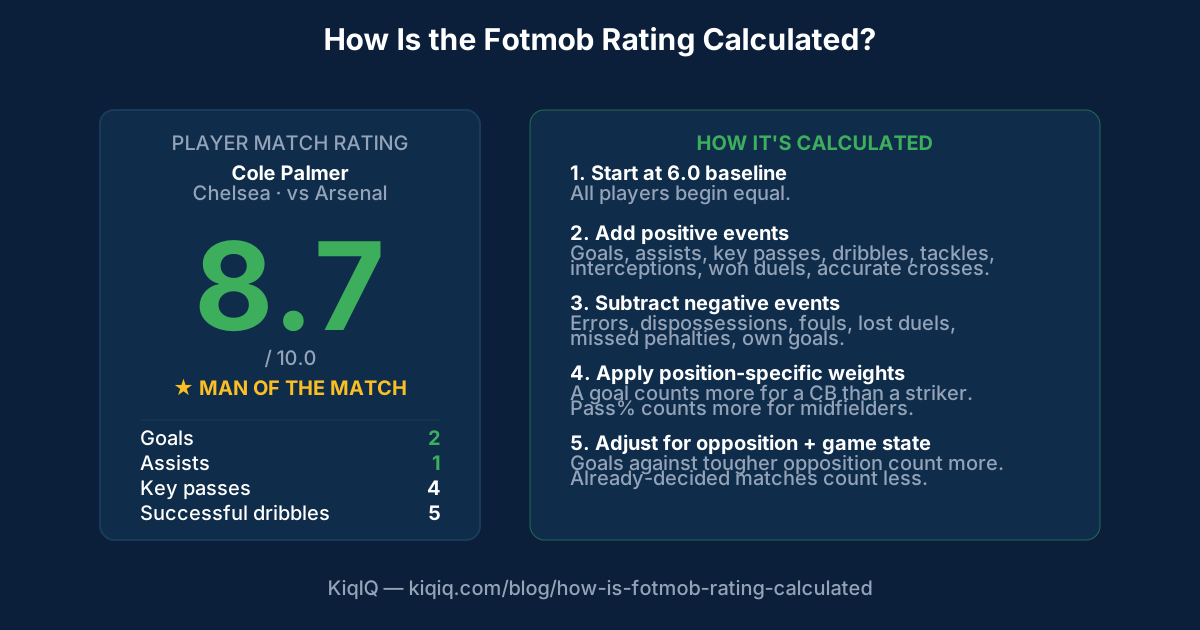
Fotmob's player ratings are 0-10 numerical scores assigned to every player after a match. They are calculated using a multi-input model that blends raw event data (goals, assists, key passes, tackles, interceptions, etc.) with contextual modifiers (opposition strength, game state, position-specific weightings). The exact algorithm is proprietary, but the underlying methodology is well-understood and largely shared with WhoScored — the original architects of in-match player ratings.
How the Fotmob rating works
Every Fotmob player rating starts from a baseline (typically 6.0) and adds or subtracts points based on positive and negative match events. The model has roughly 30+ inputs, each with a position-specific weight.
- Positive events. Goals (large positive), assists (medium-large), key passes, completed dribbles, successful tackles, interceptions, won aerial duels, completed long balls, accurate crosses, won penalties.
- Negative events. Missed clear chances, lost duels, dispossessions, errors leading to a shot, errors leading to a goal, fouls committed, yellow + red cards, missed penalties, own goals.
- Position-specific weights. A goal scored by a centre-back is worth more rating than a goal scored by a striker (rarer event). Tackles are weighted more for defenders than for forwards. Pass completion percentage is weighted heavily for midfielders.
Fotmob ratings are not subjective. They are mechanical: count the events, multiply by position-specific weights, normalise to a 0-10 scale.
How Fotmob differs from WhoScored
WhoScored introduced the in-match ratings model in the 2010s. Fotmob and several other apps use a similar (but proprietary) system. The differences are typically:
- Update frequency. WhoScored historically updates ratings periodically through and after matches; Fotmob updates more frequently in-match for live displays.
- Input set. Fotmob has invested in incorporating xG and xA into their rating model where WhoScored's legacy model was more event-count based.
- Contextual modifiers. Fotmob applies more aggressive opposition-quality and game-state adjustments than the early WhoScored model.
- Display. Fotmob shows ratings prominently in the lineup and live match views; WhoScored's ratings are part of a larger data table.
What a Fotmob rating means
Across a season, ratings cluster as follows:
- Below 6.0. Notably poor performance. Errors, lost duels, low contribution.
- 6.0-6.5. Replacement-level. Did the basics, didn't stand out either way.
- 6.5-7.5. Solid match contribution. Above-average for position.
- 7.5-8.5. Strong match. Goals, assists, dominant defensive work.
- 8.5-9.5. Outstanding. Match-winning performance.
- 9.5-10.0. Historic. Multi-goal, multi-assist, dominant. Rare.
Where Fotmob ratings can mislead
Three known weaknesses of mechanical match-rating models:
- Off-ball contribution is invisible. A defender who positions perfectly and forces an opposition pass into a low-xG zone never accumulates a "tackle" — but contributed enormously. Tracking-based metrics (StatsBomb 360, Skillcorner) would catch this; Fotmob does not.
- Game state inflates positive events. A striker scoring in a 4-0 game still gets the goal points. Leverage-aware metrics would discount this; Fotmob applies only modest contextual adjustments.
- Position effects are coarse. A "midfielder" weight applies whether the player is a #6, #8, or #10. Modern positions are more nuanced; mechanical ratings struggle with the gradient.
Comparing Fotmob to other rating systems
Several other player-rating systems exist:
- Sofascore rating. Similar mechanical model, displayed prominently.
- WhoScored rating. The original. Often used by analysts as the "industry baseline".
- Sportmonks rating. Used by some fantasy-football apps; methodology overlaps.
- Coach-driven ratings. Newspapers like The Times and L'Équipe publish post-match scores by their reporters. These are subjective but often align with mechanical ratings within ±0.5.
How to use Fotmob ratings well
Three use cases where Fotmob ratings provide value:
- Quick post-match scan. Across a 22-team league, ratings sort the standout performances quickly.
- Tracking form across matches. A player's rolling 5-match average rating is a useful smoothed performance trend.
- Fantasy football decisions. A consistent 7.0+ rating over multiple matches is a stronger signal than goal contributions alone for picking captains.
Frequently asked questions
- How is the Fotmob rating calculated?
- Fotmob calculates player ratings on a 0-10 scale using a proprietary multi-input model. Each player starts at a baseline (around 6.0) and adds or subtracts points based on ~30+ match events, each weighted by position. Positive events: goals, assists, key passes, dribbles, tackles, interceptions, aerial duels won. Negative: errors, missed chances, fouls, lost duels. Contextual adjustments are applied for opposition strength and game state.
- Is the Fotmob rating accurate?
- The rating is a mechanical, defensible score for what happened on the ball. It correlates well with reporter ratings (typically within ±0.5) and with advanced metrics like OBV. Its weaknesses: it underweights off-ball positioning (no tracking data), inflates positive events in dead matches (limited leverage adjustment), and applies coarse positional weights. Use it as one input, not the verdict.
- What is a good Fotmob rating?
- Below 6.0 is poor. 6.0-6.5 is replacement-level. 6.5-7.5 is solid above-average. 7.5-8.5 is strong / man-of-the-match candidate. 8.5-9.5 is outstanding (multi-goal performance, dominant defensive shift). 9.5-10.0 is historic — extremely rare, typically requires 2+ goals or 1 goal + 2 assists from a midfielder.
- How does Fotmob differ from WhoScored?
- WhoScored built the original in-match rating model in the 2010s. Fotmob uses a similar approach but updates more frequently in-match for the live UI, incorporates xG and xA into its inputs (where WhoScored's legacy model is more event-count based), and applies more aggressive contextual modifiers for opposition strength and game state.
References
- Fotmob — How Player Ratings Work — Fotmob
- WhoScored Rating Methodology — WhoScored
- Limitations of Mechanical Player Ratings — StatsBomb
- Comparing Reporter and Algorithmic Ratings — The Analyst
Key terms in this article
Ask KiqIQ a follow-up
Get a live, data-driven answer powered by api-football + KiqIQ's Poisson model. Try one of these prompts or write your own.
Part of pillar
Data and Systems
See every article in this knowledge pillar →
Related
Reviewed by a KiqIQ editor before publication. Spotted an error? Email editor@kiqiq.com — we follow our Corrections Policy.