
FA Rule N: What English Football's Workforce Data Actually Shows
FA Rule N forces all 92 men's professional clubs in England to publish workforce diversity data every two years. Here's what the first reporting cycle revealed and what it deliberately does not cover.
 Tap to enlarge
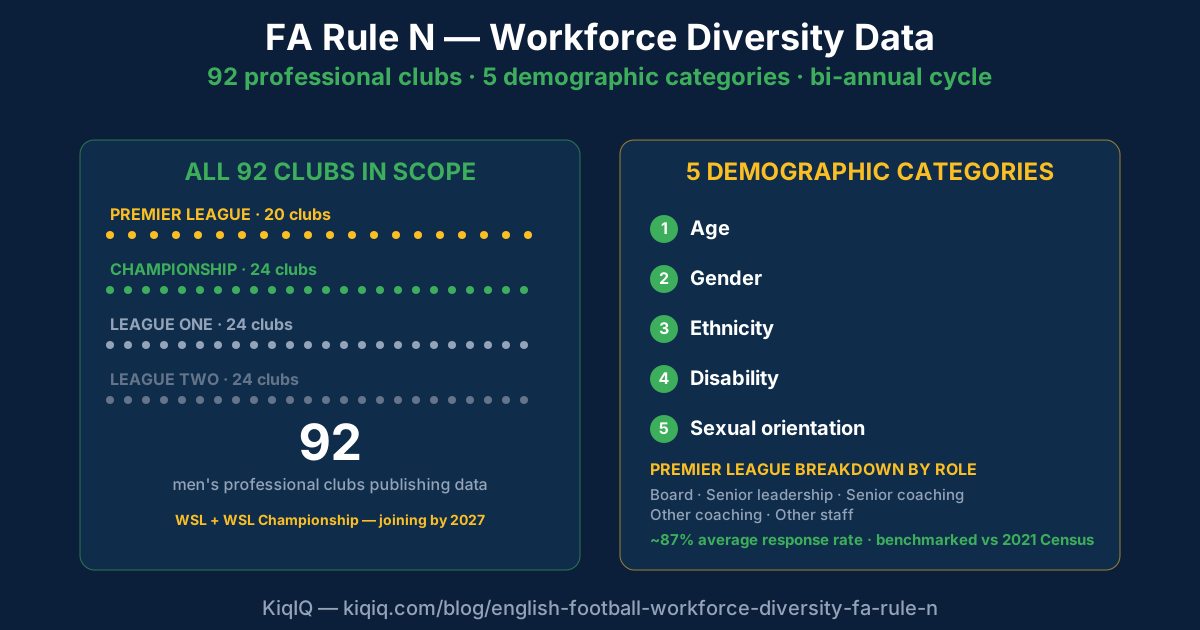
In June 2025 every professional men's club in England — all 92 in the Premier League and EFL — published demographic data on its workforce for the first time under FA Rule N. The rule mandates a fresh cycle every two years; the dataset covers age, gender, ethnicity, disability and sexual orientation, and for Premier League clubs it is broken down by role (board, senior leadership, senior coaching, other coaching, other staff). The numbers themselves are uneven across clubs, but the shape of the first cycle tells you most of what you need to know about where English football currently sits on workforce representation.
What FA Rule N actually requires
FA Rule N is the section of The Football Association's rulebook that obliges every club affiliated to the Premier League and English Football League to collect and publish workforce-diversity data on a two-year cycle. It came into force ahead of the 2024-25 season and the first public reporting deadline was June 2025. The Women's Super League and Women's Championship are not yet inside the mandate — both are scheduled to be folded in by 2027.
Each club asks staff to complete an anonymous, voluntary questionnaire covering five characteristics: age, gender, ethnicity, disability and sexual orientation. The responses are aggregated, benchmarked against the 2021 Census, and published in the club's own corporate or fan-facing area of its website. Premier League submissions add a layer of granularity that EFL clubs are not required to match — Premier League data is broken down by Board and Senior Leadership, Senior Coaching, Other Coaching, and Other Staff, so a reader can see whether boardroom representation differs from coaching or back-office representation. Several Premier League clubs (Wolves and Brentford were among the early publishers) chose to release the report as a standalone PDF on their corporate site; others fold it into a wider EDI annual report.
FA Rule N is mandatory and bi-annual. Kick It Out has publicly argued the cycle should be annual, matching the rhythm of clubs' financial and fan-engagement reporting.
What the first cycle shows — and what it leaves out
Two patterns are visible across the first cycle of published reports. First, the response rate is high — the Premier League aggregated figure is around 87%, which is unusually strong for voluntary workforce surveys. That gives the published numbers more weight than a typical opt-in employee questionnaire. Second, the gap between general workforce representation and senior-leadership representation is consistently wider than the gap to general coaching staff. Boardrooms remain the part of the building that looks least like the communities clubs serve, even at clubs whose general workforce data tracks the local census reasonably well.
The report deliberately leaves out two large groups. Event-day staff (stewards, hospitality, casual matchday workers) are excluded unless the club opts to include them, and external contractors are similarly excluded. The Premier League and EFL set this boundary so the data reflects the people whose careers actually run through the club. The practical effect, though, is that workforce snapshots understate the diversity of the people fans interact with on matchday and overstate the homogeneity of the people who run the institution day-to-day. Reading the numbers requires holding both halves of that ledger in mind.
How the data feeds the wider regulatory picture
FA Rule N sits inside a broader transparency push that has built up over the last five years. The earlier Football Leadership Diversity Code was a voluntary commitment set up in 2020 to raise representation in senior leadership, coaching and football operations; it produced three annual progress reports before Rule N moved equivalent reporting from voluntary to mandatory. The new framework also dovetails with the powers of the Independent Football Regulator that came into being under the Football Governance Act — workforce-diversity reporting is one of the explicit transparency expectations the regulator can lean on when assessing whether a club meets its custodianship obligations.
For anyone reading the data with a long horizon, the most useful comparison is club-to-club within the same role band rather than club-to-club overall. A boardroom-level comparison between similarly-sized Premier League clubs is signal; an overall headcount comparison between a 600-employee top-tier club and a 40-employee League Two club is noise. The role-band breakdown is the part of Rule N that turns the dataset from a compliance artefact into something a fan, journalist or regulator can actually use.
- 92 clubs in scope — every Premier League and EFL men's side.
- 5 protected characteristics — age, gender, ethnicity, disability, sexual orientation.
- Bi-annual cycle — next mandatory publication is the 2026-27 season report.
- Premier League adds role splits — board, senior leadership, senior coaching, other coaching, other staff.
- Benchmarked against the 2021 Census — published figures are absolute counts plus a comparison to the local catchment.
- Excluded by default — event-day staff and contractors (unless the club opts in).
- Women's competitions — WSL and Championship to be folded in by 2027.
Where to find each club's numbers
Kick It Out maintains a central index linking to every one of the 92 published reports. Most Premier League clubs host the data on a corporate-information page (Liverpool, Tottenham, West Ham, Manchester United, Manchester City), an EDI-policy page (Luton Town, Chelsea), or alongside their annual report (Arsenal). EFL clubs vary more: many publish a single PDF named "Rule N submission" hosted on their CDN, a smaller number embed the data inside a longer equality monitoring report. Stockport County was the only club to appear without a linked submission at the time of the index's publication.
For comparison purposes, the most useful files to download are the Premier League PDFs that follow the standardised template — they make role-band comparison possible across clubs. EFL files vary in granularity; some include disability and sexual-orientation breakdowns at the level of detail the Premier League template demands, others stop at age, gender and ethnicity. Treat the EFL cohort as a directional dataset until the next reporting cycle pulls more clubs onto the standard template.
Frequently asked questions
- What is FA Rule N?
- FA Rule N is the Football Association's rule requiring every men's professional club in England — all 92 in the Premier League and EFL — to collect and publish workforce diversity data on a bi-annual cycle. It covers age, gender, ethnicity, disability and sexual orientation, with Premier League clubs adding role-band breakdowns.
- When did clubs first publish under FA Rule N?
- The first mandatory reporting cycle landed in June 2025 covering the 2024-25 season. The next cycle is due in 2027 covering the 2026-27 season, when the Women's Super League and Women's Championship are also scheduled to be brought into scope.
- Does FA Rule N apply to women's football?
- Not yet. The first reporting cycle covers the 92 men's clubs only. The Women's Super League and Women's Championship are scheduled to be folded into the mandate by 2027, by which point WSL clubs will publish workforce diversity data on the same bi-annual rhythm.
- What does Rule N data not cover?
- Event-day staff — stewards, hospitality, casual matchday workers — are excluded by default unless the club chooses to include them. External contractors are similarly excluded. The data therefore understates the diversity of matchday-facing workers and reflects only the people whose careers run through the club itself.
- Is the data anonymous?
- Yes. Each club asks staff to complete the questionnaire voluntarily and anonymously. The aggregated, published figures contain no individual-level information; the Premier League's aggregate response rate across clubs was around 87% in the first cycle.
References
- Kick It Out — Workforce Diversity Data Index — Kick It Out
- Premier League publishes workforce diversity data — Premier League
- Football Leadership Diversity Code — Year 3 report — The FA
- Liverpool FC — Workforce Diversity Reporting — Liverpool FC
Key terms in this article
Ask KiqIQ a follow-up
Get a live, data-driven answer powered by api-football + KiqIQ's Poisson model. Try one of these prompts or write your own.
Part of pillar
Football Business
See every article in this knowledge pillar →
Related
Reviewed by a KiqIQ editor before publication. Spotted an error? Email editor@kiqiq.com — we follow our Corrections Policy.