
How Many Football Clubs Are in London? The Full Breakdown
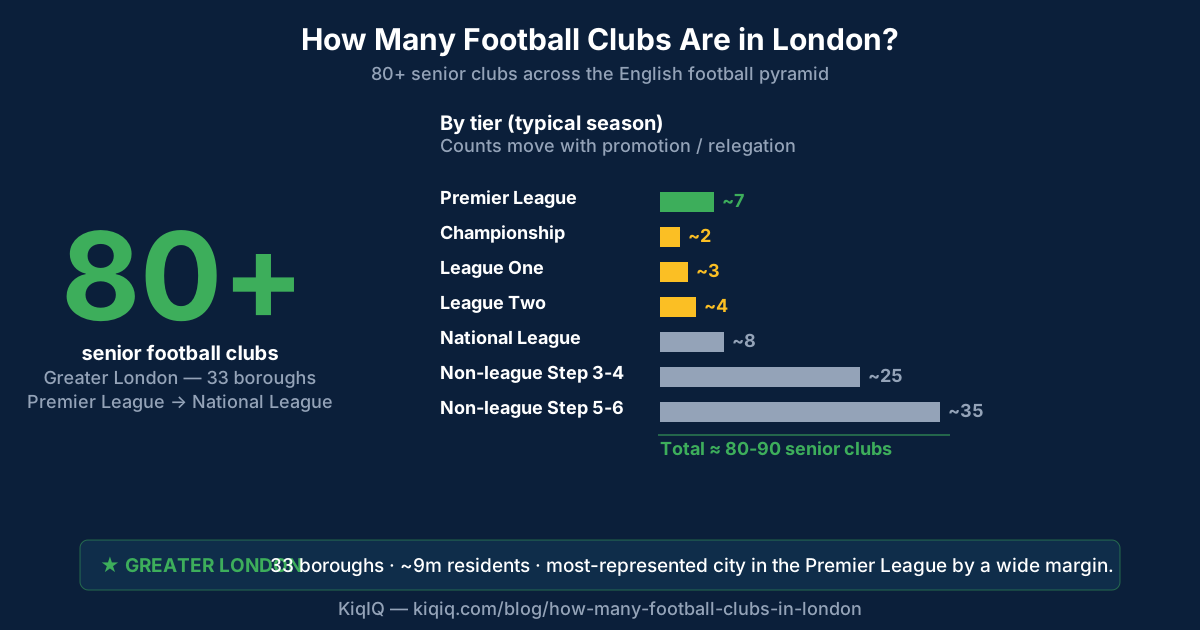
London has more than 80 football clubs across all senior tiers, including six to seven Premier League sides in a typical season. We break down the count by league tier and explain how the Greater London boundary defines who counts.
 Tap to enlarge
London has more than 80 senior football clubs across the English football pyramid — typically six or seven in the Premier League, two to three in the Championship, a similar mix across League One and Two, and 60+ across the National League and the regional non-league system. The exact count moves season to season as clubs are promoted, relegated, or restructured. The boundary that decides which clubs "count" is Greater London — the 33-borough area defined by the Greater London Authority.
The headline number — 80+ across all senior tiers
Counting football clubs in London depends on two choices. First, the boundary: do you mean Greater London (the 33 London boroughs administered by the Greater London Authority) or the looser "London area" that includes Watford, Stevenage, or Dartford? Second, the floor: do you stop at the National League (the top of non-league) or include the regional pyramid down to Step 6 and below?
Using Greater London + senior football down to the National League South / Isthmian Premier (Steps 1-3), London has consistently had roughly 80-90 football clubs since the late 2010s. Adding the regional non-league pyramid below that — Steps 4 to 6 — pushes the total well above 100, but most of those clubs operate at amateur or part-time level and play to small crowds.
Greater London = 33 boroughs. Watford, Stevenage, Dagenham (technically just outside), and Brentwood-area clubs are usually treated as "Home Counties", not London.
Premier League — the six-or-seven London sides
London is consistently the most-represented city in the Premier League. In a typical season, six or seven London clubs are in the top flight — more than any other city in Europe by a wide margin.
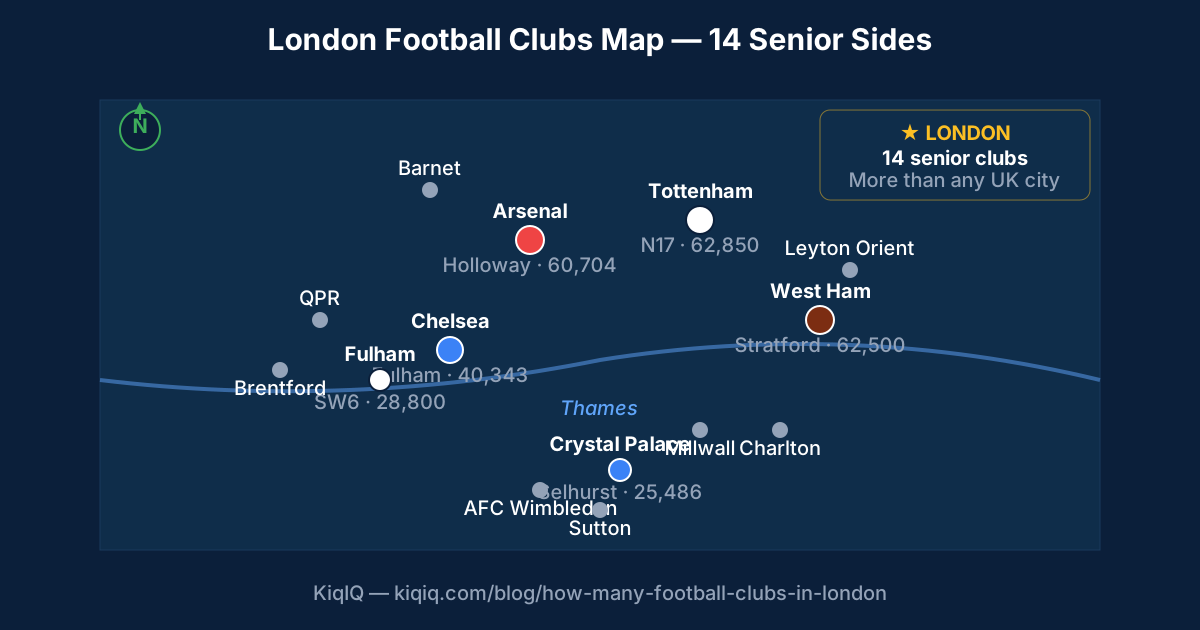
- Arsenal — Holloway, north London. Emirates Stadium (60,704). Founded 1886.
- Chelsea — Fulham, west London. Stamford Bridge (40,343). Founded 1905.
- Tottenham Hotspur — Tottenham, north London. Tottenham Hotspur Stadium (62,850). Founded 1882.
- West Ham United — Stratford, east London. London Stadium (62,500). Founded 1895.
- Crystal Palace — Selhurst, south London. Selhurst Park (25,486). Founded 1905.
- Brentford — Brentford, west London. Gtech Community Stadium (17,250). Founded 1889.
- Fulham — Fulham, west London. Craven Cottage (29,589 post-redevelopment). Founded 1879.
Championship and EFL — eight to ten more
Below the Premier League, the EFL (Championship + League One + League Two) typically holds eight to ten London clubs in any given season. The list moves with promotions and relegations, but the regular fixtures of London EFL football include:
- Queens Park Rangers (QPR) — Shepherd's Bush, west London. Loftus Road. Championship-level historically.
- Millwall — Bermondsey, south London. The Den. Championship.
- Charlton Athletic — Charlton, south-east London. The Valley. League One / Championship.
- Leyton Orient — Leyton, east London. Brisbane Road. League One.
- AFC Wimbledon — Plough Lane, south-west London. Plough Lane. League One / Two.
- Sutton United — Sutton, south London. Gander Green Lane. League Two / National League.
- Barnet — Edgware, north London. The Hive. National League / League Two.
- Bromley — Bromley, south-east London. Hayes Lane. National League / League Two.
National League — the gateway to the EFL
London is well-represented in the National League (Step 1, the fifth tier of English football) and National League South (Step 2). Across the two divisions, eight to twelve London or Greater-London-bordering clubs are typical in any season. Notable names include:
- Dagenham & Redbridge — Dagenham, east London. Victoria Road.
- Boreham Wood — Borehamwood (just outside Greater London but commonly counted).
- Hampton & Richmond Borough — Hampton, south-west London.
- Enfield Town — Enfield, north London.
- Welling United — Welling, south-east London.
- Hendon — Silver Jubilee Park, north-west London.
- Hayes & Yeading United — west London.
- Wingate & Finchley — north London.
The non-league long tail — 60+ regional clubs
Below the National League, London's non-league pyramid is dense. The Isthmian League and Southern League cover most of the regional clubs, with tiers running from Step 3 down to Step 6 (the Combined Counties League and Spartan South Midlands League at the bottom of the pyramid in Greater London).
Sixty or more London clubs play at Steps 3-6 in any given season, ranging from semi-professional outfits with average crowds of 200-500 (e.g. Cray Wanderers, Hornchurch, Tooting & Mitcham) to amateur clubs with attendances in the dozens. New clubs are formed regularly — phoenix clubs, breakaway clubs, and community-owned outfits all add to the count over time.
Why London has so many clubs
Three structural reasons explain London's outsized representation in English football:
- Population. Greater London's ~9 million residents support more local catchments than any other UK city. Even a third- or fourth-division London club draws from a population larger than most Premier-League catchments outside the capital.
- Victorian-era founding boom. Most London clubs were founded between 1880 and 1910 — the same period that produced the Football League (1888) and the second wave of professionalisation. London's industrial expansion during that period created the workplaces, pubs, and parishes that incubated football clubs.
- Geographic spread. London's 33 boroughs cover ~1,572 km² — large enough that west, north, south, and east London each developed their own football identities, with rivalries usually within a single quarter (north London derby, south London rivalries, etc.).
London clubs ranked by stadium capacity
Across the Premier League and EFL contingent, London stadium capacity ranges from Tottenham Hotspur Stadium's 62,850 seats down to Sutton United's 5,013. The capacity ranking is a useful cross-reference for the rivalry hierarchy — the biggest grounds host the biggest derbies.
- Tottenham Hotspur Stadium — 62,850 (Tottenham).
- London Stadium — 62,500 (West Ham).
- Emirates Stadium — 60,704 (Arsenal).
- Stamford Bridge — 40,343 (Chelsea).
- Craven Cottage — 29,589 post-redevelopment (Fulham).
- The Valley — 27,111 (Charlton Athletic).
- Selhurst Park — 25,486 (Crystal Palace).
- The Den — 20,146 (Millwall).
- Loftus Road — 18,439 (QPR).
- Gtech Community Stadium — 17,250 (Brentford).
- Plough Lane — 9,300 (AFC Wimbledon).
- Brisbane Road — 9,271 (Leyton Orient).
- The Hive — 5,419 (Barnet).
- Borough Sports Ground — 5,013 (Sutton United).
 Tap to enlarge
How the count compares to other UK cities
London's 80+ senior clubs is well ahead of any other UK city. For comparison:
- Greater Manchester — ~30 senior clubs (Man Utd, Man City, plus EFL and non-league sides).
- Merseyside — ~12-15 senior clubs (Liverpool + Everton plus regional non-league).
- Glasgow — ~12-15 (Celtic, Rangers, Partick Thistle, Queen's Park, plus lower-tier sides).
- Birmingham (West Midlands) — ~25-30 across the conurbation.
Frequently asked questions
- How many football clubs are in London?
- London has more than 80 senior football clubs across all tiers — typically six or seven in the Premier League, eight to ten in the EFL (Championship, League One, League Two), and 60+ across the National League and regional non-league pyramid. Adding amateur clubs at Step 6 and below pushes the total above 100. The Greater London boundary (33 boroughs) is the standard definition.
- How many London clubs are in the Premier League?
- The Premier League typically has six or seven London clubs in a given season — Arsenal, Chelsea, Tottenham, West Ham, Crystal Palace, Brentford, and Fulham have all been Premier League fixtures in the 2020s. The exact count moves with promotions and relegations. London is consistently the most-represented city in the Premier League by a wide margin.
- What counts as a London football club?
- The standard definition is a club whose home ground sits within the 33 boroughs of Greater London — the area administered by the Greater London Authority. Clubs in immediately adjacent towns like Watford, Stevenage, Borehamwood, or Dartford are sometimes counted in informal lists but are not Greater London clubs by the strict definition.
- Which is the oldest football club in London?
- Cray Wanderers, founded in 1860 and based in Bromley, is the oldest senior football club in London still in existence. Among Premier League clubs, Fulham is the oldest (founded 1879), followed by Tottenham (1882), Arsenal (1886), and Brentford (1889). Cray Wanderers' 1860 founding makes them one of the oldest clubs anywhere — second only to Sheffield FC (1857) and Hallam FC (1860).
- Are Watford a London club?
- No. Watford's home, Vicarage Road, is in the town of Watford in Hertfordshire — outside the Greater London Authority boundary. Watford is sometimes informally lumped in with London clubs because of its proximity to Wembley and its commuter-belt identity, but it is not counted in any official tally of London football clubs.
References
- Premier League — Clubs — Premier League
- EFL — League directory — English Football League
- The FA — National League System overview — The Football Association
- Greater London Authority — London boroughs — Greater London Authority
Ask KiqIQ a follow-up
Get a live, data-driven answer powered by api-football + KiqIQ's Poisson model. Try one of these prompts or write your own.
Part of pillar
Football Culture
See every article in this knowledge pillar →
Related
Reviewed by a KiqIQ editor before publication. Spotted an error? Email editor@kiqiq.com — we follow our Corrections Policy.