
Microcycle Planning in Football: The Weekly Training Architecture
A microcycle is the weekly training plan structure between matches. We cover the standard MD-1 / MD+1 framework, load distribution across the week, and how it adapts for two-game weeks.
 Tap to enlarge
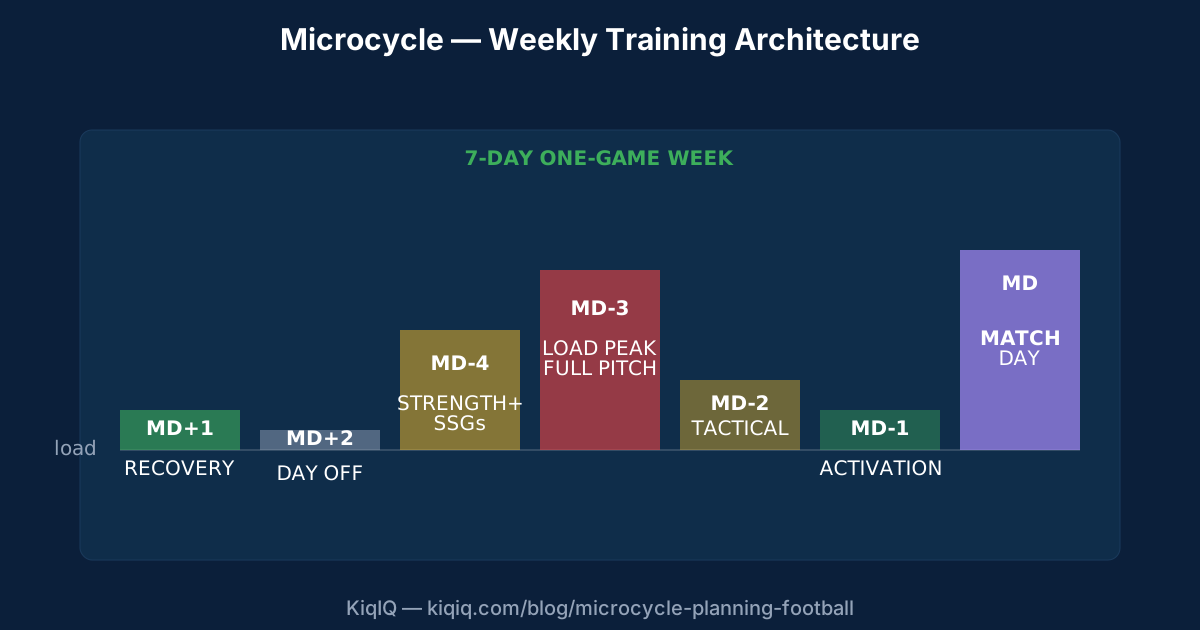
A microcycle is the weekly training plan structure between matches in football. The standard one-game week is 7 days, organised relative to match day (MD): MD+1 (recovery), MD+2 (day off), MD-3 / MD-4 (load peak), MD-2 (tactical-tactical), MD-1 (activation), MD (match). The microcycle architecture is one of the most-debated topics in football performance science because it directly determines whether players arrive at match day fresh + tactically prepared.
The standard 7-day microcycle
A typical Premier League microcycle when there's only one match per week (Saturday → Saturday):
- MD+1 (Sunday). Recovery — pool, bike, light jog. Players who didn't play do extra running.
- MD+2 (Monday). Day off (in most schedules).
- MD-4 (Tuesday). First high-load day — strength + small-sided games (SSG).
- MD-3 (Wednesday). Load peak — intense tactical work, full-pitch games.
- MD-2 (Thursday). Tactical-tactical day — set pieces, pattern of play, lower physical load.
- MD-1 (Friday). Activation — short, sharp session; players ready their bodies.
- MD (Saturday). Match day.
The principle: high physical load 3-4 days from match day, then a controlled drop in volume but maintained intensity in the final 48-72 hours. Frequency drops, intensity holds.
Two-game microcycles (mid-week + weekend)
- 3-4 day window. Sun match → Wed match → Sat match. Standard during European nights.
- Recovery is the priority. MD+1 always recovery; MD+2 may be light technical only.
- Reduced peak load. No "load peak" day possible; the microcycle becomes recovery-focused.
- Squad rotation likelihood increases. Coaches rotate to ensure no individual plays both midweek + weekend at full load.
Periodisation principles
- Tapered intensity. Highest load 3-4 days out, lowest 1-2 days out.
- Position-specific tweaks. GKs need different recovery vs outfield; CBs need different load vs wingers.
- Individualisation for fatigued players. A starter who played 90 minutes vs a substitute who played 0 follow different MD+1 plans.
- Compensation training. Players who didn't feature in the previous match do high-volume running on MD+1 to maintain conditioning.
Common microcycle mistakes
- Heavy load on MD-2. Too close to match day; players arrive fatigued.
- No recovery on MD+1. Skipping recovery → cumulative fatigue across the season.
- Inconsistent week-to-week structure. Players need consistency to anticipate sessions and prepare mentally.
- Ignoring the substitute / non-playing squad. Players who didn't play need extra work; otherwise they decondition.
Modern adaptations
- Tactical periodisation (Vítor Frade origin). Each MD has a specific tactical theme, not just physical theme. Used by Mourinho, Conceição, others.
- Heart-rate-derived monitoring during sessions. Adjusts intensity in real time based on player physiological response.
- Game-model integration. Sessions are built to rehearse specific in-match patterns (defensive transitions, set-piece routines, etc.).
- Individualised microcycles for chronic-injury players. Personal MD-3 / MD-1 modifications for players with hamstring / Achilles vulnerabilities.
Frequently asked questions
- What is a microcycle in football?
- A microcycle is the weekly training plan structure between matches. A standard one-game week is 7 days organised relative to match day (MD): MD+1 (recovery) through MD-1 (activation) and back to MD (match). It is the most fundamental unit of football periodisation.
- How is a Premier League microcycle structured?
- Typical Saturday-to-Saturday: MD+1 (Sunday) recovery; MD+2 (Monday) off; MD-4 (Tuesday) high-load strength + SSG; MD-3 (Wednesday) load peak; MD-2 (Thursday) tactical-tactical; MD-1 (Friday) activation; MD (Saturday) match. Load tapers to match day; intensity holds.
- How does the microcycle change in a two-game week?
- In Sun-Wed-Sat (or similar) two-game cycles, recovery is prioritised, no "load peak" day is possible, and squad rotation likelihood increases. Coaches plan rotation in advance to ensure no player exceeds load tolerance for both matches.
- What is tactical periodisation?
- Tactical periodisation (originated by Vítor Frade in Portugal) is a microcycle planning method where each training day has a specific tactical theme integrated with physical load — e.g., MD-3 = defensive transitions; MD-2 = set pieces. Used famously by José Mourinho. Different from purely physical periodisation models.
References
- Soccer Interaction — Microcycles — Soccer Interaction
- Ekkono Coaching — Microcycle Design — Ekkono
- Martin Buchheit — In-Season Periodisation — Martin Buchheit
- Sport Horizon — Periodisation — Sport Horizon
Key terms in this article
Ask KiqIQ a follow-up
Get a live, data-driven answer powered by api-football + KiqIQ's Poisson model. Try one of these prompts or write your own.
Part of pillar
Performance Science
See every article in this knowledge pillar →
Related
Reviewed by a KiqIQ editor before publication. Spotted an error? Email editor@kiqiq.com — we follow our Corrections Policy.