
What Is the Bosman Ruling? How a 1995 Court Case Changed Football
The Bosman ruling is a 1995 European Court of Justice judgment that gave footballers free movement after their contracts ended. It restructured football's transfer market and player power forever.
 Tap to enlarge
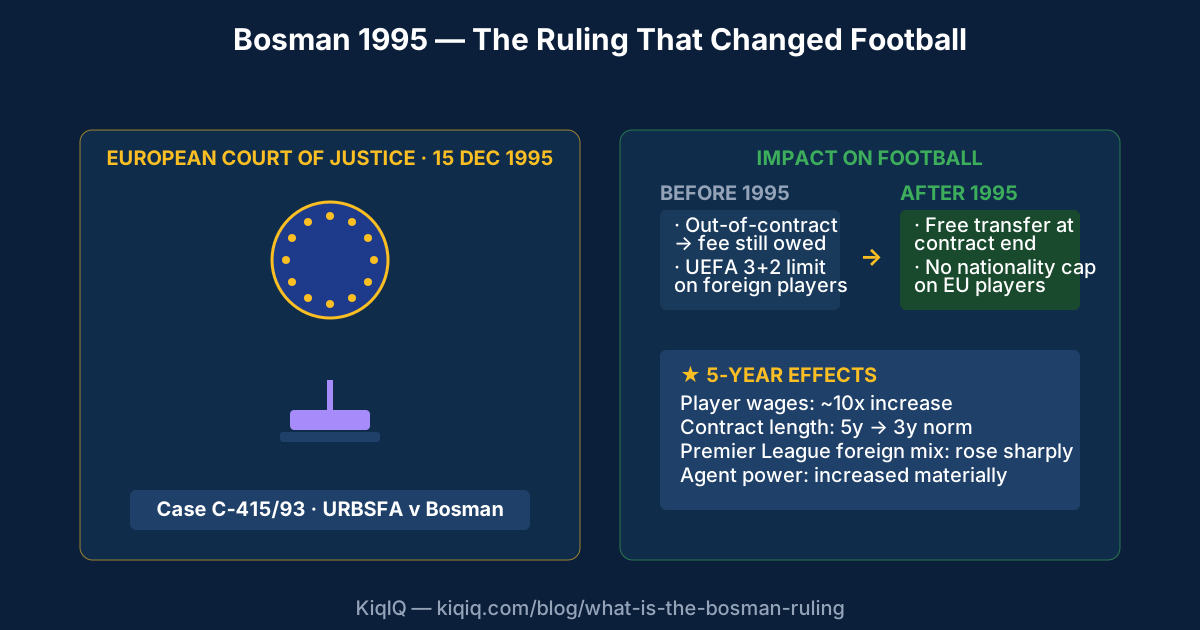
The Bosman ruling is a 1995 European Court of Justice judgment that gave footballers free movement to a new club after their contract expired — without their old club being able to charge a transfer fee. Jean-Marc Bosman, a Belgian midfielder, sued his club RFC Liège after they blocked his move to a French side. The judgment restructured the transfer market, multiplied player wages, and shifted power from clubs to players permanently.
Who was Jean-Marc Bosman?
Jean-Marc Bosman was a midfielder for the Belgian club RFC Liège. In 1990, his contract expired and he wanted to join the French club Dunkerque. His existing club, RFC Liège, demanded a transfer fee for him despite the fact that his contract had ended — and refused to register the move when Dunkerque didn't agree.
Bosman was effectively prevented from playing professional football. He took the case to the European Court of Justice, citing EU laws on free movement of workers between member states.
The judgment
The European Court of Justice ruled in Bosman's favour on 15 December 1995. The two key parts of the ruling:
- End of the transfer fee for out-of-contract players. Once a footballer's contract has expired, the club cannot charge another club a transfer fee — the player is free to negotiate with anyone.
- End of the "3+2" foreign player rule. Previously, UEFA permitted only 3 non-domestic + 2 domestically-trained foreign EU players per matchday squad. The ruling made this illegal as discrimination by nationality.
Bosman vs RFC Liège, UEFA, and the URBSFA, decided 15 December 1995. The single most consequential court case in European football history.
How the transfer market changed after Bosman
Five immediate effects of the ruling:
- Wages exploded. Players entering free agency could negotiate signing-on fees from new clubs. Cumulative player wages rose ~10x in the 5 years following the ruling.
- Players signed shorter contracts. Pre-Bosman, 5-year contracts were normal. Post-Bosman, players preferred 3-year contracts to reach free agency more often.
- Top European clubs concentrated talent. With no nationality limits in EU competitions, the top clubs could hoard non-English / non-Spanish / non-Italian players. The Premier League is now famously cosmopolitan.
- Smaller clubs lost their player-asset value. Once a player's contract approached expiration, his transfer fee dropped to zero. Smaller clubs had to sell early to recoup.
- Agent power increased. Negotiating a free-agent move became a high-stakes, high-fee process for agents.
Famous post-Bosman moves
Some of the most famous Bosman free transfers in football history:
- Sol Campbell (2001). Tottenham → Arsenal, the most controversial Bosman move in English football. Campbell crossed the North London divide.
- Andrea Pirlo (2011). Milan → Juventus, made Pirlo a critical Juve signing during their domestic dominance.
- Robert Lewandowski (2014). Borussia Dortmund → Bayern Munich, costing Bayern nothing but transformed their attack.
- Aaron Ramsey (2019). Arsenal → Juventus, a rare Premier League → Serie A free transfer at elite level.
- Lionel Messi (2021). Barcelona → PSG, the most famous "free" transfer ever (Barcelona could not register him under La Liga financial rules).
Bosman in 2026
How Bosman has shaped 2020s football:
- Free transfers as strategic recruitment. Top clubs now systematically pursue out-of-contract talent — Arsenal, Atlético Madrid, and Chelsea have built squads around free-transfer arrivals.
- Brexit complicated things for English football. Post-Brexit, EU players need work permits to play in the Premier League — Bosman free-movement rights between the UK and EU no longer apply automatically.
- The Webster ruling (2008). Extended Bosman to allow players to break contracts after 3 years (or 2 years if signed before 28) by paying compensation. Rarely used in practice.
- FIFA RSTP (Regulations on the Status and Transfer of Players). The current global framework that builds on Bosman to govern transfers worldwide.
What Bosman did NOT change
Three things the ruling explicitly preserved:
- Transfer fees for in-contract players. A club still owns a player's "registration" while under contract; another club must pay a transfer fee to acquire them mid-contract.
- Training compensation. Clubs that develop young players (under 23) are still entitled to compensation when those players move — even on a free transfer. This protects youth-development clubs.
- Solidarity payments. Clubs that helped develop a player between ages 12-23 receive a percentage of the transfer fee. Bosman didn't override this.
Frequently asked questions
- What is the Bosman ruling?
- The Bosman ruling is a 1995 European Court of Justice judgment that gave footballers free movement to a new club after their contract expired, without the old club charging a transfer fee. The case was brought by Belgian midfielder Jean-Marc Bosman after RFC Liège blocked his move to Dunkerque despite his contract having ended. The ruling also abolished UEFA's 3+2 foreign player limit.
- When was the Bosman ruling?
- The European Court of Justice judgment was delivered on **15 December 1995**, after several years of litigation. The case is formally known as Union Royale Belge des Sociétés de Football Association ASBL v Jean-Marc Bosman (1995 ECJ Case C-415/93).
- How did the Bosman ruling change football?
- It restructured the transfer market and shifted power from clubs to players. Wages rose ~10x in 5 years, players signed shorter contracts to reach free agency more often, top clubs hoarded non-domestic talent, and smaller clubs lost asset value when players approached contract expiry. The ruling also made it possible for European leagues like the Premier League to become globally cosmopolitan.
- Did Brexit affect the Bosman ruling for English football?
- Yes. Post-Brexit, EU players need work permits (governed by the FA Governing Body Endorsement) to play in the Premier League and EFL. Free-movement rights between the UK and EU no longer apply automatically. The Bosman principle of contract expiry → free transfer still applies within EU competitions, but the Bosman-era talent flow into England has been complicated by post-Brexit immigration rules.
References
Ask KiqIQ a follow-up
Get a live, data-driven answer powered by api-football + KiqIQ's Poisson model. Try one of these prompts or write your own.
Part of pillar
Football Business
See every article in this knowledge pillar →
Related
Reviewed by a KiqIQ editor before publication. Spotted an error? Email editor@kiqiq.com — we follow our Corrections Policy.