
What Is a Cap in Football? The Origin, Meaning, and Records
A cap in football is one international appearance for a national team. We explain the term's origin in 1860s English football, the modern meaning, and the all-time cap leaders.
 Tap to enlarge
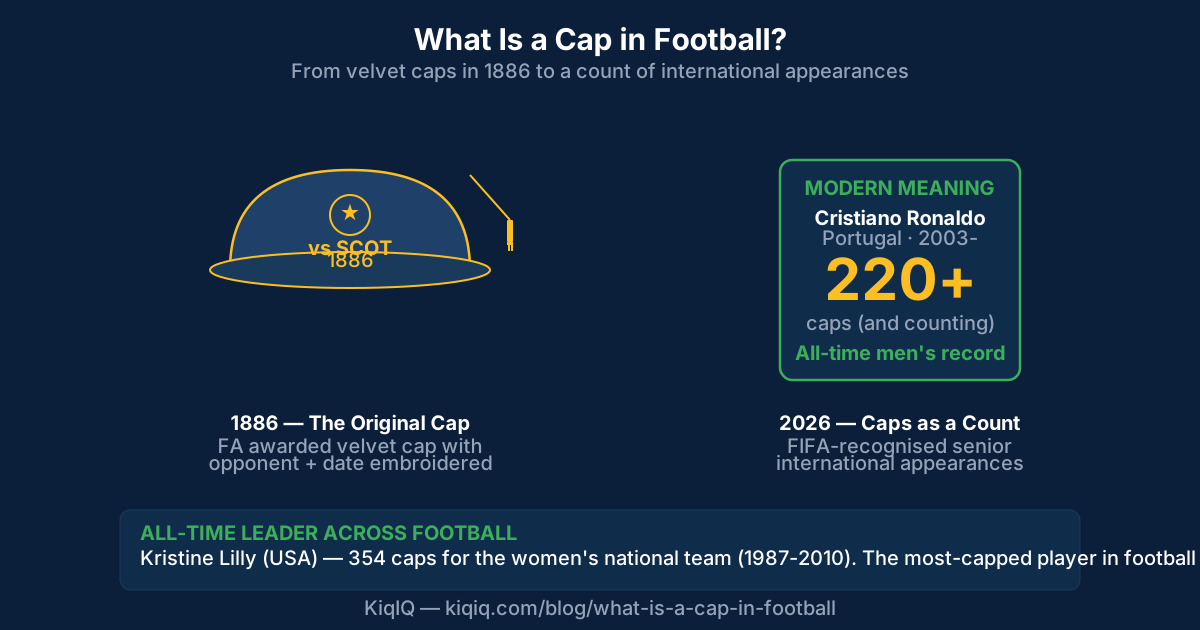
A cap in football is one appearance for a senior national team in an officially recognised international match. The term comes from 1880s English football, when the FA literally awarded players a velvet cap with a tassel after each international appearance. The tradition of giving caps as physical objects continues today (England players still receive a cap for major appearances), but the word has come to mean a count — "Cristiano Ronaldo has 220+ caps" means 220+ international appearances.
The origin of the cap
In 1886, the FA established the rule that all England international players would be awarded a cap as a reward for representing their country. The choice of object was deliberate: caps had been worn by university and public-school sports teams for decades as a mark of belonging. Awarding international players a cap symbolised admission to a national team in the same way.
Early caps were dark blue velvet with the player's opponent and date embroidered on the front in silver thread, plus a tassel. They were heavy, distinctive, and prized possessions. Some players accumulated dozens.
How the term evolved
For roughly the first century, "cap" referred to the physical object. As football professionalised and globalised, the word evolved into a metric — "winning a cap" came to mean appearing in an international, with or without an actual cap being awarded.
Most football associations still award physical caps for major milestones. England awards a cap for every senior appearance. Some FAs award them only for first appearance, or for milestone appearances (50th, 100th, 200th).
"Cap" as a count is now standard global football terminology. "Cristiano Ronaldo has X caps" means X international appearances, regardless of whether a physical cap was issued for each.
What counts as a cap
FIFA's definition: an appearance in a senior international match that meets at least one of these criteria:
- A FIFA World Cup qualifier or finals match.
- A continental confederation tournament (Euros, Copa America, AFCON, Asian Cup, OFC Nations Cup, Gold Cup).
- A friendly between two FIFA member national teams.
- A FIFA-recognised tournament (Confederations Cup historically, Olympic finals for women, Nations League matches).
What does NOT count as a cap
Several appearances are commonly mistaken for caps but do not count under FIFA standards:
- Under-21 / youth international appearances.
- B-team / second-team international appearances (separately recorded as "B-caps").
- Olympic men's tournament appearances (which are U-23 with three over-age players — separate count).
- Unofficial friendlies (a national-team coach's warm-up match against a club side, for example).
The most-capped players in football history
All-time men's international cap leaders (career-end counts where applicable, current as of 2025-26):
- Cristiano Ronaldo (Portugal) — 220+ caps and rising. The all-time leader, surpassing Bader Al-Mutawa in 2023.
- Bader Al-Mutawa (Kuwait) — 196 caps. The previous men's record-holder.
- Soh Chin Ann (Malaysia) — 195 caps (career 1969-1984). Held the record for over 30 years.
- Mohamed Al-Deayea (Saudi Arabia) — 178 caps. Goalkeeper, four World Cups.
- Hossam Hassan (Egypt) — 178 caps. Striker, 1985-2006.
- Sergio Ramos (Spain) — 180 caps as of retirement in 2025.
The most-capped women players
The women's game has many of the most-capped players in the sport overall:
- Kristine Lilly (USA) — 354 caps (1987-2010). Most-capped player in football history across genders.
- Christie Pearce/Rampone (USA) — 311 caps.
- Carli Lloyd (USA) — 316 caps.
- Christine Sinclair (Canada) — 331 caps.
- Birgit Prinz (Germany) — 214 caps.
Cap presentation traditions
Many associations have specific cap traditions:
- England. Players receive a navy velvet cap for each appearance, embroidered with opponent and date. New caps presented at training-ground ceremonies.
- Brazil. First-cap recipients are honoured by team-mates at the post-match changing room — a rite of passage.
- Germany. First-cap recipients receive a special silver cap with their initials engraved.
- United States. Players receive a stars-and-stripes cap for milestone appearances (1st, 50th, 100th, 150th).
Frequently asked questions
- What is a cap in football?
- A cap is one appearance for a senior national team in an officially recognised international match. The term originated in 1886 when the FA began awarding actual velvet caps to England players. Today, the word means a count — "Cristiano Ronaldo has 220+ caps" means 220+ international appearances.
- Who has the most caps in football history?
- For men, Cristiano Ronaldo of Portugal holds the all-time record with 220+ caps and counting. He surpassed Kuwait's Bader Al-Mutawa (196 caps) in 2023. Across all of football, Kristine Lilly of the USA holds the overall record with 354 caps for the women's national team (1987-2010).
- Do under-21 appearances count as caps?
- No. Under-21 and youth international appearances are tracked separately and don't count toward senior caps. Olympic men's tournament appearances also don't count (the men's Olympic competition is U-23 with three over-age players). B-team appearances are recorded as "B-caps" — a separate count from the senior total.
- Are caps still physical objects?
- Yes — many football associations still award physical caps. England issues a navy velvet cap with the opponent and date embroidered for every senior appearance. Germany awards a special silver cap for first appearances. Brazil has a changing-room rite of passage for first-cap players. The physical tradition continues alongside the metric meaning.
References
- The Origin of the Football Cap — The FA
- FIFA International Match Standards — FIFA
- Most-Capped Players in Football History — Wikipedia (verified)
- Kristine Lilly — All-Time Cap Leader — FIFA
Ask KiqIQ a follow-up
Get a live, data-driven answer powered by api-football + KiqIQ's Poisson model. Try one of these prompts or write your own.
Part of pillar
Fundamentals
See every article in this knowledge pillar →
Related
Reviewed by a KiqIQ editor before publication. Spotted an error? Email editor@kiqiq.com — we follow our Corrections Policy.