
Football Club Badges: Symbolism, History, and Identity
Football club badges are visual identity. We explain the symbols, history, and design conventions of crests across Europe — and what they reveal about each club.
 Tap to enlarge
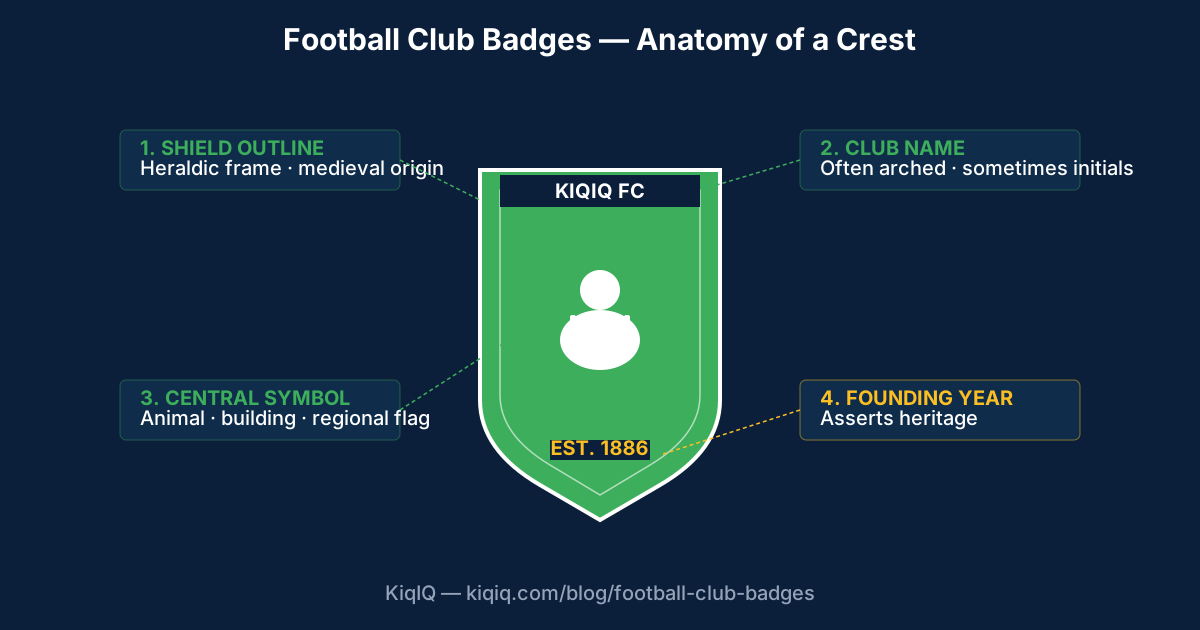
A football club badge is the visual shorthand for a club's history, geography, and identity. Most modern crests share four design components: a shield, the club name, the year of founding, and a symbolic emblem (animal, building, or local reference). The symbols reveal the club's story — Liverpool's Liver Bird is from the city's coat of arms, Tottenham's cockerel commemorates the founder Harry Hotspur's fighting cocks, and Barcelona's Catalan flag asserts regional identity.
The four standard badge components
Most football badges share a recognisable structure:
- Shield outline. A heraldic frame, almost always present. Comes from medieval coat-of-arms tradition.
- Club name or initials. Often arched across the top. Sometimes truncated to initials in modern minimal redesigns.
- Year of founding. A scroll or banner with a date, e.g. "1886" on Arsenal's crest. Asserts heritage.
- Central symbol. An animal, building, or local emblem that ties the club to its city or its founders. The most distinctive element.
The central symbol is the badge's personality. The shield, name, and year are conventions — the symbol is where the club gets specific.
Symbol types and what they mean
Football club badge symbols fall into recurring categories:
- Animals from the local coat of arms. Liverpool's Liver Bird, Watford's hart, Hull City's tiger.
- Animals tied to the founder or area folklore. Tottenham's cockerel (Harry Hotspur), Wolves' wolf head, Brighton's seagull.
- Buildings or geographic features. Crystal Palace's actual Crystal Palace silhouette, Sheffield's arrows from the city's coat of arms, Borussia Dortmund's stylised "BVB" framed in their canary-yellow circle.
- Regional or political symbols. Barcelona's four-bar Catalan flag, Athletic Bilbao's Basque ikurriña-derived elements, Celtic's shamrock for Irish heritage.
- Industry references. Arsenal's cannon (Royal Arsenal munitions factory), West Ham's crossed hammers (Thames Ironworks shipbuilders), Manchester City's pre-2016 ship-and-rose (industrial Manchester).
Modern redesigns and fan backlash
Several major clubs have redesigned their badges in the last 20 years. The patterns:
- Manchester City (2016). Returned to a circular badge with the Manchester ship + rose, after years with a non-circular badge. Generally well-received.
- Juventus (2017). Stripped to a stylised "J" — minimalist, modern, controversial with traditionalists.
- Leeds United (2018). Proposed a fan-saluting figure that was nearly universally rejected; reverted within 24 hours.
- Inter Milan (2021). Stripped to "IM" plus the year — modernist, divisive.
Famous badge stories
Three badges with stories most fans don't know:
- Arsenal's cannon. Originated when the club was Royal Arsenal in Woolwich (1886) — Royal Arsenal was a munitions factory. The cannon has been on every Arsenal crest since 1888 in some form.
- Borussia Dortmund. "Borussia" is the Latinised name of Prussia. The club was named after Borussia beer, brewed by a Dortmund brewery — not directly after the historical region.
- Atlético Madrid's bear and madroño tree. From the official coat of arms of Madrid. The bear (oso) eating the strawberry-tree (madroño) berries is the city's heraldic emblem.
Colour conventions
Badge colours typically match the club's playing kit. Red shields = Liverpool, Manchester United, Arsenal, AC Milan, Bayern Munich. Blue = Chelsea, Manchester City, Inter, PSG, Barcelona (alongside red/yellow). Black + white = Juventus, Newcastle, Borussia Mönchengladbach.
Colour combinations carry cultural weight too. Black + green = Celtic's Irish heritage. Black + yellow = Borussia Dortmund's industrial roots. Red + black stripes = AC Milan's rossoneri identity.
Why badges matter beyond aesthetics
A badge is the most-reproduced piece of club marketing — printed on every shirt, every ticket, every digital asset. Fans associate emotionally with the symbols. Redesigns that attempt to modernise can backfire if they sever historical ties (Cardiff City's brief 2012-15 red rebrand under Vincent Tan is the warning case).
Modern best practice is incremental simplification — keeping the symbol, simplifying the linework. Manchester City's 2016 redesign and Juventus's 2017 refresh both followed this template, with mixed reception. The challenge is honouring heritage while preparing for the digital era of small-screen rendering.
Frequently asked questions
- What do football club badges represent?
- A football club badge is visual shorthand for the club's history, geography, and identity. Most badges share four components: a shield outline, the club name, the year of founding, and a central symbol. The symbol reveals the most about the club — animals from local coats of arms, buildings, regional flags, industrial references, or folklore tied to the founders.
- Why does Tottenham have a cockerel on its badge?
- The cockerel commemorates Harry Hotspur (Sir Henry Percy), a 14th-century English knight who is the namesake of the club. Hotspur was famous for keeping fighting cocks, and his armour featured a cockerel emblem. The cockerel has been on every Tottenham crest since the 1900s.
- Why does Arsenal have a cannon?
- The cannon dates to the club's founding name — Royal Arsenal — when the club was based in Woolwich, South London (founded 1886). Royal Arsenal was a Crown munitions factory. The cannon has appeared on every Arsenal crest since 1888 in some form, becoming the club's defining symbol after they moved to North London in 1913.
- What is the meaning of Atlético Madrid's bear?
- The bear (oso) eating berries from the strawberry-tree (madroño) is taken directly from the official coat of arms of the city of Madrid. The image dates to the 13th century and represents Madrid as both a hunting region (the bear) and a place of natural abundance (the tree). Atlético adopted it to assert its identity as the club of the Madrid working class.
References
- A Brief History of Football Crests — The Athletic
- Heraldry in Football — Design Conventions — FIFA Museum
- Cardiff City 2012-15 Rebrand Case Study — BBC Sport
- Borussia Dortmund Club History — Borussia Dortmund
Key terms in this article
Ask KiqIQ a follow-up
Get a live, data-driven answer powered by api-football + KiqIQ's Poisson model. Try one of these prompts or write your own.
Part of pillar
Football Culture
See every article in this knowledge pillar →
Related
Reviewed by a KiqIQ editor before publication. Spotted an error? Email editor@kiqiq.com — we follow our Corrections Policy.