
Football Transfer Windows Explained: How Buying and Selling Works
The football transfer window is the regulated period when clubs can sign players from other teams. We explain how the windows work, summer vs winter, FIFA TMS, and the deadline-day rituals.
 Tap to enlarge
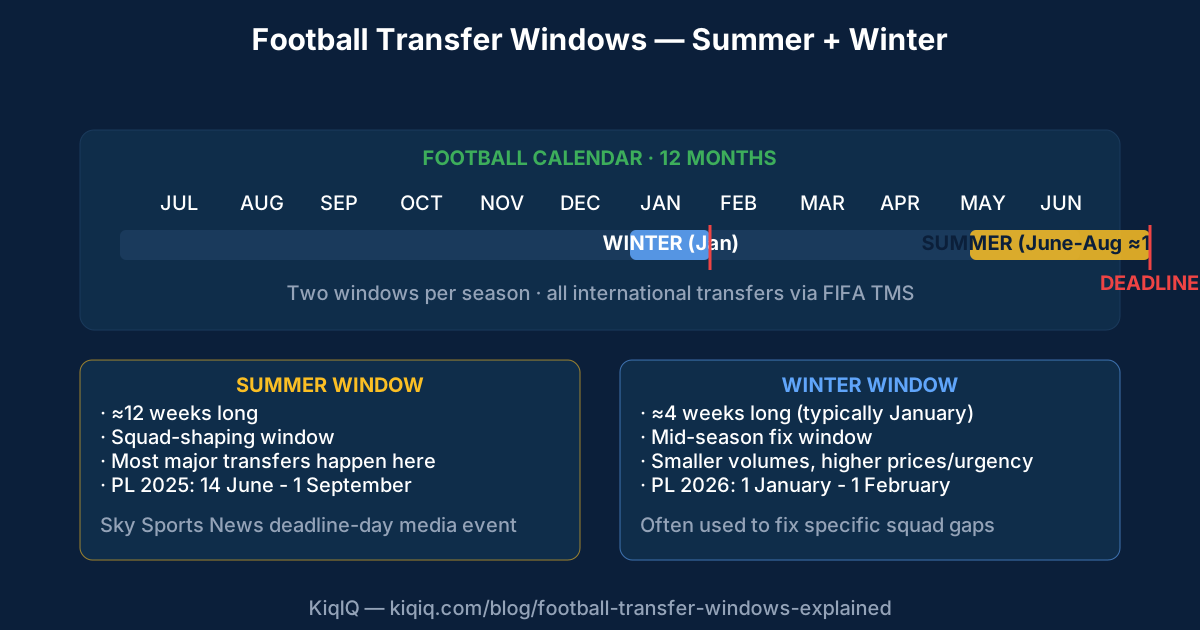
A football transfer window is the regulated time period during which clubs can sign players from other teams. There are two windows per season — a summer window (typically June-August / September) and a winter window (typically January). All international transfers must be processed through FIFA's Transfer Matching System (TMS), and the windows close on a precise deadline that has become a media event in its own right (Sky Sports' Transfer Deadline Day).
Why transfer windows exist
Transfer windows were introduced to:
- Stabilise squads. Without windows, clubs could sign players at any time, disrupting team cohesion mid-season.
- Prevent unfair competitive advantage. A club losing a key player mid-season is forced to manage; without windows, struggling clubs could spend their way out of relegation in March.
- Centralise contract administration. FIFA TMS processes every international transfer in one window, simplifying compliance.
- Provide regulatory clarity. Players, agents, and clubs all know when transfers can happen, reducing background uncertainty.
The two windows: summer vs winter
Different in length and characteristics:
- Summer window. Typically opens early June (Europe) or late June; closes late August or early September. ~12 weeks long. Most major transfers happen here. Squad-shaping window.
- Winter window. Typically January 1 - January 31 (one calendar month). Shorter, with smaller volumes. Used to fix specific problems mid-season — a goalkeeper crisis, a relegation-threatened club bringing in a target striker, etc.
- Premier League example. Summer 2025 window: 14 June to 1 September; winter window: 1 January to 1 February.
- MLS difference. MLS has secondary transfer windows aligned with the calendar-year season — different from European norms.
The Premier League historically had a deadline-day frenzy because the closing time (typically 11pm UK on the deadline day) became a media event with Sky Sports News covering deals minute-by-minute.
How FIFA TMS works
FIFA's Transfer Matching System processes every international transfer:
- Mandatory for international transfers. Domestic transfers within the same federation use league-specific systems.
- Contract upload. Both clubs upload the player contract; FIFA TMS verifies the match.
- Player passport. Each player has a unique FIFA ID; their transfer history is tracked.
- Transfer fee transparency. FIFA TMS receives the agreed transfer fee — though the public sees only what clubs disclose.
- Solidarity payments. FIFA TMS routes solidarity payments to clubs that developed the player between ages 12-23.
Common transfer mechanisms
Five ways clubs sign players:
- Transfer fee. Club pays Club B for the player's registration. Most common.
- Free transfer (Bosman). Player is out of contract; new club pays no fee. (See: Bosman ruling.)
- Loan with option to buy. Player joins on loan; the new club has the option to make the move permanent at the end of the loan period.
- Loan without option. Pure loan — player returns to original club at end of loan.
- Player exchange. Two players swap clubs. Sometimes with a balancing fee.
Deadline-day culture
Sky Sports News popularised "Transfer Deadline Day" in the early 2000s. Modern characteristics:
- Continuous live coverage. Sky Sports and BeIN dedicate full programming to deadline-day deal-tracking.
- Dramatic late deals. Many transfers complete in the final minutes — sometimes due to genuine negotiations, sometimes due to deliberate brinkmanship.
- Fax / DocuSign moments. Deals occasionally fail because paperwork doesn't reach FIFA TMS in time.
- Manager press conferences. Many managers do post-deadline press conferences, often complaining about deals not done.
- Fan culture. Twitter / Reddit transfer rumour threads become major social events.
Recent changes to transfer regulations
Several regulatory developments have altered the transfer landscape:
- FFP / PSR. UEFA Financial Fair Play (now Profit and Sustainability Rules in the Premier League) caps net spending by club revenue. Has reshaped transfer strategy.
- Brexit (2021). UK clubs lost EU free movement; signing EU players now requires work permit.
- Multi-club ownership scrutiny. UEFA has tightened rules on clubs with shared ownership transferring players to each other.
- Squad-size caps. Premier League limits squads to 25 players over age 21 — affects transfer planning.
- Saudi Pro League (2023+). Saudi clubs entering the European transfer market has shifted player wage expectations and transfer fees.
Frequently asked questions
- What is a transfer window in football?
- A transfer window is the regulated time period during which clubs can sign players from other teams. There are two windows per season — a longer summer window (typically June-September, ~12 weeks) and a shorter winter window (typically January, ~4 weeks). All international transfers must be processed through FIFA's Transfer Matching System (TMS).
- When are the football transfer windows?
- Most European leagues follow similar timing. Summer window: typically opens early-to-mid June, closes late August or early September (~12 weeks). Winter window: 1 January to 31 January (~4 weeks). Exact dates vary by league. The Premier League 2025 summer window ran 14 June to 1 September; winter window was 1 January to 1 February.
- What is FIFA TMS?
- FIFA Transfer Matching System — the centralised platform that processes every international football transfer. Both clubs upload the contract; FIFA verifies the match; the player's FIFA ID is updated; transfer-fee solidarity payments are routed to clubs that developed the player between ages 12-23.
- What is Transfer Deadline Day?
- Transfer Deadline Day is the final day of a transfer window — typically a Friday or weekend. Sky Sports News popularised it as a media event in the early 2000s with continuous live coverage. Many transfers complete in the final hours; some fail because paperwork doesn't reach FIFA TMS in time. The Premier League deadline is typically 11pm UK on the closing day.
References
Ask KiqIQ a follow-up
Get a live, data-driven answer powered by api-football + KiqIQ's Poisson model. Try one of these prompts or write your own.
Part of pillar
Football Business
See every article in this knowledge pillar →
Related
Reviewed by a KiqIQ editor before publication. Spotted an error? Email editor@kiqiq.com — we follow our Corrections Policy.