
Transferable Skills in Football Academies: What the IDEA Framework Captures
A 2026 study of 25 academy scholars at English Premier League and Championship clubs identified four transferable skill dimensions developed across the academy journey, Interpersonal, Dependability, Enterprising, Adaptability.
 Tap to enlarge
Most players who pass through a professional football academy do not become professional footballers. The standard estimate is that fewer than 1 in 200 academy scholars reaches a sustained first-team career; the vast majority leave the sport at 18 or 19, often without a clear sense of which non-football skills the academy years actually developed. A 2026 study by Green & Kay at Hartpury University surveyed 25 male academy scholars from eight Premier League and Championship clubs and identified four coherent transferable skill dimensions developed across the academy journey, Interpersonal, Dependability, Enterprising, and Adaptability (IDEA).
The IDEA framework: four dimensions
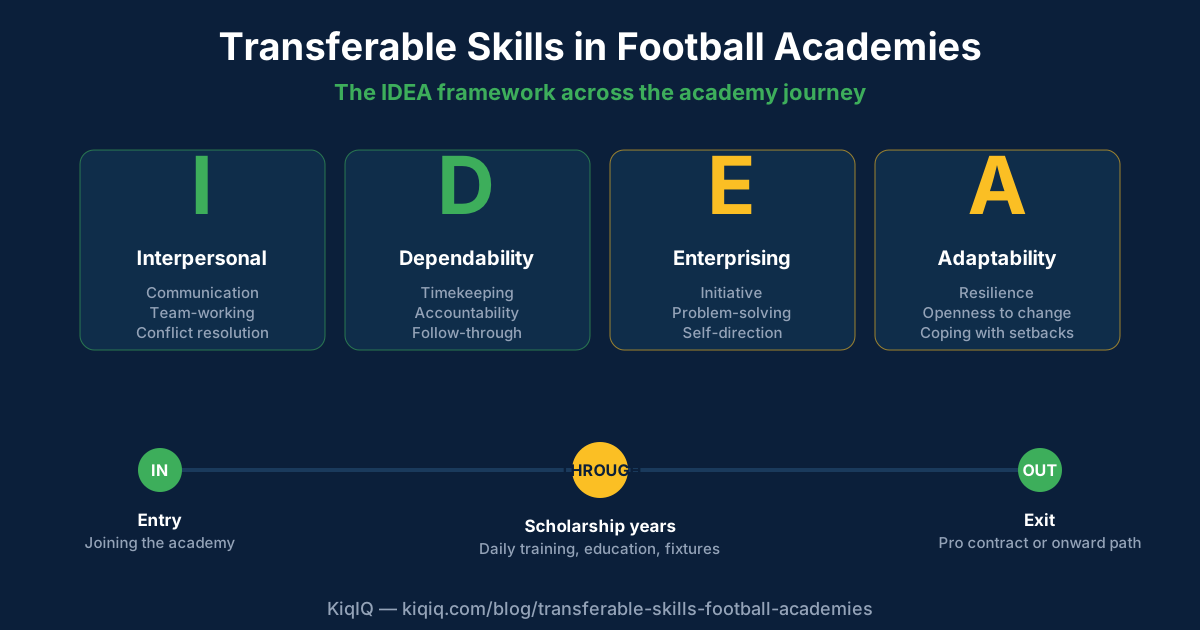
Interpersonal skills cover communication, relationship-building, working effectively in teams of differing experience levels, and adapting to the social dynamics of an environment with constant turnover. Academy scholars spend years operating in changing peer groups (different age bands, different coaches, players cycling in and out of the squad), which the data showed builds interpersonal capability faster than most equivalent non-football environments at the same age.
Dependability covers timekeeping, professionalism, accountability for performance, and the willingness to do the unglamorous work that academy life requires (extra fitness, rehab compliance, video review). Academy environments operate at a higher accountability standard than school does, sessions start on time, attendance is monitored, performance is reviewed weekly, and the dependability dimension is one of the most consistently transferable to subsequent employment contexts.
Enterprising skills cover initiative, self-management, problem-solving under ambiguity, and the willingness to seek opportunities rather than wait for them. The lived experience of academy players includes navigating loan decisions, club moves, contract conversations, and competition for game time, all of which build initiative and problem-solving capacity. The study found this dimension was particularly developed in the "out" phase as players approached the exit point of the scholarship system.
Adaptability covers responsiveness to changing demands, resilience after setbacks, openness to new methods, and the ability to learn rapidly across different coaches' philosophies. Academy scholars typically experience several coaching changes, multiple positional adjustments, and at least one major setback (injury, deselection, transfer block) by the time they finish the scholarship. The adaptability dimension is partly trained by the academy structure and partly self-selected, the players who finish the scholarship tend to be the ones who adapted.
IDEA, Interpersonal, Dependability, Enterprising, Adaptability. Four transferable skill dimensions developed by academy scholars across the in / through / out phases of the scholarship.
In: through, out, the three phases of academy life
The study's second contribution is framing skill development as phase-specific rather than continuous. The "in" phase (entering the scholarship at 16-17) is dominated by interpersonal adjustment, learning the social and professional codes of the academy, establishing relationships with new coaches and peers. The "through" phase (the bulk of the two-year scholarship) is where dependability and adaptability are most actively built, the daily routines, the response to setbacks, the navigation of competition for game time.
The "out" phase (the final months of the scholarship, when the contract decision is approaching) is where the enterprising dimension intensifies. Players are aware of their professional pathway either materialising or not, and the behavioural shifts, proactive conversations with agents, willingness to consider loan moves, exploration of alternative careers, were measurable in the study's interviews. The lived experience reconceptualises life-skill development as phase-specific rather than the generic "academy graduates have good transferable skills" claim that often gets made without specificity.
Why this matters for academies: coaches and players
For academy staff, the framework provides a structured way to embed transferable-skill development into the curriculum rather than leaving it as implicit. The Lived Development of Identity (LDI) contexts of assessment and intervention can be used to make the IDEA principles explicit in the academic provision provided to scholars, the educational hours that already exist alongside the football work. Players can be assessed on the dimensions, not just on football technique.
For coaches, the framework is a reminder that the lived experience of academy life is doing skill-development work even when the explicit curriculum doesn't address it. Encouraging players to articulate what they're developing in each phase makes the implicit explicit, which both helps the players (they can talk about their academy experience as employability evidence later) and helps the coaches (they can see when a player is or isn't developing in a dimension that the academy is implicitly trying to build).
For players themselves, especially those who leave the academy without a professional contract, the framework provides language for talking about what they actually gained. Saying "I was an academy scholar at a Championship club" tells an employer very little; saying "I developed interpersonal capability in mixed-age teams, dependability under daily-accountability standards, and adaptability across coaching changes" tells them something substantive.
Where future research is going
The 2026 study's authors highlighted future research directions that the framework opens up. How do players translate IDEA principles into wider career contexts once they leave the academy? How do stakeholders (coaches, parents, player-care teams) help shape skill development across the transitional phases? Are the four dimensions equally developed across different academy categories (Category 1 vs Category 2)? Do the same patterns hold for women's academies, which were not included in the 2026 sample?
The broader takeaway from the work is that academy environments are doing more developmental work than the win-loss record of their first-team graduates suggests. The vast majority of scholars who don't become professional footballers are leaving with measurable, articulable skills that the academic and employer worlds value. Naming those skills explicitly (through frameworks like IDEA) turns implicit development into explicit human capital.
- I, Interpersonal: communication, team-working, social adjustment across changing peer groups.
- D, Dependability: timekeeping, professionalism, accountability, doing the unglamorous work.
- E, Enterprising: initiative, self-management, problem-solving, opportunity-seeking.
- A, Adaptability: responsiveness to change, resilience after setbacks, learning across coaches.
- Phase-specific: in (interpersonal), through (dependability + adaptability), out (enterprising).
Frequently asked questions
- What transferable skills do football academies develop?
- A 2026 study at Hartpury University identified four core transferable skill dimensions developed across the academy journey: Interpersonal (communication, team-working), Dependability (timekeeping, accountability), Enterprising (initiative, problem-solving), and Adaptability (resilience, openness to change). The framework is known by the acronym IDEA.
- How many football academy players become professional footballers?
- The standard estimate is that fewer than 1 in 200 academy scholars reaches a sustained first-team career. The vast majority leave the sport at 18 or 19. This makes the transferable-skill development question (what academy graduates take into the wider career market) particularly important.
- What does the IDEA framework mean?
- IDEA is an acronym for the four transferable skill dimensions identified in academy scholars: Interpersonal, Dependability, Enterprising, and Adaptability. The framework emerged from a 2026 study of 25 male scholars at eight Premier League and Championship academies who had been through the scholarship system within the previous three years.
- Why is the IDEA framework useful?
- It provides language for naming what academy environments develop in scholars beyond football technique. Coaches can structure the curriculum to make the skills explicit; players can articulate their academy experience as employability evidence when they leave the sport; researchers can compare skill development across academies, countries, and competition tiers.
References
Ask KiqIQ a follow-up
Get a live, data-driven answer powered by api-football + KiqIQ's Poisson model. Try one of these prompts or write your own.
Part of pillar
Player Development
See every article in this knowledge pillar →
Related
Reviewed by a KiqIQ editor before publication. Spotted an error? Email editor@kiqiq.com — we follow our Corrections Policy.