
Mixed Football: Why Playing Boys and Girls Together Develops Better Players
Mixed football is not a goal. It's a development tool. When used intentionally at younger ages, it creates better challenge, more variety, and stronger weekly demands for both boys and girls.
 Tap to enlarge
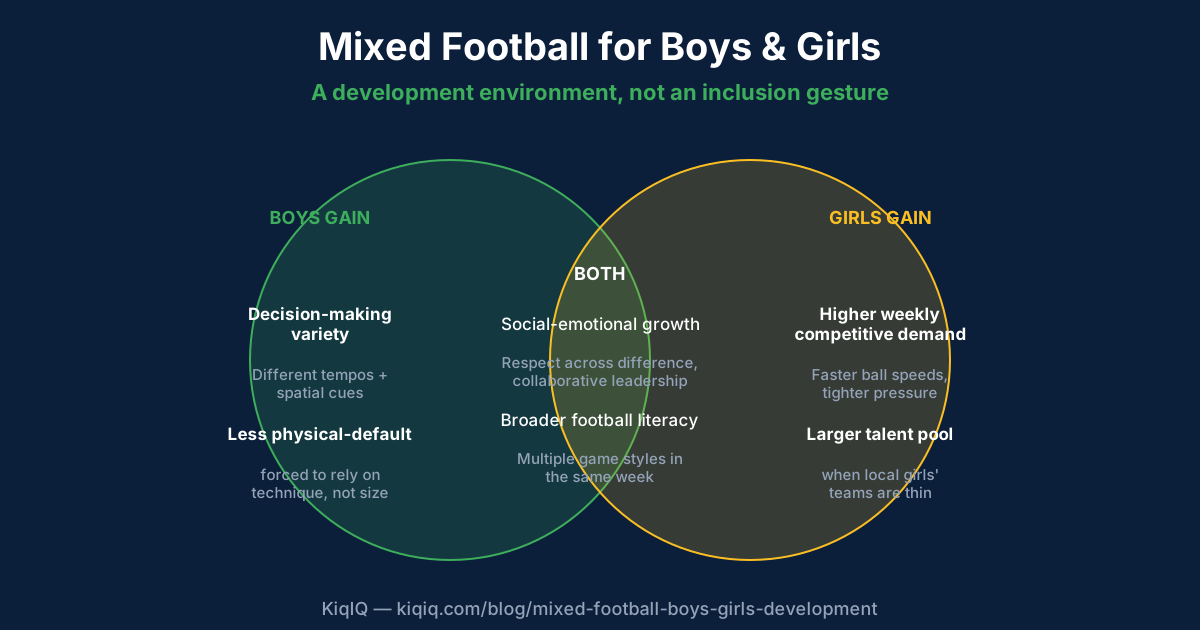
Mixed football, where boys and girls play on the same teams, is too often framed as an access or inclusion question. The frame undersells the case. Mixed football is, used well, a development environment that produces better players across both genders. It creates challenge, variety, and weekly competitive demands that single-gender environments at younger ages often can't consistently provide. The question is not whether mixed football should exist; the question is how to design it deliberately so it serves players rather than reproducing the problems it's meant to solve.
The development case, not the inclusion case
Single-gender environments at younger ages tend to organise children by calendar age, current performance, and gender. That is three layers of imperfect proxies for football potential stacked on top of each other. Current performance is a snapshot, not a forecast: some players are ahead because they're older in the age group, earlier maturing, more confident, or have had more cumulative football exposure. Others may show later because their environment hasn't allowed potential to emerge yet.
Mixed football is one of the most efficient tools for cutting through that pile of proxies. It exposes players to a wider range of decision-making contexts, a broader range of physical match-ups, and a more varied social dynamic than same-gender groupings can offer at the same age. Talented girls in particular gain access to weekly competitive demands that all-girls environments at younger ages can't always provide; the boys gain different team dynamics, broader communication, stronger empathy and collaboration, and exposure to football problems they wouldn't otherwise face.
The female lens: why the player gap is often an environment gap
By ages 14-15, boys and girls of the same calendar age are often comparing very different development realities. Boys may have been in structured club environments since 8, with more training volume, stronger competition, better-resourced coaching, and clearer development planning. Many girls remain in less-resourced contexts for longer, with fewer of those advantages even when interest and ability are equivalent.
What looks like a player gap at 15 is often, mechanically, an environment gap. A girl who has had six years of weekly training at a Category 1 club is going to be ahead of a girl who has had three years of grassroots Saturdays, the same way a boy in identical circumstances would be. Treating the 15-year-old's current level as the predictive signal ignores the environment difference and bakes the gap into the talent-ID system. Mixed football, used at younger ages, partly mitigates this by ensuring the weekly competitive demand is consistent for girls who would otherwise be in thinner environments.
By 14-15, the player gap between boys and girls is often, mechanically, an environment gap. Mixed football at younger ages mitigates this by ensuring the weekly competitive demand is consistent.
Where mixed football goes wrong
Mixed football is not automatically positive. It only works when the environment is designed well. Without strong coaching, inclusive behaviours, safeguarding processes and clear developmental thinking, mixed football can reproduce exactly the problems it's meant to solve. Physical mismatch (especially around puberty), stereotype pressure on both genders, unequal involvement (boys taking the ball more often without coaching intervention), and talent-ID bias toward early-maturing physical dominance can all appear when adults reward current readiness instead of football actions and learning indicators.
The design tests for a mixed environment: are the coaching observations focused on football actions (scanning, decision quality, technique) rather than physical outcome (who won the duel)? Are both genders represented in leadership moments (captain, free-kick taker, voice in tactical discussions)? Is the safeguarding protocol clear and visible? Are puberty-window physical adjustments made (smaller pitches, modified rules, paired training environments) when the physical mismatch becomes meaningful? Without those guardrails, mixed football is just shared space, and the development benefit goes unrealised.
What better talent identification looks like
The corollary of recognising the environment-gap problem is recognising that the talent-ID system needs to be wider, longer, and more behaviour-focused than it currently is. Wider: keep the pool of potential players open for longer, since some players show later. Longer: track players across multiple seasons, not assess them in a single trial. Behaviour-focused: emphasise football actions, learning indicators, and growth trajectory rather than current physical dominance or single-snapshot performance.
This applies regardless of gender, but applies particularly to girls given the environment differential. Re-entry points into elite pathways at 16, 17 and 18, for players who weren't identified at 12, are a structural feature of any female talent system that's been thought through. The same logic supports re-entry points for late-maturing boys, but the magnitude of the effect is larger on the girls' side because the environment gap is larger.
Mixed football is a means, not an end
The point of mixed football is not equality optics, and not even diversity for its own sake. The point is better developmental environments, places where the competitive demand is consistent, the social-emotional learning is broader, and the football challenge is more varied than same-gender alternatives can deliver at younger ages. When mixed football increases challenge, protects safety, strengthens belonging and improves learning conditions, it is one of the most powerful tools available to youth development.
It is not the end-point. Single-gender competition has its own developmental purpose, particularly from late adolescence onward and at the top levels of the game. The mixed-environment argument is about earlier ages, where the variety, the unfamiliar problems, and the broader social dynamic produce better players in both directions. Better environments are the end-point; mixed football is one of several routes there.
- Not an inclusion question: a development environment question.
- Benefits both genders: girls get consistent competitive demands; boys get variety and social-emotional breadth.
- Environment gap explains player gap: at 14-15, the difference is often training volume and resourcing, not ability.
- Design matters: without safeguarding, inclusive behaviour, and football-action-led assessment, the model reproduces its own problems.
- Re-entry points: talent ID systems should support late identification and maturation-adjusted pathways.
Frequently asked questions
- Should boys and girls play football together?
- At younger ages, used intentionally, mixed football can be a powerful development tool. It increases decision-making variety, strengthens social-emotional skills, and ensures consistent weekly competitive demands, particularly for girls in environments that can't always provide them in single-gender form. The case is developmental, not just inclusive.
- What are the benefits of mixed-gender youth football?
- For girls: access to higher-tempo weekly training and matches, broader varieties of football problems, more competitive challenge. For boys: different team dynamics, stronger communication and empathy, exposure to football contexts they wouldn't otherwise face. For both: better social and emotional development, broader peer networks, more inclusive footballing culture.
- When does mixed football stop working?
- Around the puberty window if physical mismatch isn't managed. Without coaching that emphasises football actions over physical outcomes, the environment can favour early-maturing players regardless of long-term potential. Mixed football also fails when safeguarding is weak, when one gender consistently dominates ball involvement, or when stereotype pressure isn't actively countered.
- Why is the 14-15 gap between boys and girls so often an "environment gap"?
- Boys at competitive academy level often have 6+ years of weekly structured training, professional coaching, and clearer development planning by 14-15. Many girls remain in less-resourced contexts longer with fewer of those advantages. What looks like a player gap at 15 is mechanically a cumulative environment gap. Talent ID that ignores this bakes it into the system.
References
- England Football, Girls' football development — The Football Association
- UEFA, Women's Football Strategy — UEFA
Key terms in this article
Ask KiqIQ a follow-up
Get a live, data-driven answer powered by api-football + KiqIQ's Poisson model. Try one of these prompts or write your own.
Part of pillar
Player Development
See every article in this knowledge pillar →
Related
- Smart coaching in youth football →
- Game intelligence in academy football →
- Transferable skills in football academies →
- Pillar: Player Development →
- Football Training Equipment for Academies: A Practical Kit List by Session Type →7 min read
- How a Football Academy Benefits a Club: Sporting, Financial, Cultural →6 min read
Reviewed by a KiqIQ editor before publication. Spotted an error? Email editor@kiqiq.com — we follow our Corrections Policy.