
Perceptual-Cognitive Skills in Academy Football: What "Game Intelligence" Actually Means
A 2026 UK-wide survey of 63 academy coaches found 63% had no formal education in perceptual-cognitive skills assessment. "Game intelligence" gets coached on instinct — here's what the research says it should look like.
 Tap to enlarge
Every academy coach who has been asked what they look for in a young player will mention "game intelligence" or "football IQ" — the cluster of perceptual-cognitive skills (PCS) that separates the player who reads the next phase of play from the one who reacts to it. A 2026 peer-reviewed survey of 63 UK academy coaches across Category 1-3 clubs and every development phase (U9 to U23) confirmed how universally coaches value these skills — and also how unevenly they're defined, assessed and developed across the country.
The four components of perceptual-cognitive skill
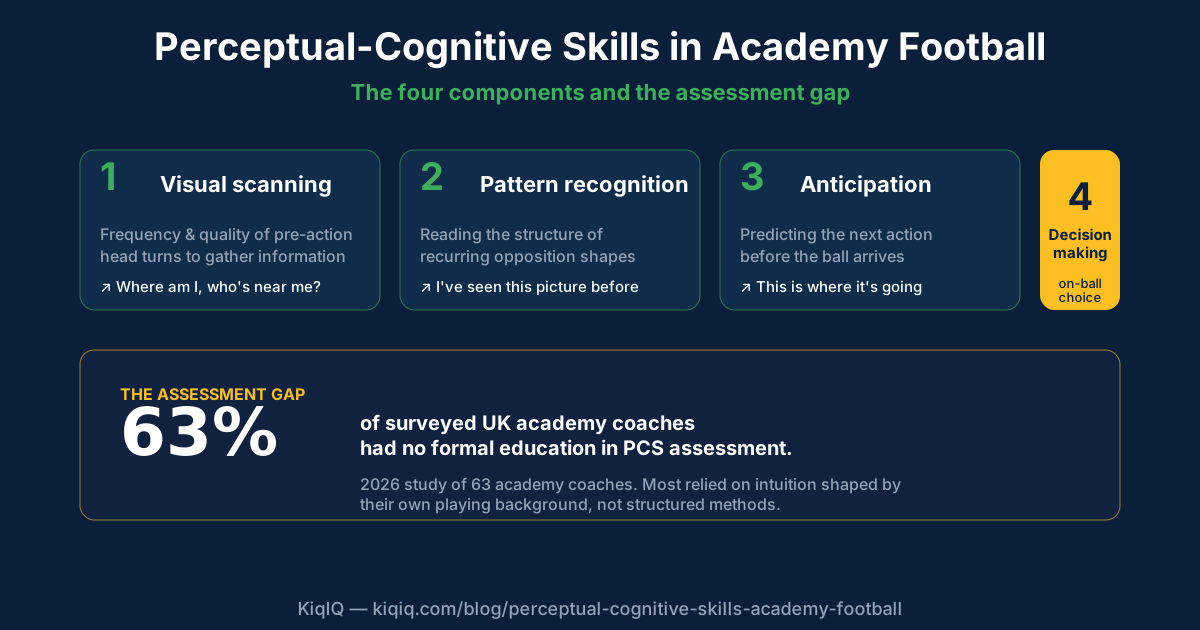
The research literature on PCS in football typically breaks the construct into four interrelated components: visual scanning (how often and how widely a player checks their surroundings before receiving), pattern recognition (how quickly familiar tactical situations are categorised), anticipation (forecasting opponent and teammate actions before they happen), and decision-making (selecting the option with the best expected outcome under time pressure). Each is partly trainable and partly bound up with playing experience.
The four work together rather than independently. A player with elite scanning but poor pattern recognition gathers information they can't use; a player with strong anticipation but weak decision-making sees the moment but plays the wrong option. The best academy-graduate players tend to score above average on all four — and the academy environments most successful at producing them deliberately train each component rather than treating the whole construct as a single trait.
What the 2026 survey of UK academy coaches found
Sixty-three coaches across U9-U23 development phases at Category 1-3 academies were surveyed on how they define, identify and assess PCS. The findings cluster around three themes that academies will want to address. First, coaches almost universally view PCS as vital for long-term player development. Second, definitions vary significantly between coaches and between clubs — there is no shared technical vocabulary. Third, most coaches feel confident identifying PCS despite low formal familiarity, which the authors note suggests heavy reliance on intuition rather than structured methods.
The most-cited specific number: 63% of surveyed coaches reported no formal PCS-specific education. Those who had received training mostly referenced a single FA coaching course. Influences on how coaches assess PCS came primarily from personal playing experience and informal learning networks, not from formal education — which produces inconsistency between clubs in what "game intelligence" actually means and how it's observed.
63% of the 63 surveyed academy coaches reported no formal education in perceptual-cognitive skills assessment. Most rely on intuition shaped by their own playing background, not structured methods.
Why the lack of shared language matters
When coaches at the same club describe the same player's "game intelligence" using different criteria, talent identification becomes unreliable. A U13 player flagged as "intelligent" by one coach because they scan widely may be flagged as "not intelligent" by another coach who values decision speed over breadth of information gathering. The same player gets different development pathways depending on whose assessment lands first.
The research literature has been pointing at this problem for over a decade. Recent calls — including the 2026 survey's own conclusions — argue for the development of shared technical vocabularies, more accessible CPD modules specifically on PCS assessment, and practical observational tools that ground the construct in measurable behaviours rather than intuition. The current state is closer to art than science; the recommendation is to move it closer to the latter without losing the contextual judgement coaches bring.
How clubs can address the gap
Three practical steps emerge from the survey findings. First, establish a club-wide PCS vocabulary — a one-page definition document agreed by the academy coaching staff, defining what each component means in operational terms. Second, invest in formal CPD for coaches on PCS assessment, ideally via a structured course rather than one-off workshops. Third, build observation tools that anchor assessments to specific behaviours (number of head-checks before receiving, number of progressive passing options identified, time-to-decision under pressure) rather than holistic gut-feel ratings.
None of this replaces coach intuition — the contextual judgement an experienced coach brings is irreplaceable. What it does is reduce the gap between assessments from different coaches at the same club, between assessments at different clubs, and between assessments and the academic literature's growing evidence base. Players move through academies more consistently when the people assessing them share a vocabulary.
- Visual scanning — frequency + breadth of head-checks before receiving the ball.
- Pattern recognition — speed at which familiar tactical situations are categorised.
- Anticipation — forecasting opponent and teammate actions.
- Decision-making — option selection under time pressure.
- Coaching implication — shared vocabulary + structured CPD + behavioural observation tools beat pure intuition.
Frequently asked questions
- What is game intelligence in football?
- Game intelligence is a colloquial term for perceptual-cognitive skills (PCS) — the cluster of cognitive abilities that allow a player to read the game effectively. It typically includes visual scanning, pattern recognition, anticipation, and decision-making under pressure.
- Can perceptual-cognitive skills be trained?
- Yes, but each component is partly trainable and partly bound up with cumulative playing experience. Visual scanning and pattern recognition respond well to structured drills (scan-frequency cues, situational repetition). Anticipation and decision-making improve with high-pressure, representative practice that closely mirrors match contexts. Pure cognitive-training apps have less evidence of transfer than football-specific work.
- Why is there no shared definition of "game intelligence" across academies?
- A 2026 UK academy survey found 63% of coaches had no formal education in PCS assessment and most relied on intuition shaped by their own playing background. Without shared technical vocabularies or standardised observation tools, the same player can be rated very differently by two coaches at the same club, let alone across clubs.
- How should academies improve PCS assessment?
- Three steps: establish a club-wide PCS vocabulary as a one-page agreed definition; invest in formal CPD for coaches on PCS assessment via structured courses; build observation tools that anchor ratings to specific behaviours (number of head-checks, time to decision) rather than gut-feel holistic ratings.
References
- Triggs et al. (2026) — Perceptual-Cognitive Skills in Talent Development Environments — Frontiers in Psychology
- England Football — DNA coaching curriculum — The Football Association
Ask KiqIQ a follow-up
Get a live, data-driven answer powered by api-football + KiqIQ's Poisson model. Try one of these prompts or write your own.
Part of pillar
Player Development
See every article in this knowledge pillar →
Related
- Smart coaching in youth football →
- Transferable skills in football academies →
- How football academies benefit clubs →
- Pillar: Player Development →
- Mixed Football: Why Playing Boys and Girls Together Develops Better Players →6 min read
- Football Training Equipment for Academies: A Practical Kit List by Session Type →7 min read
Reviewed by a KiqIQ editor before publication. Spotted an error? Email editor@kiqiq.com — we follow our Corrections Policy.