
Smart Coaching in Youth Football: What Actually Changes Player Outcomes
The coaching decisions that matter most in youth football are rarely about drills or tactics — they're about how the coach pays attention. Five evidence-aligned habits that compound across a season.
 Tap to enlarge
The honest version of "smart coaching" in youth football has very little to do with elaborate periodisation or premium analytics platforms. It is built from how the coach pays attention — to the person, to the game-state, and to what each session actually teaches. Five habits that compound across a season are doing more for player outcomes than almost anything else an under-resourced coach could spend money on, and they're all free.
Treat the person before the player
A player's performance on any given week is downstream of what's happening off the pitch — school, family, sleep, social pressure, identity. The coach who knows which kid is going through a parents' separation, which kid is overloaded by a music exam, and which kid hasn't been picked for the school team is doing emotional triage that any subsequent technical correction has to land inside. Coaching that ignores the person is at best half-finished; at worst, it tells the player that the only thing the adult cares about is the result they produce.
Practically, this means the first five minutes of training are conversational, not tactical. It means a coach who asks "how was your week?" and means it. It means knowing each player well enough to spot when their normal animation drops, and following up later that day, not three weeks later when the form has visibly cratered.
Ask before you tell
The default move in youth coaching is to fix a mistake by instructing the correct action. The better move is to ask the player what they saw, what option they considered, and what they'd try next time. Reflection is what consolidates learning into transferable patterns; instruction tends to produce compliance on the next rep and amnesia by Saturday.
A pointed question — "what was the first defender doing when you tried that pass?" — does three things at once. It centres the player's perception, it surfaces the actual decision criterion they used, and it leaves the answer with them. Players who reflect their way to a fix retain it. Players who are told the fix retain the telling, not the fix.
Design for transferability, not the drill itself
The training session is a vehicle, not a destination. Every drill should be assessed against one question: does the game state, decision space, and pressure profile look meaningfully like the moments this skill needs to surface on Saturday? An unopposed passing drill teaches mostly itself. A 4v4+2 in a constrained half-pitch teaches scanning, body shape under pressure, and progressive passing — which is what the player actually needs to do at the weekend.
The principle is well-supported by motor-learning research and by every coaching qualification framework that has updated itself in the last fifteen years: representativeness of the practice environment is the single biggest variable in whether a skill transfers. If the practice doesn't look like the game, the practice probably isn't teaching the game.
Surface values, then measure how well you're surfacing them
Every youth coach will say their programme values respect, effort, accountability and resilience. Fewer can say when and how those values were explicitly named in last week's sessions, or which player was singled out for demonstrating them. Values that aren't verbalised and observed go invisible to the player. The session plan should treat value-naming as a deliberate item — three minutes at the start to name what "great effort" looks like today, three minutes at the end to call out who showed it.
A short coaching journal, updated within an hour of the session ending, captures which players got recognised, for what, and when. Patterns emerge fast: which players always get praised for the same trait, which players never get praised at all, which traits the coach consistently misses. Measuring this is what turns values from a brochure line into something the squad actually experiences.
Be the coach you needed at that age
The single most useful test of a coaching decision is whether the version of the coach who was once a player at this age would have wanted to be coached this way. The coach who remembers being yelled at for a misplaced first touch tends to be slower to yell. The coach who remembers being substituted at half-time without explanation tends to explain the substitution. The coach who remembers feeling invisible tends to make sure no player feels invisible.
This isn't softness. It's a memory-based audit of the actual emotional consequences of common coaching habits. Most adult coaches were once 11-year-olds whose love of the game survived their early coaches by accident rather than design. The legacy that compounds across a coaching career is the players who kept playing — and who keep playing because they associate the sport with feeling seen, stretched and supported, in roughly that order.
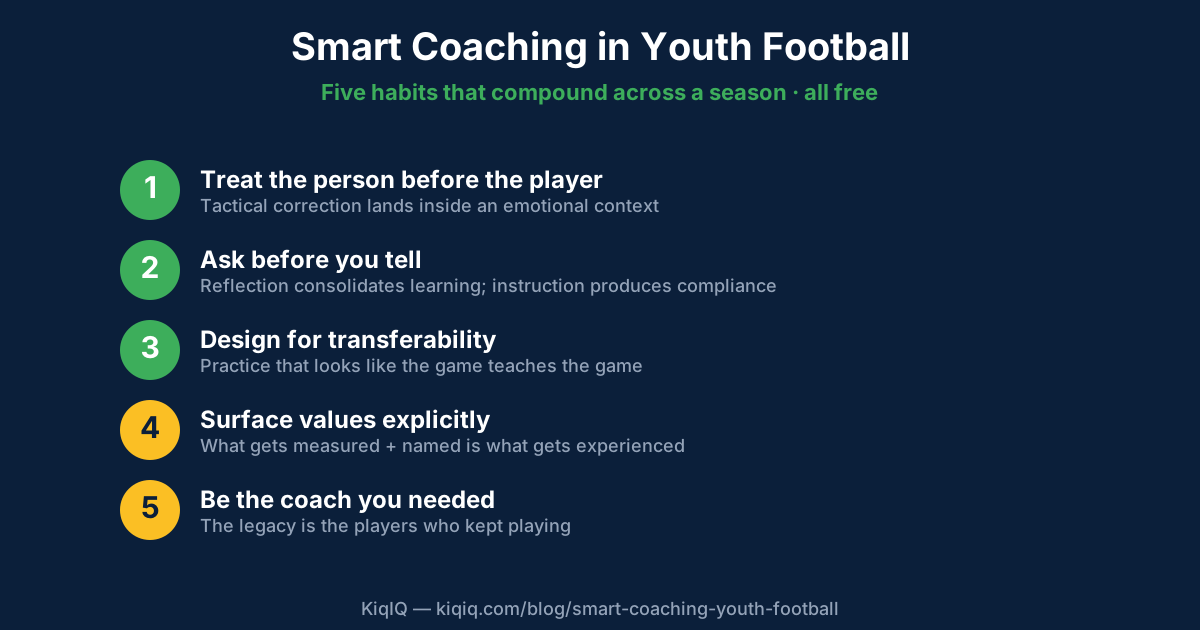
- Know the person first. Tactical correction lands inside an emotional context — know the context.
- Ask before you tell. Reflection consolidates learning in a way instruction does not.
- Design for transferability. Practice that doesn't look like the game probably doesn't teach the game.
- Surface values explicitly. What gets named and observed is what players experience.
- Coach as the adult you needed. The legacy is the players who kept playing.
Frequently asked questions
- What makes a youth football coach effective?
- Five recurring habits separate effective youth coaches from average ones: knowing the player as a person before the athlete, asking reflective questions rather than instructing fixes, designing practice environments that look like the actual game, naming and recognising values explicitly each session, and coaching as the adult that the coach themselves needed at that age. None require extra resources.
- Why does asking questions beat giving solutions in coaching?
- Reflection consolidates learning into transferable patterns; instruction tends to produce compliance on the next repetition and forgetting by the next match. A pointed question after a mistake forces the player to surface their own decision criterion, which is what actually changes the next decision. Telling them the answer leaves the answer with the coach.
- What is "transferability" in football coaching?
- Transferability is the degree to which a skill learned in training surfaces in a match. It is highest when the practice environment closely matches the game environment in decision space, pressure, opposition, and pace. An unopposed passing drill has low transferability; a constrained-space small-sided game with realistic defenders has high transferability.
- How do you measure values in youth football?
- Decide which 3-4 values the programme is targeting (effort, respect, accountability, etc.), name them explicitly at session start, observe them deliberately during the session, and recognise specific players publicly at session end. Keep a brief coach journal listing which players got recognised for which value across the week — patterns of who never gets recognised surface fast.
References
- England Football — DNA coaching principles — The Football Association
- UK Coaching — How great coaches give feedback — UK Coaching
Ask KiqIQ a follow-up
Get a live, data-driven answer powered by api-football + KiqIQ's Poisson model. Try one of these prompts or write your own.
Part of pillar
Player Development
See every article in this knowledge pillar →
Related
- How football academies benefit the club →
- Game intelligence in academy football →
- Pillar: Player Development →
- How to Run a Grassroots Football End-of-Season Presentation Evening →8 min read
- Transferable Skills in Football Academies: What the IDEA Framework Captures →6 min read
- Training the Free Kick: Why Inflatable Walls and Dummies Beat Cones →6 min read
Reviewed by a KiqIQ editor before publication. Spotted an error? Email editor@kiqiq.com — we follow our Corrections Policy.