
How a Football Academy Benefits a Club: Sporting, Financial, Cultural
A working football academy returns value to its parent club across five distinct dimensions — sporting, financial, cultural, strategic and global. Here's how the maths actually works for an EFL or Premier League club.
 Tap to enlarge
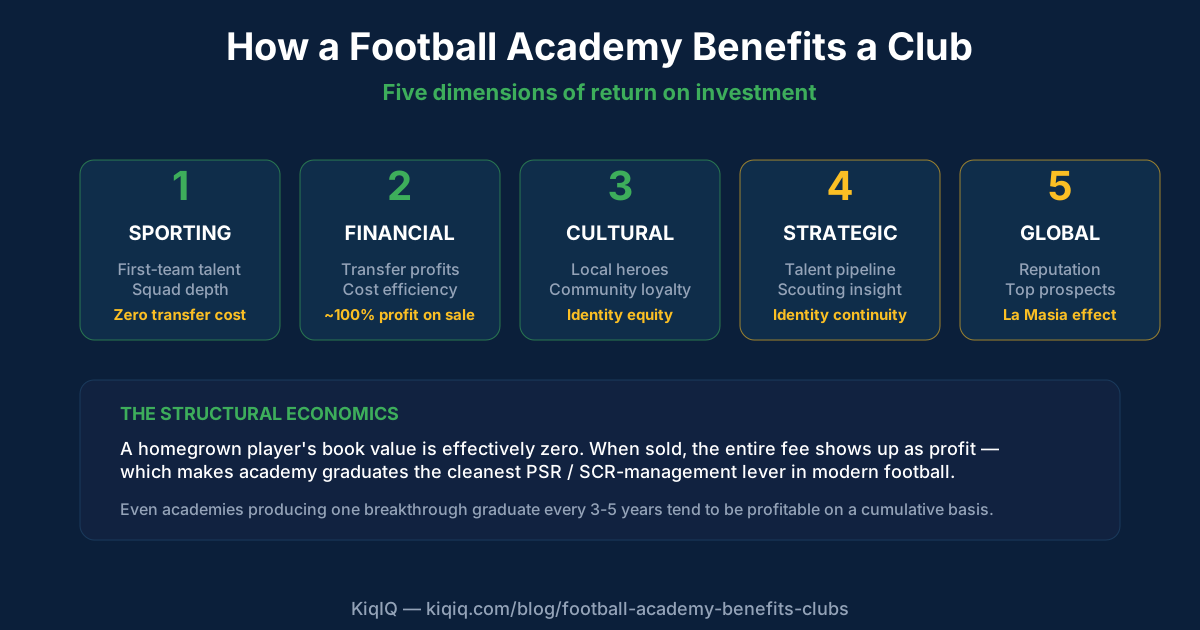
The academy line on a football club's budget is one of the easiest items for a finance director to question. It costs eight figures a year at Category 1 level, the return horizon is five to fifteen years, and most players who pass through never reach the first team. Yet the clubs that have committed seriously to academy investment — Chelsea, Manchester City, Borussia Dortmund, Real Madrid's Castilla, Sporting CP's Alcochete — return value across five dimensions that the budget line's "cost" framing fails to capture. Understanding all five is what separates an academy that's an expense from one that's an asset.
Sporting: first-team talent + squad depth
The most visible benefit. An academy that promotes one or two senior-squad-quality players per generation transforms the parent club's squad-build economics. Phil Foden cost Manchester City less than the agent fee on an equivalent external signing; Bukayo Saka cost Arsenal nothing in transfer fee at all. Across a decade the cumulative saving runs into hundreds of millions for the elite academies.
The second-order benefit is squad depth without squad cost. Even academy graduates who don't become first-team starters provide cup-rotation cover, training-ground intensity, and an option-value if a senior player departs unexpectedly. That depth is invisible until injury hits — and then it's the difference between a season that continues and one that collapses.
Financial: transfer profits + cost efficiency
The clearest accounting benefit comes from player sales. Under standard accounting treatment, a homegrown player's book value is roughly zero — there's no transfer-fee amortisation balance to subtract. When that player is sold, the entire fee shows up as profit. The benefit is so structural that several Premier League clubs (Chelsea most prominently) have run their PSR position by treating academy graduate sales as a near-automatic profit lever every summer window.
The compounding effect on cost efficiency is similar. Importing equivalent talent from elsewhere costs both the transfer fee (amortised over the contract) and a wage premium against an unproven academy graduate. Even when the academy produces only one or two senior contributors per generation, the savings against the alternative external recruitment cost are often larger than the academy's annual operating budget.
Homegrown player sales appear as almost pure book profit because the player's carrying value is effectively zero. That accounting treatment makes academy graduates the cleanest PSR / SCR-management lever in the modern Premier League.
Cultural: local heroes + community loyalty
An academy graduate who breaks into the first team carries cultural weight that no external signing replicates. They were a fan; their family is from the city; their school is local. The mental short-cut for the supporter base is that the player represents the club in a way a Brazilian winger signed in July from Cruzeiro cannot. That representation matters for season-ticket renewals, for matchday atmosphere, for the willingness of the fanbase to absorb a difficult result.
Local-hero pathways also create longer-term equity in the local community pipeline. Parents enrolling six-year-olds in pre-academy programmes can point to a specific graduate who walked the same path. That continuity feeds the bottom of the development funnel for the next generation.
Strategic: pipeline + scouting insight
A well-run academy is also a structured market-research operation. Coaches and recruitment staff watch hundreds of opposition academies, regional grassroots leagues, and international youth tournaments every season. The intelligence about which 14-year-olds are developing fastest, which clubs are sleeping on undervalued talent, and which international markets are producing surplus players feeds the senior recruitment process directly.
The pipeline also serves as a development environment for the first team's identity. A club committed to possession-based football can coach 9-year-olds in the same principles, building a 15-year continuity that makes integration into the first team faster when a graduate is finally promoted. The opposite — academies coached one way, first team playing another — produces the all-too-common outcome where graduates struggle on debut and get loaned out indefinitely.
Global: reputation + top prospects
The reputational benefit compounds slowly but durably. A club known for producing players — La Masia, Ajax, Sporting CP — becomes the destination of choice for international teenage prospects choosing between five offers. That self-reinforcing effect raises the academy's ceiling and lowers the cost-per-prospect of attracting top young talent. The most-cited example is Lionel Messi's decision to join La Masia at 13 over more financially attractive options; the second-most-cited is Ronaldo at Sporting.
Reputational equity also unlocks commercial partnerships. Adidas's long-term tie-up with Real Madrid Castilla, kit-supplier deals that extend to academy teams, and the licensing of the academy methodology to overseas clubs all add revenue lines that an academy without that reputation can't access. The numbers are smaller than first-team commercial revenue but compound over decades.
- Sporting — graduates fill first-team squad slots at zero transfer cost.
- Financial — graduate sales appear as almost pure book profit; carrying value is effectively zero.
- Cultural — local heroes carry community loyalty that imports cannot.
- Strategic — academy doubles as a scouting + identity-development pipeline.
- Global — reputation attracts top international prospects; methodology can be licensed.
Frequently asked questions
- What are the main benefits of a football academy to its parent club?
- Five dimensions of value: sporting (first-team talent at zero transfer cost), financial (graduate sales appear as almost pure book profit because carrying value is effectively zero), cultural (local heroes drive community loyalty), strategic (scouting insight + identity development from age 9 upward), and global (academy reputation attracts top international prospects).
- Why are homegrown players so valuable on the balance sheet?
- Under standard football accounting, an academy graduate's book value is effectively zero — there's no amortising transfer-fee balance. When the player is sold, the entire fee appears as profit. This makes academy sales the cleanest tool clubs have for managing Profit and Sustainability Rule (PSR) and the new Squad Cost Ratio (SCR) frameworks.
- How long does it take an academy to pay back its investment?
- At Category 1 level, breakeven typically takes 8-12 years from the start of structured operations. The first generation of graduates needs to reach senior level and either contribute on the pitch or be sold. Academies that get one breakthrough graduate every 3-5 years tend to be profitable on a cumulative basis; those that don't typically run as net costs offset by other benefits.
- What's the difference between a Category 1 and Category 2 academy?
- Category 1 academies have the largest staffing, training-ground, and player-recruitment budgets, with full age groups from U9-U23, and broader recruitment reach. Category 2 is one tier down — smaller scope, narrower recruitment radius, more cost-conscious operations. Category 3 academies operate at the EFL's second tier of investment and below. The EPPP (Elite Player Performance Plan) defines the categorisation.
References
- Premier League — Elite Player Performance Plan (EPPP) — Premier League
- CIES Football Observatory — Academy production rankings — CIES Football Observatory
Key terms in this article
Ask KiqIQ a follow-up
Get a live, data-driven answer powered by api-football + KiqIQ's Poisson model. Try one of these prompts or write your own.
Part of pillar
Player Development
See every article in this knowledge pillar →
Related
- Smart coaching in youth football →
- Game intelligence in academy football →
- Transferable skills in football academies →
- Pillar: Player Development →
- Football Training Equipment for Academies: A Practical Kit List by Session Type →7 min read
- Mixed Football: Why Playing Boys and Girls Together Develops Better Players →6 min read
Reviewed by a KiqIQ editor before publication. Spotted an error? Email editor@kiqiq.com — we follow our Corrections Policy.