
Tatran Čierny Balog: The Football Pitch With a Steam Train Running Past the Touchline
Tatran Čierny Balog's ground in central Slovakia has the Čiernohronská železnica narrow-gauge railway running along one touchline — steam locomotives pass within a few metres of the pitch during matches. Here's why it exists, how it works on matchday, and what tier the village club plays in.
 Tap to enlarge
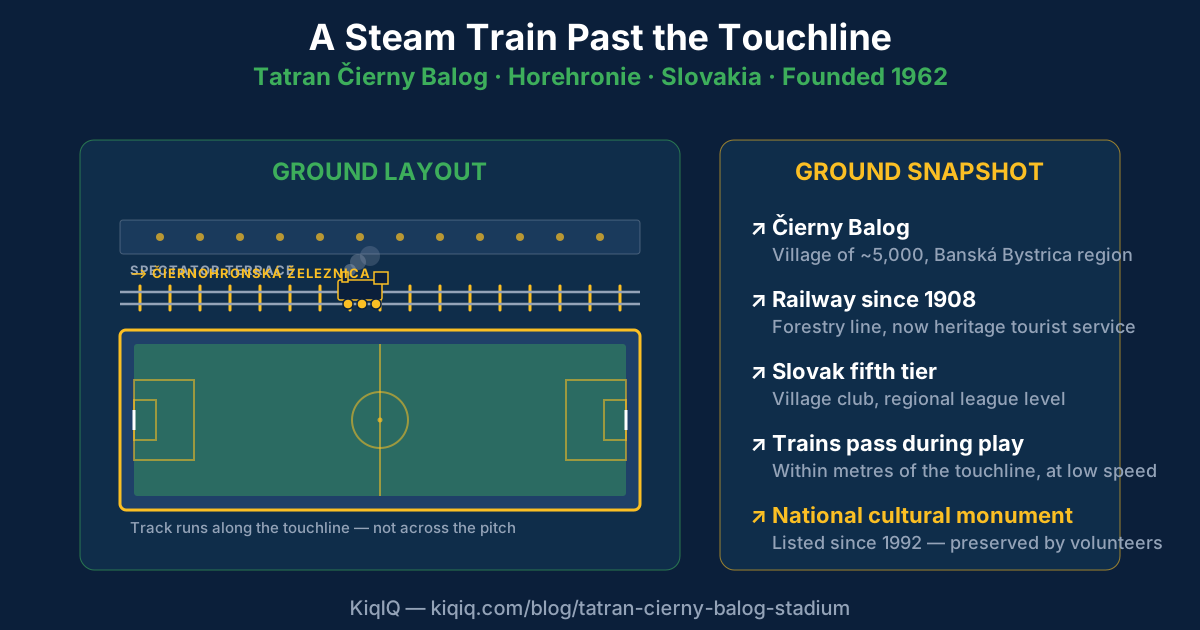
Tatran Čierny Balog's ground in the Horehronie region of central Slovakia is the village football pitch where a working narrow-gauge railway runs along one touchline — steam locomotives pass within a few metres of the playing surface, between the spectator terrace and the pitch itself, while matches are in play. The Čiernohronská železnica line — a 19th-century forestry railway turned heritage tourist attraction — was there long before the football club, which is why the pitch was laid out tight against the track rather than the other way round.
The setup, briefly
Tatran Čierny Balog is the village football club of Čierny Balog, a settlement of roughly 5,000 people in the Banská Bystrica region of Slovakia. The club plays at a small ground next to the village school, and the Čiernohronská železnica's narrow-gauge line — built in 1908 to haul timber out of the surrounding forests — runs along one touchline, sandwiched between the timber spectator terrace and the pitch itself.
The track is still in active use. Heritage steam and diesel locomotives run scheduled tourist services along the line throughout the summer. Trains pass within a few metres of the touchline while matches are in progress; the engine's smoke and whistle are part of the matchday experience rather than something to schedule around. The popular caption that "a train crosses the pitch" is wrong — the track has always run alongside, not over, the playing surface.
The pitch was built around the railway, not the other way round. The Čiernohronská železnica opened in 1908; organised football in Čierny Balog came decades later — which is why the pitch sits tight against the track rather than the track being routed around the pitch.
Why the track is there at all
The Horehronie valley is one of the most heavily forested parts of Slovakia, and from the late 19th century into the post-war period its economy revolved around timber. The Čiernohronská železnica — literally "Čierny Hron Railway" after the river that runs through the valley — was built as a logging line to move felled timber from the upper valley to the sawmill at Hronec. At its peak, the network had more than 130 km of narrow-gauge track threading through the forests.
Most of that network was lifted in the 1980s once road haulage took over, but the section running through Čierny Balog village was preserved by local volunteers and now operates as a heritage railway, listed as a national cultural monument since 1992. The pitch sits where it does because the village school, the football ground and the main railway line are all clustered along the same flat strip of valley floor — the only practical building plot in a steep, wooded landscape. With nowhere else flat to put it, the ground was levelled hard up against the existing track.
Match-day logistics
There is no scheduling drama. Heritage trains run to the published timetable through the summer tourist season; matches kick off when matches kick off. When a service is due, the locomotive trundles past the touchline at low speed, often with the driver waving and tourists pointing cameras out of the carriage windows. Play continues. The smoke drifts across the pitch, the whistle goes off as the loco passes, and the goalkeeper on the railway side gets a temporary cloud of steam over his goalmouth.
For visiting players the routine is the standard one for any village ground in Slovakia's lower tiers — a small clubhouse with a bar, a terraced area along the railway-side touchline, and a hand-operated scoreboard. The track sits a few metres beyond the touchline, with a low boundary fence between the rails and the spectator terrace. Players are warned at the team-talk that the railway side is the same as any tight touchline: a heavy first touch and the ball is on the ballast.
The ground has no formal capacity but easily holds the few hundred spectators a regional fixture might draw. Tourists riding the railway during summer often disembark at the village halt to watch a few minutes of the match — frequently more visitors than locals on a sunny afternoon.
- Track runs along one touchline, not across the pitch
- Trains pass within a few metres of the playing surface during matches
- Spectator terrace sits between the rails and the pitch on one side
- Regional summer-tourism crowd often outnumbers village locals
Where the club actually plays in the league pyramid
TJ Tatran Čierny Balog plays in the regional Slovakian league system rather than the professional pyramid. The club has spent most of its modern history in the fifth tier (V. liga) of Slovakian football — the regional adult league for the Banská Bystrica region — with occasional spells one tier up or down depending on form and reorganisations of the regional structure.
Slovakia's top two tiers (Slovak Super Liga and 2. liga) are professional. Below that the Slovak FA runs the 3. liga (semi-professional regional level), then four further amateur tiers including the V. liga where Tatran most often features. The club is a community institution rather than a competitive one; survival, not promotion, is the typical season goal.
How to visit
The simplest route is to take the heritage train itself. Čiernohronská železnica services run from Chvatimech (the main-line interchange near Hronec) up the valley to Čierny Balog, with a stop at the Vydrovo open-air forestry museum a few minutes' walk from the football ground. Match fixtures are listed on the club's social channels and the village notice board; the regional FA publishes the V. liga schedule on its site.
The ground is open year-round and is photogenic regardless of whether a match is on. The combination of the steam locomotive, the goalposts and the forested valley walls behind has made it one of the most-photographed football grounds in central Europe — a cult fixture on "weirdest stadiums" lists since photographs of it first circulated widely in the 2010s.
Frequently asked questions
- Does a train really cross the pitch during matches?
- No — and the popular caption that says it does is wrong. The Čiernohronská železnica narrow-gauge line runs along one touchline, between the spectator terrace and the playing surface. Steam locomotives pass within a few metres of the pitch during matches, but the track has never crossed the playing surface itself.
- What league does Tatran Čierny Balog play in?
- Tatran Čierny Balog typically plays in the V. liga, the fifth tier of the Slovak football pyramid for the Banská Bystrica region. It is an amateur regional league rather than part of Slovakia's professional structure (Super Liga and 2. liga).
- Why is there a railway next to a football pitch in Slovakia?
- The Čiernohronská železnica narrow-gauge line was built in 1908 to haul timber out of the Horehronie valley's forests, decades before the village football pitch was laid out. With flat land scarce in the steep, wooded valley, the pitch was levelled hard up against the existing track — which is why the railway now runs immediately alongside one touchline.
- Can tourists watch matches at the ground?
- Yes. The ground is open, fixtures are listed publicly, and the heritage railway stops at the village. Summer tourists riding the train often disembark to watch a few minutes of any match in progress before continuing up the valley.
- Is the railway still operational?
- Yes — the section through Čierny Balog is run as a heritage railway and listed as a Slovak national cultural monument since 1992. Steam and diesel services run on a published timetable through the summer tourist season.
References
- Čiernohronská železnica — official site — Čiernohronská železnica
- Čierny Balog — village profile — Wikipedia
- Čiernohronská železnica — heritage line history — Wikipedia
- Slovak football pyramid — V. liga (regional fifth tier) — Wikipedia
- TJ Tatran Čierny Balog — club record — Futbalnet (Slovak FA)
Key terms in this article
Ask KiqIQ a follow-up
Get a live, data-driven answer powered by api-football + KiqIQ's Poisson model. Try one of these prompts or write your own.
Part of pillar
Football Culture
See every article in this knowledge pillar →
Related
- The biggest football stadium in the UK →The other end of the spectrum — England's 90,000-capacity national ground.
- A short history of football club badges →Why village clubs and Premier League giants both still cling to their crests.
- Live football fixtures →Predictions, xG, lineups and live in-play data for the 14 leagues KiqIQ covers.
- Who Is the Face of Ghana Football? Past, Present, and the Black Stars Legacy →7 min read
- South Korea National Football Team Players: The Taegeuk Warriors' Post-Son Generation →5 min read
- Marseille Shirt History: The All-White Home, the Mediterranean Blue, and OM Identity →6 min read
Reviewed by a KiqIQ editor before publication. Spotted an error? Email editor@kiqiq.com — we follow our Corrections Policy.