
Who Is the Face of Ghana Football? Past, Present, and the Black Stars Legacy
From Abedi Pelé to Asamoah Gyan to Mohammed Kudus, several players have been the face of Ghanaian football. We trace the lineage and explain who carries the mantle today.
 Tap to enlarge
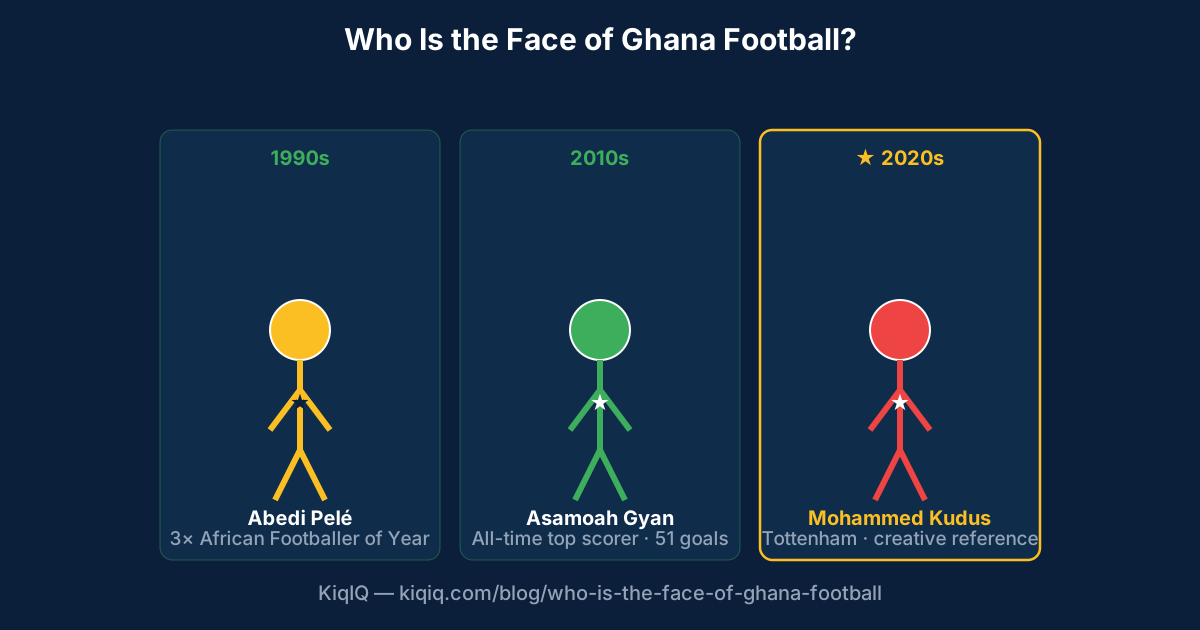
Ghana's national football team — the Black Stars — has had multiple iconic faces across its modern era. From Abedi Pelé in the 1990s, through Michael Essien and Sulley Muntari, to Asamoah Gyan as the 2010s talisman, and now Mohammed Kudus carrying the mantle into the 2020s. Each era's face has reflected Ghana's footballing strengths — technical brilliance, tactical intelligence, physical presence, and the production of midfield royalty.
Abedi Pelé — the original modern Ghanaian icon (1980s-90s)
Abedi Ayew, known as Abedi Pelé, played 73 times for Ghana between 1982 and 1998. Three-time African Footballer of the Year (1991, 1992, 1993). Won the Champions League with Marseille in 1993 — one of the few African players to win Europe's biggest club trophy.
Pelé's playmaking — vision, dribbling, set-piece accuracy — defined a generation. His three sons (André, Jordan, and Rahim Ayew) all played international football. Abedi remains the most-cited reference for Ghanaian footballing skill.
Tony Yeboah and Stephen Appiah — the in-between generation
Tony Yeboah scored 50+ goals in the Bundesliga for Eintracht Frankfurt and Leeds United in the early 1990s. His Premier League volley vs Liverpool in 1995 remains one of the most iconic goals of the era.
Stephen Appiah captained Ghana to their first World Cup (2006). The midfielder played at Juventus and was central to the African Cup of Nations campaigns of the 2000s. The bridge between the Pelé era and the Essien era.
Michael Essien and the Premier League era (2000s-2010s)
Michael Essien played 153 times for Ghana between 2002 and 2014. He became the most-capped Ghanaian Premier League player at Chelsea, winning two PL titles, an FA Cup, and a Champions League. "The Bison" — his nickname for his physical presence — represented Ghana's transition from technical artistry to combined physical-technical excellence.
Essien's national-team peers (Sulley Muntari, John Mensah, Kevin-Prince Boateng, Asamoah Gyan) formed the famous Black Stars team that reached the World Cup quarter-final in 2010 — Ghana's best-ever World Cup performance and only the third African nation to reach that stage.
Asamoah Gyan — the goalscorer and the captain (2010s)
Asamoah Gyan is Ghana's all-time top scorer with 51 goals in 109 caps. He scored at three World Cups (2006, 2010, 2014) — the only Ghanaian to do so — including the iconic last-minute extra-time penalty miss vs Uruguay in the 2010 quarter-final, and the subsequent emotional retake.
Gyan captained Ghana through the late 2010s and remains the country's most-cited modern striker. After retiring in 2023, he transitioned into administration and broadcasting.
Mohammed Kudus — the current face (2020s)
Mohammed Kudus, born 2000, is the current face of Ghanaian football. After breaking through at FC Nordsjælland and Ajax, he moved to West Ham in 2023 and to Tottenham in 2025 (multi-club moves reflecting his Premier League pedigree).
Kudus combines technical skill, dribbling, and goal-scoring from attacking midfield positions. He made his Ghana debut at 18 and has been the team's creative reference since the 2022 World Cup. His club performances have made him the most-Googled Ghanaian footballer of the mid-2020s.
Other current candidates for the "face" mantle include: Thomas Partey (Arsenal midfielder), Jordan Ayew (Leicester forward), and Antoine Semenyo (Bournemouth winger). But Kudus carries the brightest profile.
The Black Stars' wider footballing identity
Ghana has hosted some of African football's most decorated teams. Four AFCON titles (1963, 1965, 1978, 1982). Six World Cup appearances (1966 youth, 2006, 2010, 2014, 2022, qualified 2026). Three Olympic medals. The Ghana national team is a near-permanent fixture in African football's elite.
The Black Stars name comes from the black star on the Ghanaian flag — a symbol of African pride and freedom. Both the team name and the flag's central image reference Marcus Garvey's Black Star Line shipping company, which symbolised African self-determination in the early 20th century.
Frequently asked questions
- Who is the most famous Ghanaian footballer ever?
- Abedi Pelé is the most-cited historical name — three-time African Footballer of the Year (1991-93) and 1993 Champions League winner with Marseille. By caps, Asamoah Gyan is Ghana's all-time top scorer (51 goals in 109 caps). By current profile, Mohammed Kudus carries the mantle.
- Who is the face of Ghana football today?
- Mohammed Kudus, born 2000, is the current face. After breakthrough at Ajax and West Ham, he moved to Tottenham in 2025. He combines technical skill, dribbling, and goal-scoring from attacking midfield positions, and has been the team's creative reference since the 2022 World Cup. Thomas Partey, Jordan Ayew, and Antoine Semenyo are other current candidates.
- Has Ghana ever won the World Cup?
- No. Ghana's best-ever World Cup performance was reaching the quarter-final at the 2010 South Africa World Cup — only the third African nation to reach that stage. They lost on penalties to Uruguay after Asamoah Gyan's iconic last-minute miss in extra time. Ghana have qualified for the 2026 World Cup.
- How many AFCON titles has Ghana won?
- Four. Ghana won the African Cup of Nations in 1963, 1965, 1978, and 1982. Multiple second-place finishes since. Ghana is one of the most-decorated African national teams alongside Egypt, Cameroon, and Nigeria.
References
- Ghana Football Association (GFA) — GFA
- CAF — Confederation of African Football — CAF
- Abedi Pelé — Career Profile — FIFA
- Mohammed Kudus — Player Profile — The Athletic
Ask KiqIQ a follow-up
Get a live, data-driven answer powered by api-football + KiqIQ's Poisson model. Try one of these prompts or write your own.
Part of pillar
Football Culture
See every article in this knowledge pillar →
Related
Reviewed by a KiqIQ editor before publication. Spotted an error? Email editor@kiqiq.com — we follow our Corrections Policy.