
The Best Football History Books to Read: A Reader's Canon
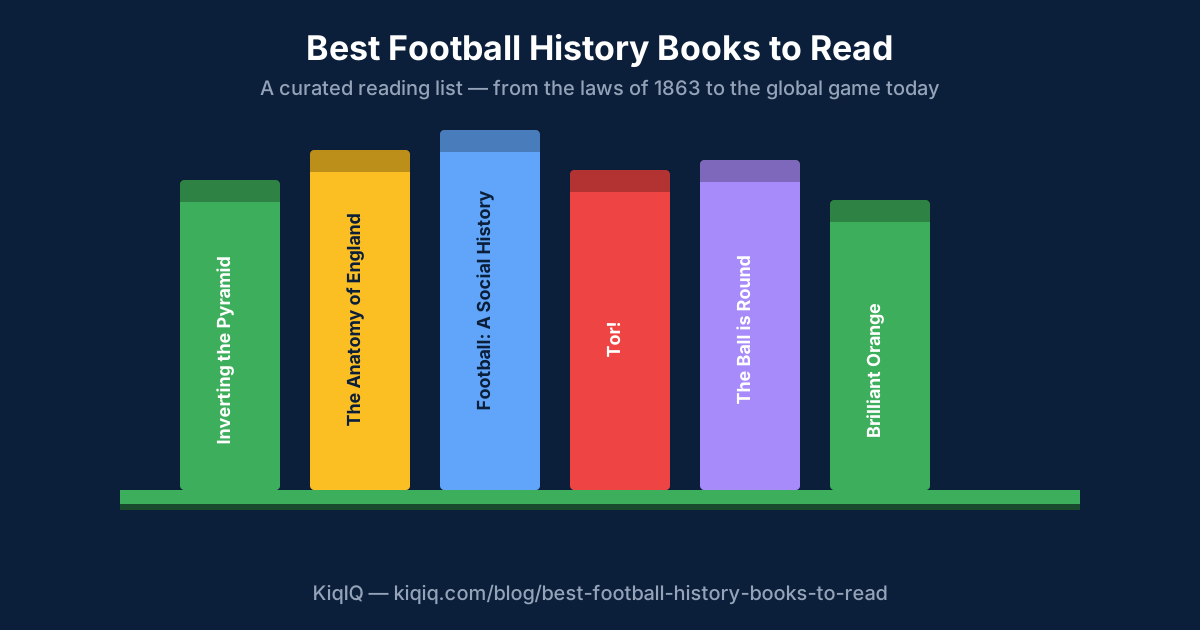
Football has a deeper literary canon than most fans realise. Seven books that genuinely explain how the modern game arrived where it is, from global social history to tactical evolution.
 Tap to enlarge
The best football-history books don't just retell the major tournament wins. They explain how the game got organised, why tactics evolved the way they did, and what the sport says about the societies that play it. The reader's canon is short: David Goldblatt for global social history, Jonathan Wilson for tactical evolution, David Winner for cultural anthropology, and a handful of newer entries that fill in the gaps. Together they explain the modern game in a way the highlight reels never can.
Why football history actually matters
Football is the most-watched sport on earth, but the average fan's historical knowledge is shallow: the names of a few past World Cup winners, a vague awareness that "total football" happened in the 1970s, the assumption that the Premier League era is the only one that really counts. The depth of the game's history is the part you only encounter once you start reading.
A good football-history book does three things at once. It situates the game in the society that produced it: late-Victorian industrial Britain, post-war Brazil, communist-era Eastern Europe, post-colonial Africa. It traces tactical evolution as a chain of reactions, where every system was a response to something the previous era couldn't solve. And it tells the story through people: the obsessive coaches, the federation politicians, the unfashionable clubs that changed the sport without winning much. The books that do all three are the ones worth keeping on the shelf.
What to look for in a football history book
Not every football book that claims "history" in the title is actually historical. A lot of what gets shelved as football history is closer to memoir, hagiography, or season-by-season chronicle. The genuinely useful history books share a few traits.
Look for primary sources. Authors who quote contemporary newspaper accounts, club minutes, FA records, federation archives, and interviewed living witnesses are doing actual historical work; authors recycling secondary summaries are not. Look for tactical literacy paired with cultural context: pure tactical history (no social grounding) loses its meaning, and pure social history (no on-pitch detail) loses the game. Look for a global scope or at least an honest admission of which corner of the game the book covers. The best football books are the ones that admit what they're not trying to be.
- Primary sources: newspaper archives, club records, interviews with surviving participants.
- Tactical literacy: the on-pitch game treated as seriously as the off-pitch politics.
- Cultural context: the society that produced the football, not just the football.
- Honest scope: covers what it covers, doesn't pretend to be a universal history when it isn't.
- Readable prose: football history is a serious topic written for a general audience; academic-tone-only books rarely make the canon.
The canon: books that genuinely explain the modern game
Global social history
David Goldblatt's *The Ball is Round: A Global History of Football* (2006) is the closest thing the game has to a definitive single-volume history. It covers the codification of association football in late-Victorian Britain, the spread of the game across the British Empire and informally through trade routes, the codification of national federations across Latin America, the development of European club competitions, the post-war professionalisation of the game in different national contexts, the commercialisation of the Premier League era, and the geopolitical use of football in the late 20th century. At ~900 pages it is not a quick read; it is, however, the one book most professional football writers cite as their foundation.
Goldblatt's follow-up *The Age of Football: The Global Game in the Twenty-First Century* (2019) brings the story up to the modern era: the Chinese Super League experiment, FIFA corruption, the post-Bosman labour market, state-owned ownership models. Read together they are the single most comprehensive English-language history available.
Sitting at the more digestible end of the social-history spectrum, *Football: A History of the Beautiful Society* traces how the game organised local communities, mediated class tensions, and shaped national identity across a number of countries, and works either as a first football-history book or as a mid-length companion to Goldblatt's heftier volumes.
The canon: tactical evolution
Jonathan Wilson's *Inverting the Pyramid: The History of Football Tactics* (2008, revised editions through 2018) is the tactical-evolution counterpart to Goldblatt. Wilson traces the game from the early Scottish passing innovation through the Italian *catenaccio* of the 1960s, the Dutch *totaalvoetbal* of the 1970s, the Argentine *bilardismo / menottismo* split, the German Cruyffian reformation, and the modern era of high-pressing and positional play. The book is the standard tactical history reference, with the merit that Wilson explicitly traces every system as a response to the one before. There are no isolated tactical revelations, just chains of cause and effect across decades.
Wilson's smaller *The Anatomy of England* (2010) and *Behind the Curtain* (2006, on Eastern European football) work as deeper dives into the territory *Inverting the Pyramid* covers more broadly.
The canon: cultural anthropology
David Winner's *Brilliant Orange: The Neurotic Genius of Dutch Football* (2000) is the foundational text on how a national football style emerges from a national culture. Winner argues (convincingly) that Dutch football's spatial obsession (totaalvoetbal's use of width, pressing, and positional rotation) maps onto centuries of Dutch architectural and landscape culture. It's one of the few football books that works as serious cultural history; if you read only one book on a single national football style, this is it.
The canon: economics and the modern era
*Soccernomics* by Simon Kuper and Stefan Szymanski (first published 2009, regular updates since) is the economics-and-data answer to the cultural-history canon. It tackles questions the more traditional histories tend to skirt: why some national teams over-perform their population size, whether transfer fees are a rational signal, why English football has historically underperformed despite massive financial inputs, how to detect a corrupt match. The economics framing won't suit everyone, but it complements the narrative-history books well.
For the very modern era (the post-2010 financial transformation of the game) Miguel Delaney's *States of Play* (2024) is the most-recent serious treatment. It covers state-owned ownership models, the Saudi Pro League, sportswashing as a policy instrument, and the entanglement of football with geopolitics in a way the older canon does not.
Where to start if you only read one
A reader looking at this list might reasonably ask where to start. The honest answer depends on what hooked you in the first place, if it was a particular national style, go to Winner for the Dutch and Wilson for the broader tactical chain; if it was the global spread of the sport, go to Goldblatt; if it was the modern financial story, go to Kuper/Szymanski or Delaney. *Football: A History of the Beautiful Society* sits as a digestible mid-length entry point that doesn't require the time commitment of *The Ball is Round*, useful as either a first football-history book or a complement to the deeper canon.
None of these books is a perfect single answer. The reason there's a reader's canon at all is that the game is too big for any single volume to cover honestly. Read two or three across the categories above and you'll know more about the structural history of football than 95% of fans, including most professionals working in the industry.
Where to read next
After the canon, the territory branches out. For the early-game and Victorian codification chapter, Tony Collins's *How Football Began* (2018) is the most thorough recent treatment. For African football, Steve Bloomfield's *Africa United* (2010) holds up well a decade and a half later. For South American football, Andreas Campomar's *¡Golazo!* (2014) is the closest single-volume equivalent to Goldblatt for the continent. For specifically British / Premier League history, David Conn's *The Beautiful Game?* (2004) and *Richer Than God* (2012, on Manchester City's Abu Dhabi era) are essential.
The football-history canon updates faster than most readers realise. The financial transformation of the last decade has produced a generation of new books that the 2000s-era canon couldn't cover. Keep an eye on the publishing year on anything you pick up, a 2005-era history of "modern football" is, at this point, a history of the recent past, not the present.
- Start broad: Goldblatt's *The Ball is Round* for global history.
- Then tactical: Wilson's *Inverting the Pyramid* for the on-pitch chain of reactions.
- Then cultural: Winner's *Brilliant Orange* for how a national style emerges from a national culture.
- Then economic: Kuper & Szymanski's *Soccernomics* for the financial structure.
- Then modern: Delaney's *States of Play* for the post-2010 geopolitical chapter.
Frequently asked questions
- What is the best football history book to read first?
- David Goldblatt's *The Ball is Round: A Global History of Football* is the most commonly recommended starting point. It's the closest the game has to a definitive single-volume history, covering the codification of football in Britain through to the modern era. It's long (~900 pages) but reads accessibly, and every later football-history book essentially builds on its framework.
- What is the best book on football tactics history?
- Jonathan Wilson's *Inverting the Pyramid: The History of Football Tactics* (2008, with later revised editions) is the standard reference. It traces tactical evolution from early Scottish passing innovations through *catenaccio*, *totaalvoetbal*, the Cruyffian reformation, and modern pressing, treating each system as a response to the one before it.
- Are there good football books about a specific country's style?
- Yes. David Winner's *Brilliant Orange: The Neurotic Genius of Dutch Football* is the classic for the Netherlands. Andreas Campomar's *¡Golazo!* covers South American football. Jonathan Wilson's *Behind the Curtain* covers Eastern Europe. Steve Bloomfield's *Africa United* covers African football. Each treats the national football style as an expression of national culture rather than just a tactical preference.
- How do I tell which football history books are worth reading?
- Look for primary sources (newspaper archives, club records, interviews with participants), tactical literacy paired with cultural context, and honest scope, books that admit what they're not trying to cover. Be wary of "definitive history" claims that lean heavily on secondary summaries; the canon is built on books that did original archival work.
References
- Football: A History of the Beautiful Society, book (affiliate) — Amazon
- The Athletic, football book reviews and author interviews — The Athletic
- The Guardian, football books coverage — The Guardian
- When Saturday Comes, independent football publishing and review archive — When Saturday Comes
Ask KiqIQ a follow-up
Get a live, data-driven answer powered by api-football + KiqIQ's Poisson model. Try one of these prompts or write your own.
Part of pillar
Football Culture
See every article in this knowledge pillar →
Related
Reviewed by a KiqIQ editor before publication. Spotted an error? Email editor@kiqiq.com — we follow our Corrections Policy.