
Difference Between Football and Soccer: Why the Two Words Exist
Football and soccer refer to the same sport. The word "soccer" originated at Oxford University in the 1880s as British public-school slang. We trace the etymology and explain why each region uses one over the other.
 Tap to enlarge
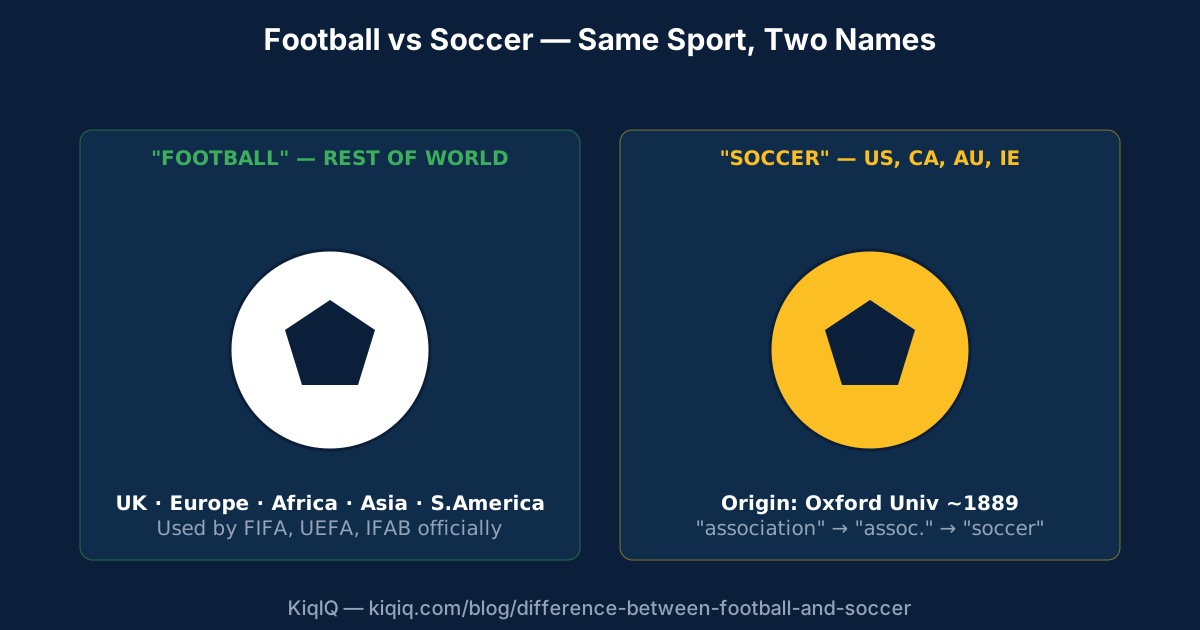
Football and soccer refer to the same sport — association football. The word "soccer" was coined at Oxford University around 1889 as British public-school slang: "association" was abbreviated to "assoc." and given the "-er" suffix common in upper-class British slang of the era (compare "rugger" for rugby). Today "football" is used in most of the world, while "soccer" predominates in the United States, Canada, Australia, and Ireland — places where another sport already claims the "football" name.
Both words mean the same sport
There is no rule difference between "football" and "soccer". They are two names for the same game — the sport governed by FIFA, played at the World Cup, and codified by IFAB. The differences are purely linguistic, regional, and historical.
In FIFA member-nation officialese, the sport is "association football". Both "football" and "soccer" are colloquial shortenings.
Where the word "soccer" came from
- Late 1800s Oxford University. The term emerged in British upper-class slang.
- Etymology: "association" → "assoc." → "soccer". The "-er" suffix was a common Oxford slang form (cf. "rugger" for rugby football).
- First recorded use: ~1889. Charles Wreford-Brown, an Oxford student, is often cited as coining or popularising the term.
- British origin, not American. Despite modern association with the US, "soccer" is a British coinage.
Why the US (and others) say "soccer"
- Another sport claimed the "football" name first. American football, Australian rules football, and Gaelic football are the dominant football codes in their countries.
- United States. "Soccer" is the everyday term; American football is "football" by default. MLS = Major League Soccer.
- Canada. Same reason — Canadian football is the default "football".
- Australia. Australian rules football and rugby league dominate domestically. Soccer = association football.
- Ireland. Gaelic football is the dominant football code; "soccer" is used to disambiguate.
- South Africa. Both "football" and "soccer" are used; soccer is more common in older usage.
Where "football" is universal
- United Kingdom. "Football" is universal; "soccer" sounds American or upper-class British.
- Continental Europe. Almost every European language uses a "football" cognate (German Fußball, French football, Italian calcio, Spanish fútbol).
- South America. Spanish-speaking countries use "fútbol"; Brazil uses "futebol".
- Africa. "Football" or "fútbol" / "futebol" depending on colonial-language heritage.
- Asia. "Football" or local-language equivalents.
Did the British stop using "soccer"?
Throughout the 20th century, "soccer" was used in Britain alongside "football", especially in writing. Multiple academic studies of British newspapers found "soccer" appeared regularly in headlines and prose into the 1990s.
British usage of "soccer" declined sharply in the late 1990s and early 2000s — partly as a deliberate distancing from the American framing of the term, and partly because "football" had become unambiguous in modern British media.
Cultural notes
- British use of "soccer" can sound either old-fashioned or American-influenced. Modern Brits typically only use "soccer" when speaking to Americans.
- American use of "football" without context refers to American football. US fans use "soccer" to mean what Europeans call football, with no negative connotation.
- FIFA, IFAB, UEFA, CONMEBOL, AFC. All international governing bodies use "football" in their official English names.
Frequently asked questions
- What is the difference between football and soccer?
- There is no rule difference — football and soccer are two names for the same sport, association football, governed by FIFA. The differences are purely linguistic and regional. "Soccer" originated at Oxford University around 1889 as British public-school slang for "association" (abbreviated to "assoc." with an "-er" suffix). Today "football" is used in most of the world; "soccer" predominates in the United States, Canada, Australia, and Ireland.
- Why does the US call football soccer?
- Because American football already claimed the "football" name in the US. To avoid confusion, "soccer" — a British coinage from Oxford University around 1889 — became the standard American term for association football. The same applies in Canada (Canadian football), Australia (Australian rules football), and Ireland (Gaelic football).
- Did the British invent the word soccer?
- Yes. "Soccer" is a British coinage from Oxford University around 1889, derived from "association" → "assoc." → "soccer" — using the "-er" suffix that was common in British upper-class slang of the era (compare "rugger" for rugby). Despite modern association with the US, the word is British in origin.
- Is "football" or "soccer" the official term?
- In FIFA member-nation officialese, the sport is "association football". Both "football" and "soccer" are colloquial shortenings of this. FIFA, IFAB, UEFA, CONMEBOL, and the AFC all use "football" in their official English names. The Major League Soccer (MLS) brand is the notable major-league exception.
References
- IFAB Laws of the Game — IFAB
- Britannica — Why Soccer / Football — Britannica
- Bundesliga FAQ — Soccer vs Football — Bundesliga
- Oxford English Dictionary — Oxford English Dictionary
Ask KiqIQ a follow-up
Get a live, data-driven answer powered by api-football + KiqIQ's Poisson model. Try one of these prompts or write your own.
Part of pillar
Football Culture
See every article in this knowledge pillar →
Related
Reviewed by a KiqIQ editor before publication. Spotted an error? Email editor@kiqiq.com — we follow our Corrections Policy.