
How Premier League Prize Money Works: The Real Pound Breakdown
A line-by-line breakdown of what each Premier League club actually receives, how a 6th-placed side ends up at 150m and a relegated club at 100m via parachutes.
 Tap to enlarge
A Premier League club annual central-payments statement is one page long and has five lines on it. Equal-share UK domestic, equal-share international pool, merit payment, facility fee, central commercial. For relegated clubs a sixth line, parachute payments, runs for three further seasons. The 2024-25 distribution paid GBP 1.64 billion to the 20 clubs (Premier League, 2024). The arithmetic produces three very different financial pictures: a 6th-placed club at roughly GBP 155m, a relegated 18th-placed club at around GBP 113m with another GBP 90m to GBP 100m of parachute money queued up, and a promoted Championship side that was operating on roughly GBP 8m of EFL central distributions the previous season.
The five lines that make up a Premier League payment
Premier League central distributions are built from two underlying revenue pools (domestic broadcast, international broadcast) and a smaller central commercial bucket, distributed across the 20 clubs through a formula written into the league shareholder agreement. The 2025-28 cycle is worth approximately GBP 6.7 billion in domestic rights across three seasons, with the international package now pushing the total above GBP 12 billion (Premier League, 2024). For the 2024-25 monitoring season, the last full year of the prior cycle, central distributions to clubs ran to GBP 1.64 billion in aggregate (Premier League central payments report, 2024).
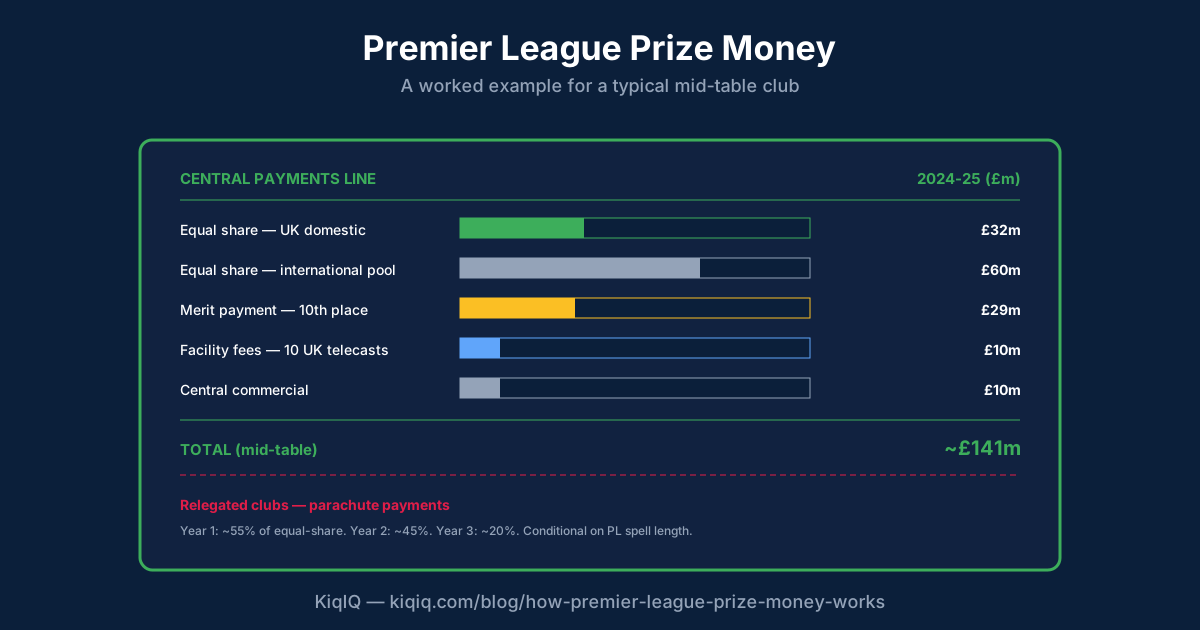
Every Premier League club payment is the sum of five lines. The first is the equal-share component of the UK domestic broadcast deal: approximately GBP 33m per club, distributed identically to all 20. The second is each club equal share of the international broadcast pool: roughly GBP 55m for 2024-25, again split evenly across the 20. The third is the merit payment, scaled by final league position with the champion banking 20 shares (around GBP 64m at GBP 3.2m per share) down to the 20th-placed club banking one share (around GBP 3.2m). The fourth is the facility fee, paid per UK live broadcast appearance at approximately GBP 1.0m to GBP 1.2m per game above a floor of ten guaranteed appearances. The fifth is a small central commercial slice from league-level sponsors, split equally and worth a few million per club.
Two of those five lines are identical for every club, two scale with where a club finishes and how often it appears on UK live broadcast, and one is a small evenly-split commercial top-up. Before merit and facility-fee variance, every Premier League club banks roughly GBP 88m a season from the two equal-share buckets alone. That is the structural floor that makes the bottom half of the Premier League a financially different category of business from anywhere else in the English pyramid.
A worked example: where the 8th-placed club ends up
Take a hypothetical Newcastle-or-West-Ham-shaped club that finishes 8th in the 2024-25 season, picks up 22 UK live broadcast appearances across the year, and receives no European-football prize money on top. The arithmetic, using the published Premier League payment structure for 2024-25, looks like this. Equal-share UK domestic: approximately GBP 33.0m. Equal-share international pool: approximately GBP 55.0m. Merit payment for 8th place (13 shares at GBP 3.2m per share): approximately GBP 41.6m. Facility fees (22 appearances at GBP 1.1m average): approximately GBP 24.2m. Central commercial bucket (1/20th of the league-sponsor pool): approximately GBP 8.5m. Total: approximately GBP 162.3m.
Move the same club up to 6th place with two extra televised appearances and the total climbs to roughly GBP 170m through the merit ladder and facility fee combined. Move them down to 14th with the broadcast minimum (10 appearances) and the total drops to roughly GBP 135m. The position-driven swing across the lower-half range is consequential: 14th finish to 6th finish, holding everything else constant, is a GBP 35m to GBP 40m difference. That is more than the entire annual revenue of a typical Championship play-off contender, and it lands in a single financial year.
For clubs in continental competition the picture changes again. Premier League central payments arrive separately from UEFA prize money, which is paid into the broadcast-revenue line but originates with UEFA rather than the Premier League. A Champions League league-phase entry is currently worth approximately EUR 18.6m in starting fees plus performance payments and a market-pool share scaled to the UK domestic TV market (UEFA, 2024). For an English club in the league phase, that adds roughly GBP 30m to GBP 60m on top of the Premier League central distribution depending on how far the run extends.
A typical 8th-placed Premier League club in 2024-25 banked roughly GBP 162m in central distributions: GBP 33m equal-share domestic, GBP 55m international pool, GBP 42m merit, GBP 24m facility fees and an GBP 8m central commercial slice. Climbing to 6th adds another GBP 8m to GBP 10m via merit and one or two extra televised appearances.
Why the relegated club still ends up around 100m
Premier League relegation collapses the broadcast revenue line by an order of magnitude. A relegated club drops from a GBP 110m to GBP 115m floor of central distributions to roughly GBP 8m to GBP 10m a season of EFL central distributions in the Championship. The parachute payment system is the league answer to that cliff. The structure pays a relegated club approximately 55 percent of the equal-share UK domestic baseline in year one after relegation, 45 percent in year two, and 20 percent in year three (Premier League Handbook, 2024). Translated into 2024-25 figures: roughly GBP 49m in year one, GBP 40m in year two, and GBP 18m in year three. The total envelope is around GBP 90m to GBP 100m across three seasons.
The full financial picture for a relegated 18th-placed club in 2024-25 therefore stretches across four financial years. The relegation season itself banked the bottom of the merit ladder (3 shares at GBP 3.2m equals GBP 9.6m), broadcast minimums on the facility fee (10 appearances at GBP 1.1m equals GBP 11m), and the two equal-share buckets at full weighting (GBP 88m). Total for the relegation year: approximately GBP 112m. Year one in the Championship adds GBP 49m of parachute money on top of around GBP 8m of EFL central distributions; year two adds GBP 40m on top of GBP 8m; year three adds GBP 18m on top of GBP 8m. A club that fails to bounce back and stays in the Championship for three seasons after relegation still banks roughly GBP 225m across the four-year window, substantial cushioning by any measure, even before broadcast appearance fees from the Sky Sports Championship deal are layered on top.
The EFL has consistently challenged the parachute system on competitive-balance grounds. The argument is that a parachute-receiving Championship club operates on a revenue base several times that of a non-parachute Championship club, which inflates wages across the division. Brighton, Bournemouth, Brentford and most recently Luton reached the Premier League without parachute revenue at the start of their promotion seasons, but the structural advantage of recently-relegated sides in promotion races is visible in the data and was flagged by the EFL own analysis (Deloitte Annual Review of Football Finance, 2024).
The 8m Championship side and the gradient that produces
A typical Championship promotion candidate without parachute payments operates on a markedly different financial base. EFL central distributions to Championship clubs are roughly GBP 8m per season, a Sky Sports broadcast share of approximately GBP 3m, solidarity payments of around GBP 4m, and a small share of the EFL own commercial revenue (English Football League financial summary, 2024). On top of that, individual clubs earn matchday revenue (typically GBP 6m to GBP 15m depending on stadium size and attendance), commercial revenue (GBP 3m to GBP 10m depending on shirt deal scale) and irregular player-trading profit when academy graduates or development signings are sold on.
A reasonable mid-Championship operating revenue base sits at GBP 25m to GBP 35m a season. A genuinely well-run promotion candidate without parachute money, Brighton in 2016-17, Brentford in 2020-21, Luton in 2022-23, might reach GBP 40m to GBP 50m by combining higher matchday yields, sale-and-leaseback property restructurings, or one-off player-trading windfalls. None of those numbers come within a multiple of the GBP 110m plus that the bottom-placed Premier League club receives from central distributions alone, never mind matchday or commercial on top.
The gradient from GBP 8m Championship floor to GBP 110m Premier League floor is what makes the Championship play-off final the most valuable single fixture in club football. The current consensus present-value estimate for promotion via the play-off route sits around GBP 200m, combining one season of full Premier League central distributions (GBP 110m plus minimum, more if the club survives) with the three-year parachute envelope (GBP 90m to GBP 100m) if the promoted club is relegated immediately (The Athletic, 2024). Sustained survival pushes the figure substantially higher.
- 6th-placed PL club — roughly GBP 170m plus in central distributions (full equal shares, 15 merit shares, 24 plus televised appearances).
- 8th-placed PL club (worked example) — roughly GBP 162m (full equal shares, 13 merit shares, 22 televised appearances, central commercial).
- 14th-placed PL club — roughly GBP 135m (full equal shares, 7 merit shares, broadcast minimum 10 appearances).
- 18th-placed PL club (relegated) — roughly GBP 112m in the relegation year, then GBP 49m / GBP 40m / GBP 18m of parachutes for three further seasons.
- Championship promotion candidate (no parachute) — roughly GBP 8m of EFL central distributions plus GBP 20m to GBP 30m of own matchday and commercial.
What the formula does, and what it deliberately does not
The Premier League distribution formula has been deliberately structured to compress the gap between top and bottom of the table. Manchester City as champions in 2023-24 received approximately GBP 176m and Sheffield United in 20th received approximately GBP 110m, a ratio of around 1.6 to 1 (Premier League central payments, 2024). The equivalent ratios in La Liga (around 4 to 1 before recent collective-bargaining adjustments) and the historic Bundesliga, Serie A and Ligue 1 models are materially wider. The political bargain underpinning the Premier League flatter curve is that 20 financially viable clubs produce a better domestic and international media product than four super-clubs and 16 financial casualties.
What the formula does not do is equalise commercial or matchday revenue. Manchester United commercial line was worth approximately EUR 300m in 2024-25, an order of magnitude above what a club outside the European-football qualifying positions can generate. Tottenham matchday revenue per fixture, on the back of a stadium designed around hospitality yield, sits well above the league average. Those gaps continue to widen even as the central-distribution gap stays narrow, which is the structural reason the top six clubs are pulling away despite a relatively flat distribution ladder.
The framework is under negotiation pressure. The Premier League moves to a new domestic plus international rights cycle from 2025-28, the Football Governance Act 2025 introduced an independent regulator with statutory powers over financial distribution, and EFL clubs continue to push for a higher share of Premier League broadcast revenue through solidarity payments. The next inflection point is whether the international pool (forecast to clear the domestic pool in absolute terms within two cycles) remains evenly distributed or shifts to a weighted share, the change would alter the entire arithmetic worked through above.
Frequently asked questions
- How much does a Premier League club earn in prize money?
- Premier League central distributions for 2024-25 ran to GBP 1.64 billion across the 20 clubs. The champion banked approximately GBP 176m and the 20th-placed club approximately GBP 110m. A typical 8th-placed club received around GBP 162m: GBP 33m equal-share domestic, GBP 55m international pool, GBP 42m merit payment, GBP 24m facility fees and an GBP 8m central commercial slice.
- How do parachute payments work?
- A relegated Premier League club receives parachute payments for three seasons after relegation. The structure pays approximately 55 percent of the equal-share domestic baseline in year one (around GBP 49m for 2024-25), 45 percent in year two (around GBP 40m), and 20 percent in year three (around GBP 18m). The total three-year envelope is around GBP 90m to GBP 100m.
- How much does promotion to the Premier League add?
- Championship promotion is worth around GBP 200m in present-value terms. The figure combines a season of full Premier League central distributions (a minimum of GBP 110m) with the three-year parachute envelope of GBP 90m to GBP 100m if the promoted club is relegated immediately. Sustained Premier League survival pushes the figure materially higher.
- What is the merit payment in the Premier League?
- The merit payment is the league position-based prize money. The champion receives 20 shares, the runner-up 19, third 18 and so on down to the 20th-placed club, which receives 1 share. For the 2024-25 cycle each share is worth approximately GBP 3.2m, so the champion banks around GBP 64m of merit money and the bottom club around GBP 3.2m.
- How are facility fees calculated?
- Facility fees are paid per UK live broadcast appearance. Each Premier League club is guaranteed a minimum of ten televised games and receives a per-appearance fee of approximately GBP 1.0m to GBP 1.2m for the 2024-25 cycle. Top-six clubs typically reach 28 to 30 appearances, banking around GBP 30m, while bottom-half clubs at the broadcast minimum bank closer to GBP 12m.
References
- Premier League broadcast rights — 2025-28 cycle — Premier League
- Premier League central payments to clubs 2023-24 — Premier League
- Annual Review of Football Finance 2024 — Deloitte Sports Business Group
- UEFA Champions League — distribution to clubs — UEFA
- The value of Premier League survival explained — The Athletic
- Premier League payment breakdown — Swiss Ramble — Swiss Ramble
Ask KiqIQ a follow-up
Get a live, data-driven answer powered by api-football + KiqIQ's Poisson model. Try one of these prompts or write your own.
Part of pillar
Football Business
See every article in this knowledge pillar →
Related
Reviewed by a KiqIQ editor before publication. Spotted an error? Email editor@kiqiq.com — we follow our Corrections Policy.