
Diamond Midfield Formation in Football: Tactical Breakdown
The 4-4-2 diamond replaces a flat midfield four with a diamond — 1 CDM, 2 wide CMs, 1 CAM, plus two strikers. We break down the structure, when it works, and the famous sides that built around it.
 Tap to enlarge
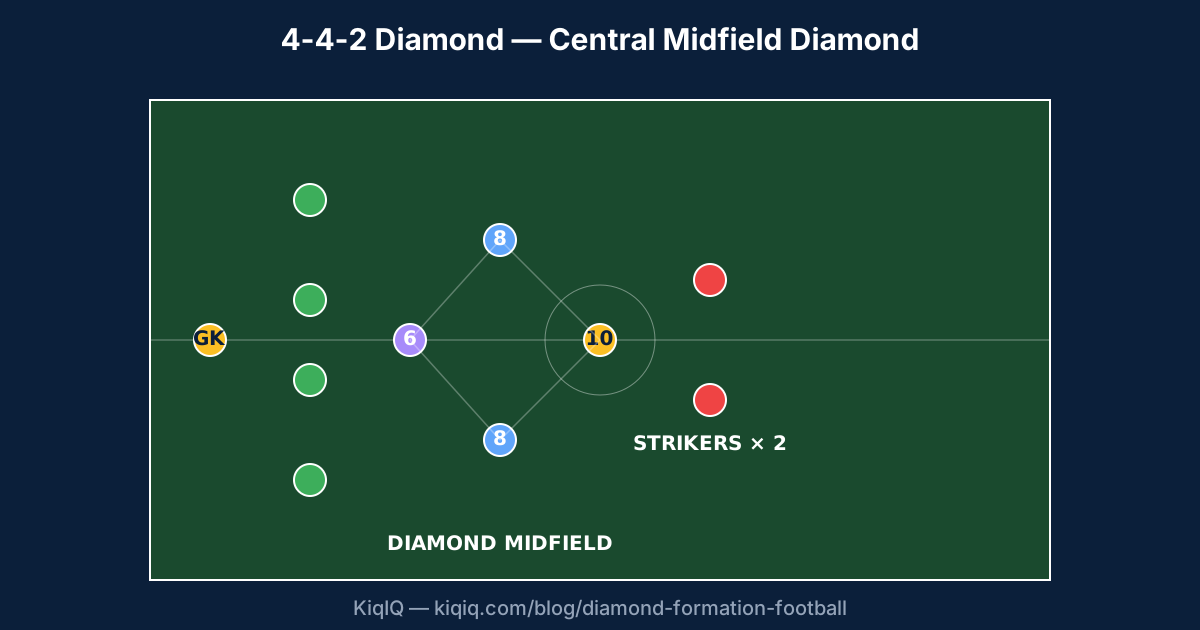
The 4-4-2 diamond (also written as 4-1-2-1-2) replaces the flat midfield four of a classic 4-4-2 with a diamond shape: one CDM at the base, two wide CMs forming the diamond width, one CAM at the apex, plus two strikers. The diamond addresses the central-midfield overload weakness of flat 4-4-2 while keeping the strike-partnership chemistry that pure 4-3-3 sacrifices. The trade-off: lost natural flank width — full-backs MUST overlap.
The diamond structure explained
The diamond reorganises 4-4-2's midfield four into a vertical diamond:
- 1 CDM at the base. Defensive screen in front of the back four. Pirlo / Busquets / Rodri profile (deep-lying playmaker).
- 2 CMs as the diamond width. Box-to-box players covering both halves of the pitch. Need to cover wide ground when full-backs overlap.
- 1 CAM at the apex. The "10" — the creator and second-striker support. Bruno Fernandes / Kevin De Bruyne / Coutinho profile.
- 2 strikers. Same as in flat 4-4-2. Can be target + poacher OR creator + finisher.
The numerical advantage of the diamond: 4 central players (1 CDM, 2 CMs, 1 CAM) vs typically 3 in opposition midfield. Outnumber the centre, win possession, dominate territory.
Strengths of the 4-4-2 diamond
Five tactical advantages:
- Central numerical superiority. 4 central midfielders is more than the 3 in 4-3-3 / 4-2-3-1.
- Strike partnership preserved. Two forwards instead of one — link-up play and target / poacher chemistry.
- Defined creative outlet. The CAM at the apex is the team's designated final-pass merchant; clear hierarchy.
- Defensive shield. The CDM at the base provides screening that pure 4-2-3-1 split-pivot variants don't always achieve.
- Counter-attack speed. When the diamond wins possession, the two strikers are already advanced and the CAM is positioned to feed them.
Weaknesses of the 4-4-2 diamond
Three vulnerabilities:
- No natural width. No wingers — the full-backs MUST overlap to provide width, or the team becomes very narrow.
- Wide-CM workload. The two wide CMs must cover the full width of the pitch when the FB overlaps; physically demanding.
- Vulnerable to wide overloads. Opposition with two wingers attacking simultaneously can pin both FBs back, leaving the diamond exposed centrally.
When the diamond works
Specific contexts:
- With elite full-backs. Squad has two attacking FBs comfortable in possession — they provide the width that diamond lacks naturally.
- With a strong CAM. The "10" must be world-class — diamond hinges on the apex player.
- With a creative CDM. Pirlo / Busquets / Rodri profile (registra/regista) at the base; not a pure destroyer.
- Against opposition with weak full-backs. Defensive full-backs let the diamond's overlapping FBs dominate the wide channels.
Famous 4-4-2 diamond sides
Coaches who have built around the diamond:
- Carlo Ancelotti at Milan (2003-2009). Pirlo + Gattuso + Seedorf + Kaká diamond, 2 Champions Leagues (2003, 2007). Often cited as the diamond's peak implementation.
- Brendan Rodgers at Liverpool (2013-2014). Henderson / Allen + Gerrard at base, Coutinho at apex, Suárez + Sturridge up top. Very nearly won the Premier League title.
- Massimiliano Allegri at Juventus. Variant 4-4-2 diamond as a tactical option alongside his preferred 3-5-2.
- Diego Simeone (Atlético Madrid, occasional). When personnel demands favoured a creative apex over flat 4-4-2 width.
How to coach a 4-4-2 diamond
Four coaching priorities:
- Full-back overlap drills. FBs must be drilled to provide width on every attack — the diamond fails without it.
- Wide-CM positional discipline. Teach when to drift wide vs when to hold central — typically wide when FB on same side overlaps.
- CAM-striker combinations. Drill the apex-to-strikers connection: through-balls, third-man runs, set-piece routines.
- CDM scanning. The base midfielder must constantly scan for opposition runners — the single CDM is the only screen between midfield and back four.
Frequently asked questions
- What is the diamond formation in football?
- The 4-4-2 diamond (also written 4-1-2-1-2) is a football formation with 1 goalkeeper, 4 defenders, a diamond-shaped midfield (1 CDM at the base, 2 wide CMs, 1 CAM at the apex), and 2 strikers. It addresses the central-midfield overload weakness of flat 4-4-2 while keeping a strike partnership.
- How is the diamond different from a flat 4-4-2?
- The flat 4-4-2 has a midfield four with 2 wide midfielders providing natural width. The diamond replaces those wide-mids with a single CDM at the base and a CAM at the apex — gaining central control but losing natural flank width. Full-backs MUST overlap to provide width in a diamond.
- When does the 4-4-2 diamond work?
- Best with: (1) elite attacking full-backs to provide width, (2) a world-class CAM at the apex (the "10" is the system's focal point), (3) a creative CDM (Pirlo / Busquets / Rodri profile) at the base, and (4) two complementary strikers. Atelético Madrid, AC Milan (Ancelotti era), and Brendan Rodgers' Liverpool 2013-14 are the canonical examples.
- What is the main weakness of the diamond?
- No natural width. Without wingers, the formation depends on full-backs overlapping aggressively to provide flank threat. If FBs are conservative or the wide-CMs don't drift wide to cover, the team becomes narrow. Opposition with two wingers attacking simultaneously can also pin both FBs back, leaving the diamond exposed centrally.
References
- The Coaches' Voice — 4-4-2 Diamond Tactics — Coaches' Voice
- IFAB Laws of the Game — IFAB
- BuildLineup — 4-4-2 Diamond — BuildLineup
- Premier League — Tactical Coverage — Premier League
Key terms in this article
Ask KiqIQ a follow-up
Get a live, data-driven answer powered by api-football + KiqIQ's Poisson model. Try one of these prompts or write your own.
Try the calculators
Apply the concepts from this article with KiqIQ's free calculators.
Part of pillar
Tactical Intelligence
See every article in this knowledge pillar →
Related
Reviewed by a KiqIQ editor before publication. Spotted an error? Email editor@kiqiq.com — we follow our Corrections Policy.