
4-4-2 Formation: Tactical Breakdown, Strengths and Modern Variants
The 4-4-2 is football's classic formation — two banks of four plus two strikers. We cover the tactical structure, strengths, weaknesses, the diamond variant, and where modern coaches still deploy it.
 Tap to enlarge
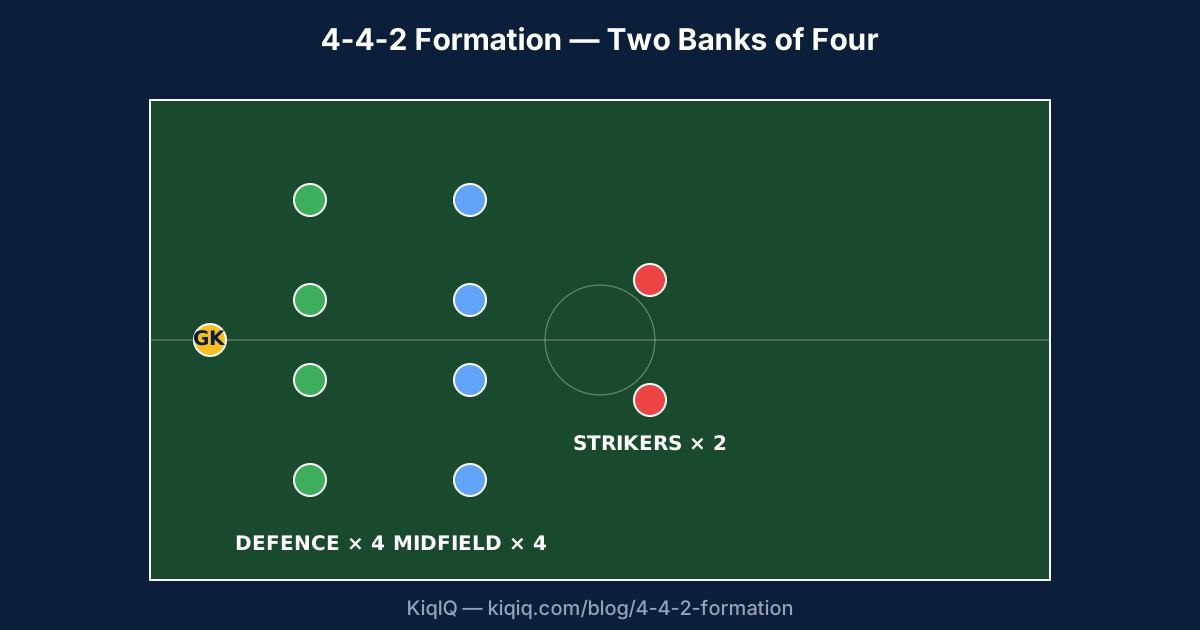
The 4-4-2 is football's classic formation: a back four, a flat midfield four, and two strikers. It dominated English football from the 1960s through the early 2000s and remains a default starting shape across grass-roots, lower-league, and pragmatic Premier League sides. Modern variants include the 4-4-2 diamond (one CDM, one CAM in midfield) and the 4-2-2-2 (split midfield with attacking outlets).
The 4-4-2 structure explained
11 starting players split as 1 GK + 4 defenders + 4 midfielders + 2 strikers:
- Goalkeeper. Distributes from the back; in modern 4-4-2s, often a sweeper-keeper.
- Back four. Two centre-backs (one stopper, one cover) and two full-backs. Width comes from the full-backs overlapping.
- Flat midfield four. Two central midfielders (one defensive, one box-to-box) and two wide midfielders (essentially wingers). Compactness is the priority.
- Two strikers. Often a target-man + poacher pairing, or a creator + finisher pairing. Both stay high; one drops to link play.
4-4-2 numbering uses the historic position numbers: GK (1), RB (2), LB (3), CB (4), CB (5), DM (6), RW (7), CAM (10) — but in 4-4-2 the 10 is replaced by an LM (11), and the second striker takes the 9 + 10 split.
Strengths of the 4-4-2
Five reasons it has lasted:
- Defensive simplicity. Two banks of four is intuitive; defensive responsibilities are clear.
- Width. Two wingers occupy wide areas naturally — no positional rotation needed.
- Compactness in the middle third. When the lines are 8-12m apart vertically, the 4-4-2 is one of the hardest shapes to play through centrally.
- Strike partnership chemistry. Two strikers with complementary profiles (target + poacher) create persistent link-up threats that single-striker systems lack.
- Coaching simplicity. Easier to drill at amateur and youth levels than possession-based 3-2-4-1 / 4-3-3 inverted systems.
Weaknesses of the 4-4-2
Three classic vulnerabilities:
- Outnumbered in central midfield. Two CMs vs three (in a 4-3-3) or four (in a 3-4-3) means the 4-4-2 can be overrun centrally — the textbook critique that pushed Premier League sides toward 4-3-3 in the 2010s.
- Wide midfielders track full-back overlaps. The wide-mid has to defend deep when the opposing full-back overlaps, leaving the team with no attacking outlet on that flank.
- Striker isolation if midfield can't connect. When central midfield is bypassed, the two strikers receive no service.
The 4-4-2 diamond variant
The 4-4-2 diamond (or 4-1-2-1-2) addresses the central-midfield overload weakness:
- 1 CDM at the base. Defensive shield; screens the back four.
- 2 CMs as the diamond width. Box-to-box players covering both halves.
- 1 CAM at the apex. The "10" supporting the strikers.
- 2 strikers. Same as in flat 4-4-2.
- Trade-off. Gains central control vs flat 4-4-2 but loses natural flank width — full-backs MUST overlap to provide width.
Where the 4-4-2 still works in 2026
Despite being declared dead multiple times, 4-4-2 lives in modern football:
- Atlético Madrid (under Diego Simeone). A modern 4-4-2 with extreme defensive compactness; the most successful 4-4-2 in the 2010s-2020s.
- Premier League pragmatic sides. Burnley (Sean Dyche era), Sheffield United (5-3-2 / 4-4-2 hybrids), and other relegation-fight clubs frequently switch to 4-4-2 mid-season.
- Lower-league and grass-roots football. Default shape across English non-league and academy under-18 / under-21 levels.
- Counter-attacking systems. When a team is content to defend deep and counter, 4-4-2 with two pacy strikers is a low-friction setup.
Famous 4-4-2 sides
Sides built around 4-4-2:
- Sir Alex Ferguson's Manchester United (1990s-2000s). Beckham + Giggs on the wings, Keane + Scholes in the middle, Cole + Yorke up top.
- Arsène Wenger's Arsenal (1996-2003). Vieira + Petit / Gilberto in midfield, Henry + Bergkamp up top — won the 2003-04 Invincibles title.
- Diego Simeone's Atlético Madrid (2011-present). La Liga title 2013-14 and 2020-21; Champions League finalists 2014, 2016. Defensive 4-4-2 at its most refined.
Frequently asked questions
- What is the 4-4-2 formation in football?
- The 4-4-2 is a football formation with 1 goalkeeper, 4 defenders (back four), 4 midfielders (flat midfield four), and 2 strikers. It is the classic English formation, dominant from the 1960s through the early 2000s, and still used by sides like Atlético Madrid (Simeone era) and many Premier League pragmatic clubs.
- What are the strengths of the 4-4-2?
- Defensive simplicity (two banks of four), natural width (two wingers occupy wide areas), compactness in the middle third, strike-partnership chemistry (two complementary forwards), and coaching simplicity at all levels. It is also one of the easiest shapes to teach in youth football.
- Why did 4-4-2 fall out of fashion at the top level?
- The 4-4-2 is outnumbered in central midfield against 4-3-3 (3 CMs) and 3-4-3 (4 CMs). The 2010s saw Premier League sides shift to 4-3-3 / 4-2-3-1 to win the central battle. The 4-4-2 didn't disappear — Atlético Madrid won La Liga twice with it — but it stopped being the default at elite level.
- What is the 4-4-2 diamond?
- The 4-4-2 diamond (also written 4-1-2-1-2) replaces the flat midfield four with a diamond: 1 CDM at the base, 2 CMs as the diamond width, and 1 CAM at the apex behind the strikers. It addresses the central-midfield overload weakness of flat 4-4-2 but loses natural flank width — full-backs must overlap to provide width.
References
- IFAB Laws of the Game — Formation Rules — IFAB
- The Coaches' Voice — 4-4-2 Tactical Breakdown — Coaches' Voice
- Premier League — Tactics Coverage — Premier League
- BBC Sport — Formations Glossary — BBC Sport
Key terms in this article
Ask KiqIQ a follow-up
Get a live, data-driven answer powered by api-football + KiqIQ's Poisson model. Try one of these prompts or write your own.
Try the calculators
Apply the concepts from this article with KiqIQ's free calculators.
Part of pillar
Tactical Intelligence
See every article in this knowledge pillar →
Related
Reviewed by a KiqIQ editor before publication. Spotted an error? Email editor@kiqiq.com — we follow our Corrections Policy.