
4-1-4-1 Formation: The Defensive Counter to Modern Attacks
The 4-1-4-1 places a single holding midfielder behind a flat midfield four — a defensive evolution of 4-3-3 used to compress space against high-possession attacks. We break down the structure and where it works.
 Tap to enlarge
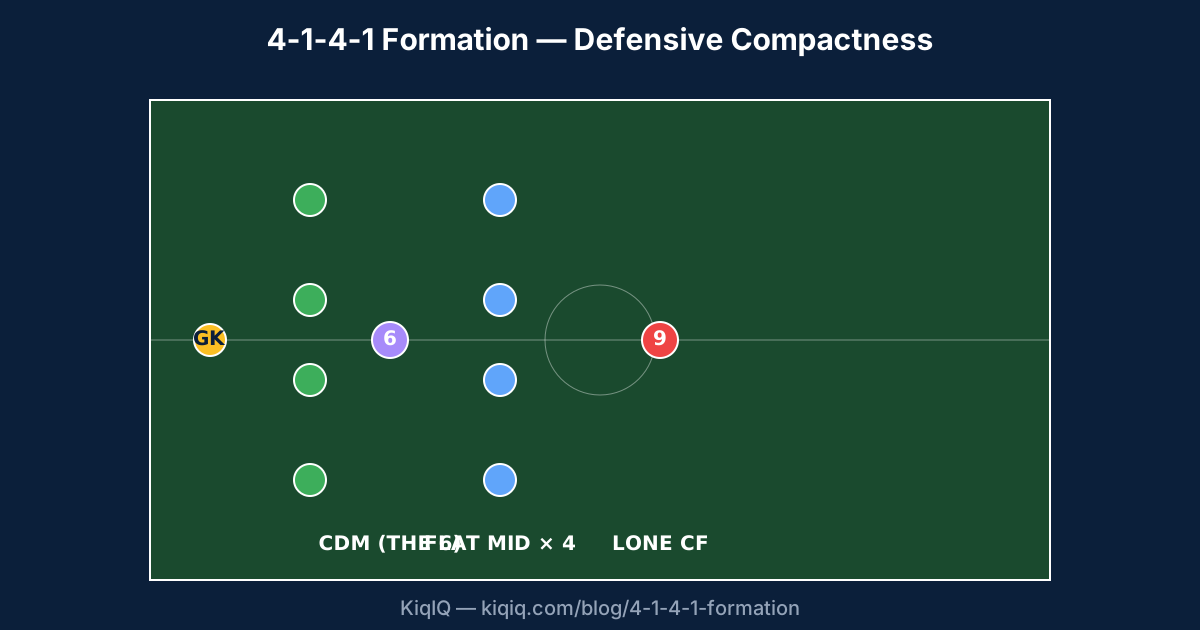
The 4-1-4-1 formation places a single holding midfielder behind a flat midfield four, with a lone centre-forward up top. It is a defensively compact shape designed to compress vertical space against high-possession opposition. The 4-1-4-1 is essentially a defensive variant of 4-3-3 — one of the box-to-box 8s drops back permanently next to the 6, creating a flat band of 4 in front of the lone CDM.
The 4-1-4-1 structure explained
11 players: 1 GK + 4 defenders + 1 CDM + 4 midfielders + 1 striker.
- Goalkeeper. Often a sweeper-keeper given the high defensive line.
- Back four. Conservative; full-backs hold position rather than overlap aggressively.
- Single 6 (CDM). The defensive anchor — screens the back four and breaks up opposition central midfield.
- Midfield four. Two CMs and two wide midfielders. The CMs are box-to-box; the wide-mids defend their flanks.
- Lone CF. Often a target striker or a fast counter-attacker depending on game state.
The 4-1-4-1 differs from 4-5-1 in midfielder shape: 4-1-4-1 has a flat 4 in front of a 6; 4-5-1 has a flat 5 with no clear depth division. Tactically the 4-1-4-1 is more compact vertically.
Strengths of the 4-1-4-1
Five tactical advantages:
- Vertical compactness. The flat midfield four sits 8-12m in front of the back four, creating a 25-30m defensive block that's hard to play through.
- Numerical superiority in midfield (defensively). 5 vs 3 in central midfield against a 4-3-3 attacking shape.
- Defensive transition cover. The CDM screens the back four; the midfield four is well-positioned to deny counter-attacks at source.
- Press triggers from the front. Lone CF can press the CB while the wide-mids close down the FBs.
- Counter-attack outlet. Once possession is won, the lone CF runs into space behind, and the wide-mids surge as quick supporting runners.
Weaknesses of the 4-1-4-1
Three vulnerabilities:
- Striker isolation. A single CF without a strike partner often runs out of attacking options if the team can't support him quickly.
- Width depends on full-backs and wide-mids. If neither is willing to attack, the team has no width and becomes very narrow in the final third.
- Reliance on the single 6. If the CDM is bypassed (a clever pass over the top, or pressing the CDM aggressively), the back four is exposed.
When 4-1-4-1 is the right choice
Specific game-state and personnel scenarios:
- Defending a lead. Move from 4-3-3 to 4-1-4-1 when leading 1-0 / 2-1 in the final 30 minutes — adds defensive solidity.
- Vs possession-heavy opposition. Against teams that dominate possession (Manchester City, Barcelona), 4-1-4-1 limits central penetration.
- Counter-attacking specialists. Teams with one elite striker (a Vardy / Haaland-type) and pace on the wings can break out of 4-1-4-1 effectively.
- Cup-tie second leg with a lead. Famously deployed by managers protecting an aggregate advantage.
Famous 4-1-4-1 deployments
Coaches who have used 4-1-4-1 prominently:
- Manuel Pellegrini at Manchester City (2014). Switched to 4-1-4-1 to defend against high-possession opponents in Champions League knockout matches.
- Marcelo Bielsa at Leeds United. Variant 4-1-4-1 with intense pressing — converted to 3-3-1-3 in possession.
- Carlo Ancelotti. Has used 4-1-4-1 as a defensive variant of his preferred 4-3-3 in big-match situations.
- National team coaches at major tournaments. Often switched into 4-1-4-1 vs technically superior opposition (e.g., England vs Spain).
How to coach a 4-1-4-1
Three coaching priorities:
- Drill compactness. The flat midfield four should always sit 8-12m in front of the back four — never more than 15m. Train this with shadow play.
- The CDM's screening role. The single 6 must be drilled in zone coverage — protecting the central channel between the CBs.
- Counter-attack triggers. Pre-define when the team transitions from defensive 4-1-4-1 to attacking shape (typically the wide-mids surge, the CF runs in behind, the CMs join the attack).
Frequently asked questions
- What is the 4-1-4-1 formation?
- The 4-1-4-1 is a football formation with 1 goalkeeper, 4 defenders, 1 holding midfielder (CDM), 4 midfielders (flat band), and 1 striker. It is a defensively compact shape designed to compress vertical space against possession-heavy opposition.
- How is 4-1-4-1 different from 4-5-1?
- 4-1-4-1 has a clear depth division — one CDM at the base + a flat midfield four in front. 4-5-1 has a flat band of 5 midfielders without that explicit depth split. Tactically, 4-1-4-1 is more vertically compact and better suited to counter-attacking; 4-5-1 is more uniform but less aggressive in defensive transition.
- When should a team use 4-1-4-1?
- Three scenarios: (1) defending a lead in the final 30 minutes; (2) playing against possession-heavy opposition where central compactness matters more than attacking width; (3) counter-attacking sides with one elite lone striker (Vardy / Haaland-type) and pace on the wings.
- What is the main weakness of 4-1-4-1?
- Striker isolation. A single centre-forward without a partner often runs out of options if the team cannot support him quickly. The team also depends heavily on the single CDM — if that player is bypassed, the back four is exposed.
References
- The Coaches' Voice — 4-1-4-1 Formation Explained — Coaches' Voice
- IFAB Laws of the Game — IFAB
- BBC Sport — Tactical Coverage — BBC Sport
- Premier League — Tactics Hub — Premier League
Key terms in this article
Ask KiqIQ a follow-up
Get a live, data-driven answer powered by api-football + KiqIQ's Poisson model. Try one of these prompts or write your own.
Try the calculators
Apply the concepts from this article with KiqIQ's free calculators.
Part of pillar
Tactical Intelligence
See every article in this knowledge pillar →
Related
Reviewed by a KiqIQ editor before publication. Spotted an error? Email editor@kiqiq.com — we follow our Corrections Policy.