
Hartlepool United Shirt History: The Pools, the Blue-and-White Stripes, and Lower-League Identity
Hartlepool United's shirt history: the blue-and-white stripes, the Pools and Monkey Hangers heritage, the 1908 founding, manufacturer churn typical of lower-league English football.
 Tap to enlarge
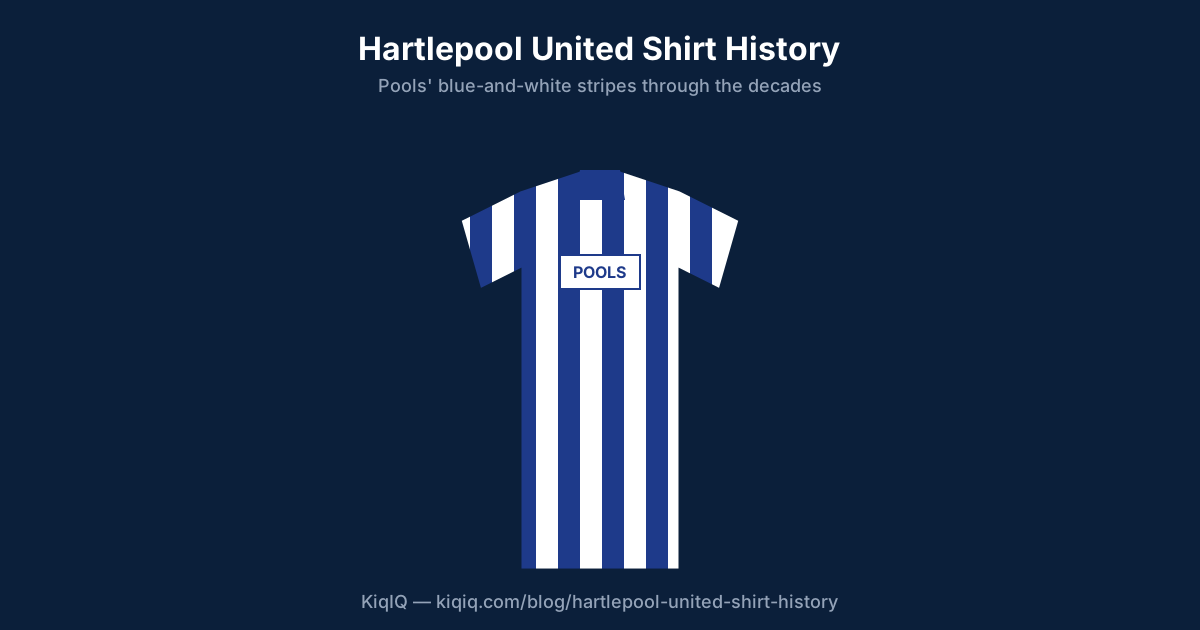
Hartlepool United's home shirt has been blue and white in vertical stripes for the overwhelming majority of the club's history. Founded as Hartlepools United in 1908 and renamed Hartlepool United in 1977, the club's kit identity has remained almost unchanged across more than a hundred seasons of professional and semi-professional football. Manufacturer turnover has been faster than at top-flight clubs, but the stripe pattern itself has anchored the visual identity through every era, including the recent National League period.
A 1908 founding and the early striped identity
Hartlepools United was founded in 1908, drawing players and structure from the local Hartlepool & District League. The blue-and-white stripe pattern is rooted in the visual customs of north-east English football of the era, where vertical stripes (often used by works clubs and town teams) were a common way of distinguishing local identity from the broader association football template. Hartlepool's stripes are slightly broader than Newcastle United's black-and-white but operate in the same regional design vocabulary.
A current example is a 2025-26 Hartlepool United away kids shirt, showing how modern manufacturers handle Hartlepool's away kits, traditionally given more design freedom than the heritage-protected striped home.
Mid-century: Football League stability and the Pools nickname
Hartlepools United joined the Football League in 1921 as a founder member of the Third Division North. The club spent most of the mid-20th century in the lower divisions, occasionally re-electing to the league after struggling for results, but consistently wearing the blue-and-white stripes. The Pools nickname (a contraction of Hartlepools) survived the 1977 renaming to Hartlepool United and is still in active use among supporters today.
The Monkey Hangers nickname, used by rival fans and now embraced by Hartlepudlians themselves, refers to a local legend from the Napoleonic Wars in which villagers reportedly hanged a monkey washed ashore from a French ship, mistaking it for a French spy. The club's mascot, H'Angus the Monkey, leans into the legend with a wink, and a former H'Angus performer (Stuart Drummond) was elected Mayor of Hartlepool in 2002 standing on the mascot platform.
The Cyril Knowles and 1990s era
Hartlepool's most-fondly-remembered seasons of the modern era include the Cyril Knowles tenure in the late 1980s and the various promotion campaigns of the early 2000s under Chris Turner and Neale Cooper. The shirts of this period were typically produced by smaller English and European teamwear manufacturers (Spall, Influence, Vandanel) rather than the Nike and Adidas of elite-tier football. The fast manufacturer turnover is typical of the EFL bottom tiers, where shirt deals are usually shorter and tied to the season-by-season commercial reality.
Vintage Hartlepool shirts from the 1990s and early 2000s have a recognisable niche in the English lower-league collector market. The combination of a clear heritage stripe pattern, smaller print runs, and minor manufacturer brands gives collectors a clean visual taxonomy by season. Specific 1990s home shirts with period sponsor branding (regional Hartlepool businesses, then later Camerons Brewery and others) are recognisable by sponsor era.
The National League period and modern manufacturer mix
Hartlepool United was relegated from the EFL in 2017, returning to the Football League via the National League in 2021 (promoted as play-off winners), then relegated again in 2023. The National League period has not changed the home-shirt design language: blue-and-white stripes, club crest, kit-supplier badge, sponsor on the chest. What it has changed is the commercial structure around the shirt: smaller manufacturer runs, more flexible designs across home/away/third, and a younger demographic of buyers shopping the away and kids ranges.
Kids shirts are a meaningful share of the lower-league shirt market. Parent purchases for youth supporters often skew toward away and third kits (which read better off-pitch) and toward the smaller sizes that mystery-box pipelines also clear. The 2025-26 Hartlepool away in kids sizing is a representative example of the format: lower-league away shirt, modern manufacturer, designed to be wearable as casual kit while still carrying club identity.
Hartlepool home shirts have been blue-and-white vertical stripes from 1908 to today, with manufacturer changes and sponsor turnover doing most of the season-by-season visual variation work.
Victoria Park and the visual continuity
Victoria Park (now sponsored under various stadium-naming-rights deals over the years) has been Hartlepool United's home ground for almost the entire history of the club. The stadium's stable location and modest capacity (around 7,856) reinforce the visual continuity of the kit: shirts photographed at Victoria Park in 1955 and 2025 are recognisable as the same club's identity, regardless of manufacturer or sponsor era.
For collectors, Hartlepool sits in the larger category of long-history lower-league English clubs with stable colour schemes, alongside teams like Rochdale, Bury, Stockport, and others. The visual continuity makes individual season-shirt collection feasible: a collector chasing 'a shirt from each Hartlepool decade' has a clear, recognisable progression to follow. The same exercise is much harder at clubs with frequent rebrands.
Frequently asked questions
- What colours does Hartlepool United play in?
- Hartlepool United play in blue and white vertical stripes at home, an identity used continuously since the club's 1908 founding as Hartlepools United. Away kits have varied across all-white, yellow, red, and black-base variants over the decades. The home stripe layout is heritage-protected in practice: every modern manufacturer has retained it across the club's EFL and National League cycles.
- Why are Hartlepool called the Monkey Hangers?
- The Monkey Hangers nickname comes from a Napoleonic-era local legend in which Hartlepool villagers reportedly hanged a monkey washed ashore from a wrecked French ship, having mistaken it for a French spy. The club mascot H'Angus the Monkey leans into the legend, and a former mascot performer was elected Mayor of Hartlepool in 2002 on the H'Angus platform. The nickname now sits alongside the older "Pools" handle.
- When was Hartlepool United founded?
- Hartlepools United was founded in 1908, joined the Football League in 1921 as a Third Division North founder member, and was renamed Hartlepool United in 1977 to reflect the merger of the boroughs of Hartlepool and West Hartlepool. The club spent most of the 20th century in the bottom two divisions, and has cycled between the EFL and National League in the 2010s and 2020s.
- Who makes Hartlepool United shirts now?
- Hartlepool's shirt manufacturer has changed several times across the 2010s and 2020s, which is typical of lower-league English clubs where kit deals are usually shorter and locally focused. Recent seasons have seen smaller English and European teamwear suppliers in the role rather than Nike or Adidas. The home shirt's blue-and-white stripes have remained the design constant across every manufacturer change.
References
- Hartlepool United, official club site — Hartlepool United FC
- Football Shirt Culture Magazine, EFL archive — Football Shirt Culture
- Classic Football Shirts, EFL editorial archive — Classic Football Shirts
- Historical Kits, Hartlepool United archive — Historical Kits
- Hartlepool United 2025-26 away shirt kids, Mystery Shirt Club (affiliate) — Mystery Shirt Club
Key terms in this article
Ask KiqIQ a follow-up
Get a live, data-driven answer powered by api-football + KiqIQ's Poisson model. Try one of these prompts or write your own.
Part of pillar
Football Culture
See every article in this knowledge pillar →
Related
Reviewed by a KiqIQ editor before publication. Spotted an error? Email editor@kiqiq.com — we follow our Corrections Policy.