
4-2-4 Formation: Brazil's 1958 World Cup Innovation
The 4-2-4 was Brazil's tactical revolution at the 1958 World Cup — four defenders, two midfielders, and four attackers. We cover its history, structure, and why it inspired modern flexibility.
 Tap to enlarge
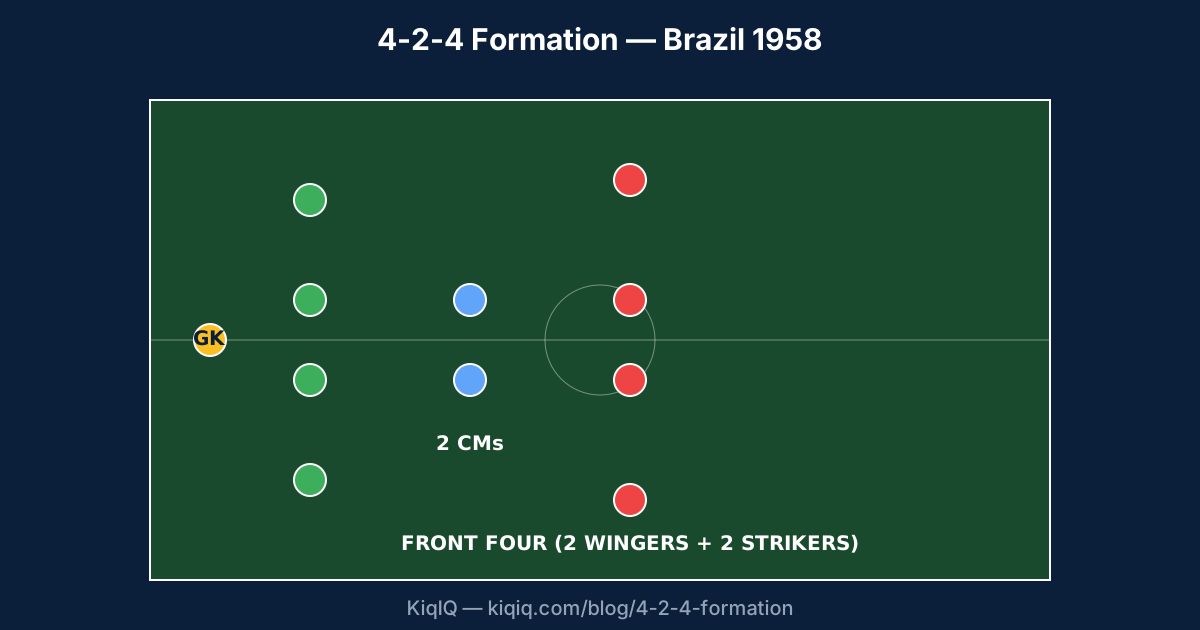
The 4-2-4 is the formation Brazil used to win the 1958 World Cup — four defenders, two central midfielders, and four attackers (two wingers + two strikers). It was a tactical revolution at the time, replacing the dominant WM (3-2-2-3) formation. Pelé scored 6 goals at age 17 in that tournament. Modern football rarely uses pure 4-2-4 because the 2-CM midfield is exposed, but it influenced flexible variants used today.
The 4-2-4 structure
- Goalkeeper. Standard role.
- Back four. Two CBs + two attacking full-backs (rare innovation in 1958).
- Two central midfielders. One CDM + one CAM, or two box-to-box players.
- Front four. Two wingers + two strikers. Both wingers stay wide; both strikers stay central.
Brazil 1958 was the first major international side to play a back four (most contemporaries used a back three or back five). The 4-2-4 was a radical break from the WM formation that had dominated since the 1930s.
Strengths of 4-2-4
- Attacking firepower. Four forwards = constant attacking presence; multiple goal threats.
- Width through wingers. Two natural wingers provide flank attack without requiring full-backs to overlap.
- Direct counter-attack. When possession is won, four attackers immediately threaten.
Weaknesses
- Outnumbered in midfield. 2 CMs vs 3-4 in any 4-3-3 / 4-2-3-1 / 4-4-2 diamond.
- Vulnerable to possession-based opposition. A team that controls the middle dictates the match.
- Defensive transition risk. When attacks break down, only 6 players are behind the ball.
Modern descendants of 4-2-4
- 4-2-2-2 (Brazilian variant). Two CMs + two attacking midfielders (drifting wide) + two strikers. Modern Brazilian and German variants have used this.
- 4-3-3 with high wingers. Functionally similar attacking shape; one extra CM addresses the midfield weakness.
- 3-4-3 with attacking wing-backs. Three forwards + two wing-backs in attack = 5 forward presences.
- Pure 4-2-4 in modern football. Rare. Used briefly by some Brazilian club sides; almost never at international level.
Brazil 1958 — the iconic side
- Garrincha and Pelé. The two wingers / forwards who defined the era. Pelé scored 6 goals including a hat-trick vs France in the semi-final.
- Didi at central midfield. The most-celebrated CM of the tournament; Player of the Tournament.
- Vavá and Pelé attacking pair. Vavá scored two in the final vs Sweden; Pelé scored two as well.
- Final. Brazil 5-2 Sweden. Pelé scored a famous chip + volley combination at age 17.
Frequently asked questions
- What is the 4-2-4 formation?
- The 4-2-4 is a football formation with 1 goalkeeper, 4 defenders, 2 central midfielders, and 4 attackers (typically 2 wingers + 2 strikers). Brazil used it to win the 1958 World Cup — a tactical revolution at the time, replacing the dominant WM formation.
- Did Brazil really play 4-2-4 at the 1958 World Cup?
- Yes. Brazil's 1958 World Cup-winning side under coach Vicente Feola played a 4-2-4 with Garrincha and Mário Zagallo on the wings, Pelé and Vavá as strikers, and Didi + Zito in central midfield. Pelé scored 6 goals at age 17, including a hat-trick vs France in the semi-final and two in the 5-2 final win over Sweden.
- Why is 4-2-4 rarely used today?
- The 2-man central midfield is exposed against modern 3-CM systems (4-3-3, 4-2-3-1) which dominate possession. A pure 4-2-4 also leaves only 6 players behind the ball when attacks break down, making it vulnerable to counter-attacks. Modern variants like 4-2-2-2 and 3-4-3 address these issues.
- What replaced 4-2-4 in modern football?
- 4-3-3 became the modern default, addressing the midfield-numbers weakness while keeping a three-man front line. The 4-2-2-2 (Brazilian variant) maintains some of the 4-2-4 ethos with two strikers + attacking midfielders rather than wingers.
References
- The Coaches' Voice — 4-2-4 Formation — Coaches' Voice
- FIFA — 1958 World Cup History — FIFA
- IFAB Laws of the Game — IFAB
- Wikipedia — Football Formations History — Wikipedia
Key terms in this article
Ask KiqIQ a follow-up
Get a live, data-driven answer powered by api-football + KiqIQ's Poisson model. Try one of these prompts or write your own.
Try the calculators
Apply the concepts from this article with KiqIQ's free calculators.
Part of pillar
Tactical Intelligence
See every article in this knowledge pillar →
Related
Reviewed by a KiqIQ editor before publication. Spotted an error? Email editor@kiqiq.com — we follow our Corrections Policy.