
3-3-3-1 Formation: Louis van Gaal's Three-Banks System
The 3-3-3-1 uses three banks of three plus a lone striker — Louis van Gaal's signature formation at Ajax, Bayern, and Manchester United. We cover the structure.
 Tap to enlarge
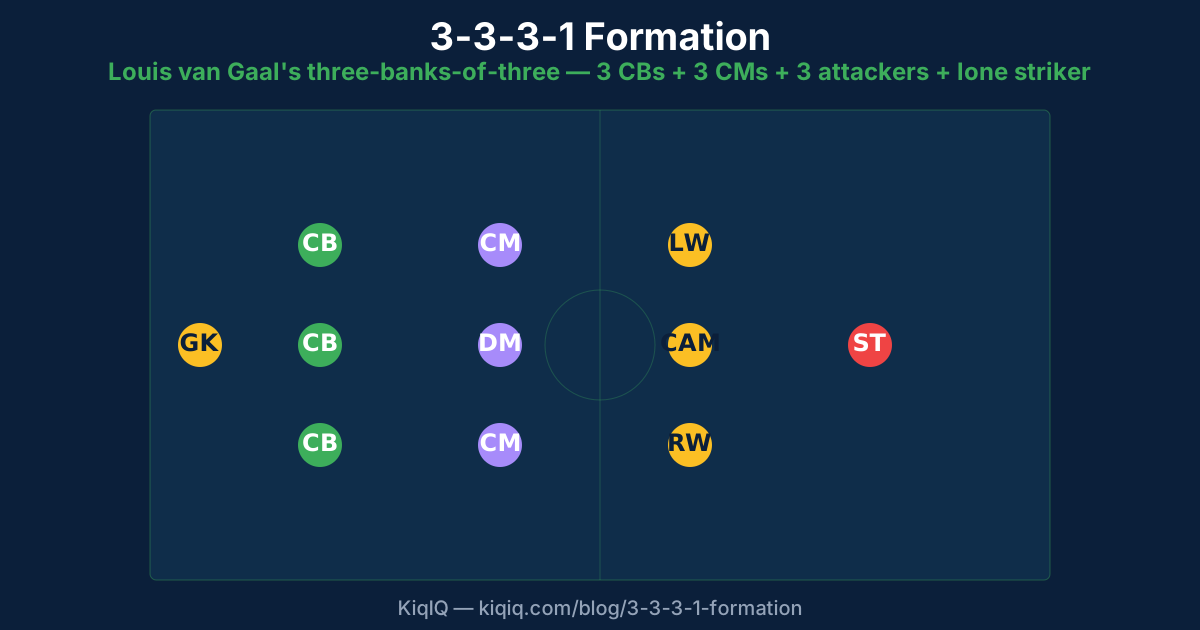
The 3-3-3-1 uses three banks of three players plus a lone striker — Louis van Gaal's signature formation. He used it most famously at Ajax (1991-1997, including the 1995 Champions League win), at Bayern Munich, and during periods at Manchester United. Three CBs + 3 CMs + 3 attackers + 1 CF.
The 3-3-3-1 structure
The 3-3-3-1 stacks the pitch into four horizontal layers, with the back three building, the middle three connecting, the advanced three creating, and a single striker finishing. The defining feature is the symmetry: every band has the same number of players, which produces clean diagonal triangles up and down the pitch and gives every player at least two short-passing options at all times.
- 3 CBs. Standard back three.
- 3 CMs. Mid-band — typically 1 deep + 2 advanced (or all box-to-box).
- 3 attackers. Front-band — 2 wingers / wide attackers + 1 attacking midfielder behind the striker.
- 1 lone striker. Target / pressing forward.
Why van Gaal used it
Van Gaal's coaching philosophy was built around positional clarity — every player knowing exactly where they should be at every phase of play. The 3-3-3-1 codified that philosophy structurally. Bands of three guarantee numerical parity or superiority against any standard opposition shape (4-4-2, 4-3-3, 4-2-3-1), and the geometric regularity makes it unusually easy to coach. Players who joined Ajax during van Gaal's tenure often described the system as the easiest part of the job to learn — the hard part was executing the principles at speed.
- Positional discipline. Each of the three bands has clear positional roles; easier to coach than fluid systems.
- Numerical superiority. 3 CBs vs 1-2 strikers; 3 CMs vs 2-3 opposition CMs; 3 attackers vs 3-4 defenders.
- Build-up clarity. Triangulation between bands creates short-passing options.
- Ajax 1995 UCL win. Won with a 3-3-3-1 / 3-4-3 hybrid.
Strengths + weaknesses
The 3-3-3-1 trades flexibility for clarity. Possession metrics tend to be strong because there is always a short option, and the back three plus advanced midfielders make pressing the team in build-up phases difficult. The cost is that the system has limited dynamic answers when the opposition rotates aggressively — a team that floods one half-space with multiple runners can pull the band of three out of shape, and once the structure breaks the discipline that makes the system work becomes a liability rather than an asset.
- Strength. Possession control + numerical superiority across all bands.
- Strength. Tactically structured — each player has a clear role.
- Weakness. Inflexibility — sticking to bands can be exploited by fluid opposition.
- Weakness. Lone striker can be isolated.
Frequently asked questions
- What is the 3-3-3-1 formation?
- 3-3-3-1 is a football formation with three banks of three players (3 CBs + 3 CMs + 3 attackers) plus a lone striker. It is Louis van Gaal's signature formation, used most famously at Ajax (including the 1995 Champions League win), Bayern Munich, and Manchester United.
- Who plays the 3-3-3-1?
- Louis van Gaal is the canonical example — Ajax 1991-1997 (including 1995 UCL), Bayern Munich, Manchester United. The formation is closely tied to van Gaal's positional-discipline philosophy.
- What is the main strength of 3-3-3-1?
- Numerical superiority across all bands and clear positional discipline. Three CBs match 1-2 strikers; three CMs match 2-3 opposition CMs; three attackers + lone striker create attacking presence. Each player has a clear role, making the system easier to coach than fluid alternatives.
References
- The Field of Green — 3-3-1-3 vs 3-3-3-1 — The Field of Green
- IFAB Laws of the Game — IFAB
- Total Football Analysis — Formations — Total Football Analysis
Key terms in this article
Ask KiqIQ a follow-up
Get a live, data-driven answer powered by api-football + KiqIQ's Poisson model. Try one of these prompts or write your own.
Try the calculators
Apply the concepts from this article with KiqIQ's free calculators.
Part of pillar
Tactical Intelligence
See every article in this knowledge pillar →
Related
Reviewed by a KiqIQ editor before publication. Spotted an error? Email editor@kiqiq.com — we follow our Corrections Policy.