
Southampton Football Club, St Mary's, Saints, 1885 to Today
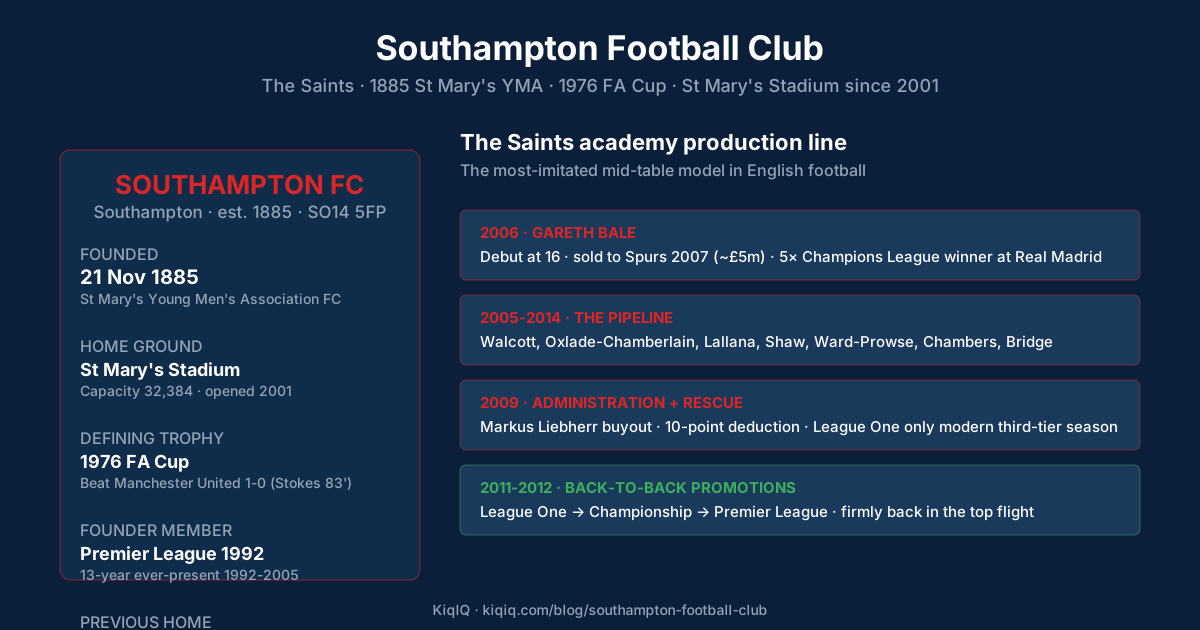
Southampton Football Club (the Saints) was founded in 1885 by members of St Mary's Young Men's Association in Southampton. The club plays at St Mary's Stadium (capacity 32,384), won the FA Cup in 1976 against Manchester United, and has been a Premier League fixture since 2012 with a notable youth-development pedigree.
 Tap to enlarge
Southampton Football Club: universally known as the Saints: was founded in November 1885 by members of the St Mary's Young Men's Association in Southampton, England. The club plays at St Mary's Stadium (capacity 32,384), which opened in 2001 as a direct replacement for The Dell, their home of 103 years. Southampton's defining honour is the 1976 FA Cup: Bobby Stokes' goal beat Manchester United 1-0 at Wembley. The club has spent the bulk of its modern era in the Premier League and is widely respected for one of English football's most productive academy systems.
Where is Southampton Football Club
Southampton play their home matches at St Mary's Stadium on Britannia Road in the St Mary's district of central Southampton (SO14 5FP). The ground sits about a mile north-east of Southampton city centre, walkable from Southampton Central railway station in roughly 20 minutes. St Mary's has a capacity of 32,384 and has been the club's home since opening on 1 August 2001, replacing the historic The Dell ground that had served the club since 1898.
The naming of the district, the original founding YMA, the modern stadium, and the city's own patron saint all derive from St Mary's Church, making 'St Mary's' the most repeated word in Saints supporters' vocabulary. The club's nickname the Saints follows the same lineage.
St Mary's Stadium · capacity 32,384 · opened 1 August 2001 · replaced The Dell after 103 years.
An 1885 founding by the church Young Men's Association
Southampton was founded on 21 November 1885 as St Mary's Young Men's Association FC, by members of the St Mary's Church YMA in Southampton. The club shortened to St Mary's FC in 1887, then to Southampton St Mary's in 1894, and finally to Southampton FC in 1897 after turning professional. The St Mary's lineage shows up in the nickname and the ground but the operational club name has been Southampton FC for over a century.
Southampton joined the Southern League in 1894 (rather than the Football League, which was Midlands- and North-dominated at the time) and dominated it, six Southern League titles before 1904. The club was elected to the Football League Third Division in 1920 when the Southern League's top division merged in en masse.
The 1976 FA Cup: Bobby Stokes and Manchester United
Southampton's defining moment is the 1 May 1976 FA Cup final. The Saints were in the Second Division at the time; their opponents Manchester United were riding high in the top flight. With seven minutes remaining at Wembley, Bobby Stokes beat the United offside trap and slid the ball past Alex Stepney for the only goal of the match. Final score: Southampton 1, Manchester United 0.
The win remains one of the most-cited cup upsets in English football history. Stokes (a Portsmouth boy raised in the Pompey-Saints heartland) became a permanent Southampton icon; the club's first-team route from the academy entrance is still named for him. Manager Lawrie McMenemy built that side around veteran signings (Peter Osgood, Jim McCalliog, Mick Channon) blended with academy graduates, a recipe that has surfaced repeatedly in Southampton's history.
The Dell to St Mary's, a 103-year transition
From 1898 to 2001, Southampton played at The Dell on Milton Road. The ground's distinctive feature was its tightness, capacity ~15,200 at its post-Taylor-Report all-seater configuration, with the touchlines closer to the stands than almost any modern English stadium. Famous Dell moments include Matt Le Tissier's repeated single-handed match-winning performances through the 1990s.
St Mary's Stadium opened in 2001 as a fully bowled-in 32,500-seater, designed by HOK Sport (now Populous). The Dell was demolished and converted into a residential development; the street naming preserves the historic ground location (St Denys Drive, McCarthy & Stone Dell housing). St Mary's has been Southampton's home since the start of the 2001-02 season and remains the club's only contemporary home.
The academy reputation: Bale, Walcott, Oxlade-Chamberlain, Shaw
Southampton's modern reputation rests heavily on its academy, which has produced an unusually long list of Premier League and international players over the past two decades:
- Gareth Bale: promoted from the academy to the first team in 2006 aged 16. Sold to Tottenham 2007 for ~£5m; subsequently Real Madrid and a five-time Champions League winner.
- Theo Walcott: debut at 16 in 2005; sold to Arsenal 2006 in a deal worth up to £12m.
- Alex Oxlade-Chamberlain: academy graduate; sold to Arsenal 2011, Liverpool 2017.
- Luke Shaw: academy graduate; sold to Manchester United 2014 for £30m+, one of the highest fees ever paid for a teenager at the time.
- Adam Lallana: academy graduate, captain at age 23; sold to Liverpool 2014 for ~£25m.
- Calum Chambers, James Ward-Prowse, Wayne Bridge, Theo Lewis, Tyrone Mings (briefly): a long tail of academy graduates who have since featured for England or top-six clubs.
The Southampton selling-club financial model
The financial model, develop, sell to top clubs, reinvest in the squad and academy, has made Southampton one of English football's most-imitated mid-table operators. The cycle has been criticised in supporter circles when first-team performance suffers, but the underlying academy infrastructure has remained productive across multiple sporting directors and head coaches.
The Premier League era and 2009 administration
Southampton was a Premier League ever-present from 1992 to 2005, a 13-year run that included the Le Tissier era, the FA Cup final of 2003 (lost to Arsenal), and the move to St Mary's. Relegation in 2005 was followed by financial collapse in 2009: Southampton entered administration, were docked 10 points, and dropped into the third tier for the only time in the club's modern history.
Markus Liebherr: Swiss-German industrialist, bought the club out of administration in July 2009 and triggered a sustained investment programme. Liebherr died in 2010; his daughter Katharina Liebherr completed the recovery. Southampton won promotion from League One in 2011, the Championship in 2012, and have spent most of the years since in the Premier League.
Honours and notable history
Southampton's major honours:
- FA Cup: 1: 1975-76 (Stokes goal vs Manchester United).
- FA Cup runners-up: twice: 1900 (vs Bury) and 2003 (vs Arsenal).
- League Cup runners-up: twice: 1979, 2017.
- Football League Trophy: 1: 2009-10 (during the League One season).
- Football League Third Division South: champions 1921-22.
- Highest league finish: 2nd in the First Division, 1983-84 (under Lawrie McMenemy).
- Notable record: produced more England internationals from a single academy than any other south-coast club in modern history.
How to visit St Mary's
Three practical visit tips:
- Train. Southampton Central is the closest mainline station, about 20 minutes' walk to the ground via the city centre. Match-day shuttle buses operate from Central during peak fixtures.
- Match-day demand. Premier League fixtures at St Mary's sell out the season-ticket allocation; general-sale availability varies by opposition. The South Stand (the supporter end) is the loudest section.
- Tour the stadium. Self-guided and guided tours cover the home and away dressing rooms, the pitchside tunnel, the press conference room, and the Saints Hall of Fame. Book via southamptonfc.com.
Frequently asked questions
- Where is Southampton Football Club based?
- Southampton Football Club plays at St Mary's Stadium on Britannia Road in the St Mary's district of central Southampton, England (SO14 5FP). The ground has a capacity of 32,384 and has been the club's home since opening on 1 August 2001, replacing The Dell after 103 years of use. Southampton Central railway station is about 20 minutes' walk to the stadium.
- When was Southampton FC founded?
- Southampton FC was founded on 21 November 1885 as St Mary's Young Men's Association FC by members of St Mary's Church YMA in Southampton. The club shortened to St Mary's FC in 1887, became Southampton St Mary's in 1894, and adopted the present name Southampton FC in 1897 after turning professional. The St Mary's lineage survives in the nickname 'the Saints' and in the name of the current stadium.
- What is Southampton's biggest trophy?
- Southampton's biggest trophy is the 1976 FA Cup, won by beating Manchester United 1-0 in the Wembley final on 1 May 1976. Bobby Stokes scored the only goal with seven minutes remaining. Southampton were a Second Division side at the time, making the result one of the most-cited cup upsets in English football history. Manager Lawrie McMenemy built the side around a blend of veteran signings and academy graduates.
- Which players came through the Southampton academy?
- Southampton's academy has produced an unusually long list of Premier League and international players, including Gareth Bale, Theo Walcott, Adam Lallana, Luke Shaw, Alex Oxlade-Chamberlain, James Ward-Prowse, Calum Chambers and Wayne Bridge. The financial model of developing players and selling them to top-six clubs has been one of the most-imitated mid-table operations in English football.
References
- Southampton FC, Official Site — Southampton FC
- Premier League, Southampton — Premier League
- BBC Sport, Southampton — BBC Sport
- RSSSF historical English tables — RSSSF
Key terms in this article
Ask KiqIQ a follow-up
Get a live, data-driven answer powered by api-football + KiqIQ's Poisson model. Try one of these prompts or write your own.
Part of pillar
Football Culture
See every article in this knowledge pillar →
Related
Reviewed by a KiqIQ editor before publication. Spotted an error? Email editor@kiqiq.com — we follow our Corrections Policy.