
Nutrition for Football Players: Pre-Match, In-Match and Post-Match Timing
A football-specific nutrition guide covering carbohydrate loading, pre-match meals, in-match fuelling, and post-match recovery. Built on UEFA, FIFA and Academy of Nutrition and Dietetics guidance.
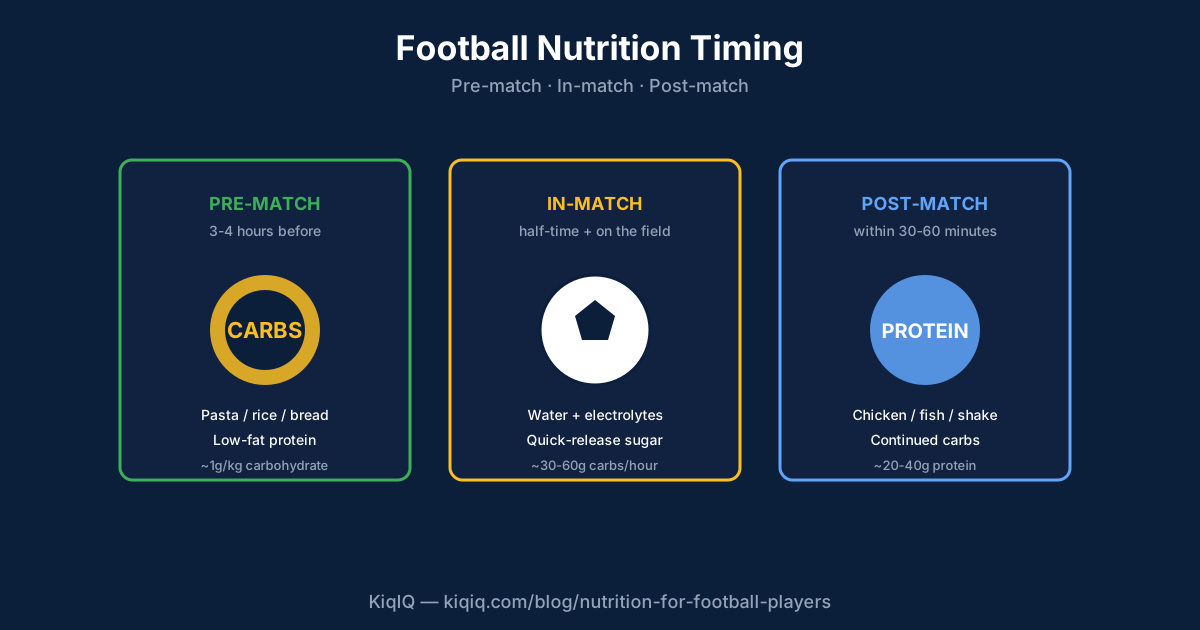 Tap to enlarge
Football nutrition is a fuelling and recovery problem, not a weight-loss problem. A 90-minute match consumes 1,000-1,400 kilocalories for a senior outfield player, with roughly 60-70% drawn from carbohydrate stores in muscle and liver. The job of the nutritional plan is to fill those stores before the match, top them up during the match, and refill them after the match in time for the next training session. The evidence base, summarised in the UEFA Expert Group consensus on nutrition and the joint statement from the Academy of Nutrition and Dietetics, the Dietitians of Canada and the American College of Sports Medicine, is now mature enough to translate into a simple matchday timeline.
Carbohydrate is the limiting fuel
A senior footballer running roughly 10-12 km in a match, with around 1-2 km of that at high speed, draws roughly 60-70% of total energy from carbohydrate. Muscle glycogen stores hold approximately 400-500 grams of carbohydrate in a trained athlete, and full depletion takes around 90 minutes of intermittent high-intensity exercise, which is precisely the duration of a football match. The implication is that a footballer starting a match with depleted glycogen stores will run out of fuel in the second half, which manifests as reduced sprint output, slower decision-making and increased injury risk in the final 20 minutes.
The UEFA Expert Group on Nutrition (Collins et al., 2021, British Journal of Sports Medicine) recommends a daily carbohydrate intake of 6-8 g per kg of body weight during weeks containing a competitive match, rising to 8-10 g per kg in the 24-36 hours before kick-off. For a 75 kg outfield player, that translates to roughly 600-750 g of carbohydrate on a heavy training day and 750 g on the day before a match.
Football is a glycogen sport. The single biggest nutritional lever is making sure muscle glycogen is full at kick-off. Everything else is secondary.
The pre-match plan: 24 hours out to kick-off
24-36 hours out, the focus is carbohydrate loading. A normal-sized dinner the night before a match should be carbohydrate-heavy: pasta, rice, potatoes, bread, with a moderate protein source. Fat and fibre should be moderate to avoid gastrointestinal disruption the next day. Hydration should be tracked through urine colour, aiming for pale yellow on the morning of the match.
3-4 hours before kick-off is the pre-match meal. The target is 1-3 g of carbohydrate per kg of body weight in a meal that empties the stomach before the warm-up. Typical examples include porridge with banana and honey, a chicken and rice bowl, pasta with tomato sauce, or a substantial sandwich. Protein should be moderate (15-25 g) and fat low to medium. Players with sensitive stomachs go closer to the 3-hour mark; players with robust digestion can sit closer to the 4-hour mark.
60 minutes before kick-off is the top-up window. A small carbohydrate snack of 30-60 g supports the warm-up without overloading the gut: a banana, an energy gel, a small bowl of cereal, a sports drink. Caffeine is widely used in this window (3-6 mg per kg, the equivalent of one strong coffee or a 200 mg caffeine gel), with evidence from the UEFA group and ACSM supporting performance improvements in sprint output and cognitive performance during the second half (Collins et al., 2021).
In-match fuelling and hydration
Carbohydrate intake during the match is restricted to the half-time interval and any natural stoppage. The most reliable vehicle is an isotonic sports drink delivering 30-60 g of carbohydrate per 500 ml, with a sodium concentration of around 0.5-0.7 g per litre to support fluid uptake. Many clubs supplement with carbohydrate gels in the changing room at half-time, particularly for players with high sprint loads in the first half.
Hydration losses are weather and intensity dependent. In temperate conditions, a player will lose 1-2 litres of sweat across a match; in hot conditions, sweat losses can reach 3-4 litres. The practical rule from the FIFA Sports Medical Committee is to weigh players pre- and post-match in the early weeks of a season and target a fluid replacement that limits weight loss to under 2% of body mass during the match. Players whose sweat tests show high sodium losses (the "salty sweater" phenotype) benefit from higher-sodium drinks during and after the match.
Post-match recovery: the 30-60 minute window
The post-match window is when glycogen resynthesis runs fastest. The Academy of Nutrition and Dietetics, Dietitians of Canada and ACSM joint position statement (2016) recommends 1.0-1.2 g of carbohydrate per kg of body weight per hour for the first 2-4 hours after exercise, paired with 20-25 g of high-quality protein within 30-60 minutes of the final whistle to support muscle protein synthesis. For a 75 kg player, that is roughly 75-90 g of carbohydrate and 20-25 g of protein in the first post-match meal.
The practical implementation in elite settings is a recovery shake or chocolate milk on the team coach immediately after the match (delivering roughly 60-80 g carbohydrate and 20-25 g protein), followed by a full meal within 90-120 minutes of the final whistle. Tart cherry juice has emerging evidence for reducing post-match inflammation and soreness, with the UEFA group noting its routine use at several Champions League clubs (Bell et al., applied physiology studies cited in Collins et al., 2021).
Sleep is the single largest recovery lever after the post-match meal. Players who consistently sleep 8-9 hours show measurably better recovery markers than those who sleep 6-7 hours, and the marginal returns from supplementation are dwarfed by the marginal returns from sleep duration.
What changes for amateur and youth players
The framework above is built for senior elite players running 10-12 km per match. Amateur Saturday-morning footballers run closer to 6-8 km per match at lower intensity, with proportionally lower glycogen demands. The practical adjustment is to scale carbohydrate intake to roughly 4-6 g per kg per day on match week rather than 6-10 g per kg, and to keep the pre-match meal lighter (1-2 g per kg of carbohydrate rather than 2-3 g per kg).
Youth players have higher relative energy needs because they are still growing, but smaller stomachs and less tolerance for large pre-match meals. The pragmatic approach for youth football is to spread carbohydrate intake across the day rather than concentrating it in one large meal, with an emphasis on hydration and a familiar pre-match snack that the player has eaten in training without gastric issues. Avoid introducing new foods, supplements or caffeine on matchday, which is the most common cause of preventable matchday gastric upset across all ages.
- 24-36 hours out. Carbohydrate-rich dinner, hydration to pale-yellow urine. Avoid alcohol.
- 3-4 hours before. Pre-match meal: 1-3 g/kg carbohydrate, moderate protein, low fat. Pasta, rice, chicken, bread.
- 60 minutes before. Top-up snack: 30-60 g carbohydrate. Banana, gel, sports drink. Optional caffeine 3-6 mg/kg.
- Half-time. Isotonic drink, optional carbohydrate gel. Sodium top-up if sweat losses are high.
- 0-60 minutes post-match. Recovery shake or chocolate milk: 60-80 g carb, 20-25 g protein. Full meal within 90-120 minutes.
Frequently asked questions
- What should a footballer eat before a match?
- A carbohydrate-heavy meal 3-4 hours before kick-off (pasta, rice, potatoes, sandwich), targeting 1-3 grams of carbohydrate per kg of body weight, with moderate protein and low fat. Then a small carbohydrate snack 60 minutes before kick-off: a banana, an energy gel or a small bowl of cereal. Avoid new foods on matchday.
- How much should a footballer drink during a match?
- Aim to limit body-mass loss to under 2% during the match. In temperate conditions, that is roughly 500-1000 ml of fluid across the 90 minutes, split between the warm-up, half-time and natural stoppages. Use an isotonic sports drink delivering 30-60 g of carbohydrate per 500 ml with a sodium content of around 0.5-0.7 g per litre.
- Is caffeine allowed in football?
- Yes. WADA removed caffeine from the banned list in 2004 and it is permitted in all FIFA, UEFA and national-league competitions. The UEFA Expert Group recommends 3-6 mg per kg of body weight taken 45-60 minutes before kick-off, which improves sprint output and cognitive performance. That is roughly one strong coffee or a 200 mg caffeine gel for a 70-80 kg player.
- What should a footballer eat after a match?
- A recovery shake or chocolate milk within 30-60 minutes of the final whistle, delivering 60-80 grams of carbohydrate and 20-25 grams of high-quality protein, followed by a full meal within 90-120 minutes of full-time. The 0-2 hour window is when glycogen resynthesis runs fastest, which makes early refuelling more effective than late refuelling.
- Does carbohydrate loading work for football?
- Yes, but the modern version is moderate rather than the extreme depletion-loading protocols of the 1970s. The UEFA Expert Group recommends 8-10 g of carbohydrate per kg of body weight in the 24-36 hours before kick-off, rather than depletion followed by overload. The goal is to start the match with muscle glycogen at full capacity, which extends the second-half sprint output.
References
- UEFA Expert Group statement on nutrition in elite football — British Journal of Sports Medicine (Apr 2021)
- Nutrition and Athletic Performance, joint position statement — Academy of Nutrition and Dietetics / Dietitians of Canada / ACSM (Mar 2016)
- FIFA Sports Medical Committee: hydration and nutrition guidance — FIFA
- English Institute of Sport: football nutrition resources — UK Sports Institute (formerly English Institute of Sport)
- The Athletic: how Premier League clubs feed their players — The Athletic
Ask KiqIQ a follow-up
Get a live, data-driven answer powered by api-football + KiqIQ's Poisson model. Try one of these prompts or write your own.
Part of pillar
Performance Science
See every article in this knowledge pillar →
Related
Reviewed by a KiqIQ editor before publication. Spotted an error? Email editor@kiqiq.com — we follow our Corrections Policy.