
Celtic Football Club, History, Lisbon Lions, Old Firm
Celtic Football Club, founded by Brother Walfrid in 1887 to feed the Irish immigrant poor of Glasgow's East End, plays at Celtic Park, the largest football ground in Scotland (60,411 capacity). Celtic are the Scottish league's most successful club, contest the Old Firm derby with Rangers, and in 1967 became the first British club to win the European Cup as the Lisbon Lions.
 Tap to enlarge
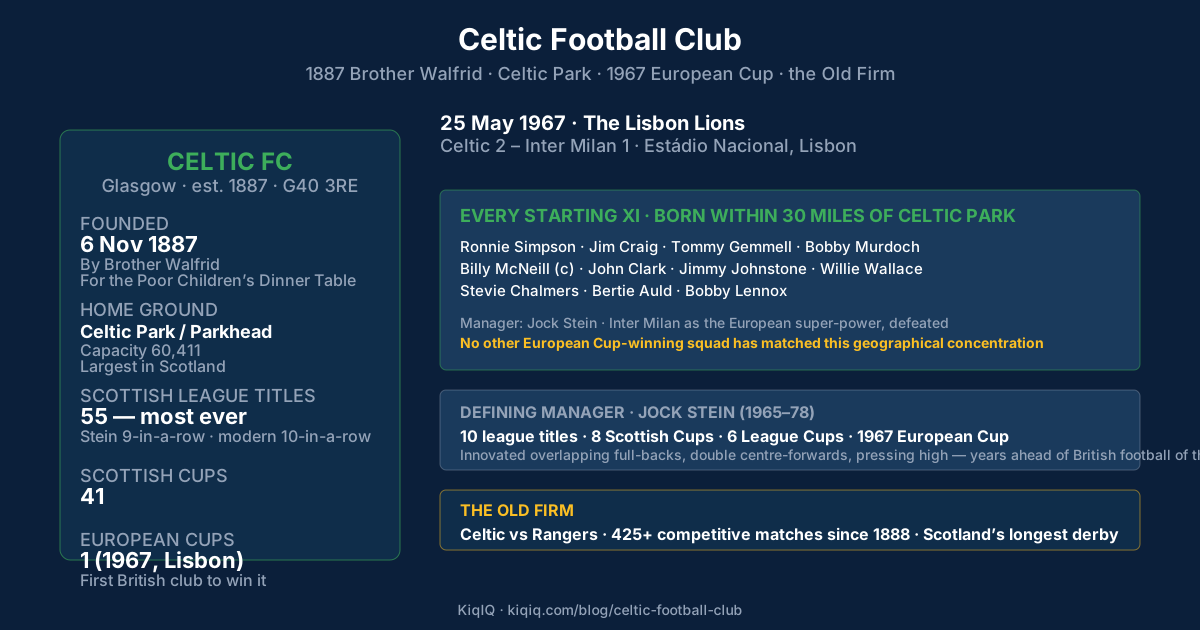
Celtic Football Club is a professional football club based in the east end of Glasgow, Scotland, founded in November 1887 by Marist Brother Andrew Kerins (Brother Walfrid) as a fundraising vehicle for the poor Irish-Catholic immigrant population of Glasgow's East End. Celtic play home matches at Celtic Park (capacity 60,411, the largest football ground in Scotland), have won the Scottish league title more times than any other club, contest the Old Firm derby with Rangers, and in 1967 became the first British club to win the European Cup: the Lisbon Lions, the only European Cup-winning squad to be made up entirely of players born within 30 miles of the home ground.
Where is Celtic Football Club
Celtic play their home matches at Celtic Park on Janefield Street in the Parkhead area of Glasgow's East End (G40 3RE). Celtic Park is the largest football stadium in Scotland: capacity 60,411: and the eighth-largest in the United Kingdom overall. The ground is universally referred to as Parkhead or Paradise by supporters and Scottish media.
Celtic Park is roughly two miles east of Glasgow city centre, walkable from Bridgeton railway station (~15 minutes) or accessible by direct buses from the city centre and Glasgow Central. Parking inside the immediate stadium cordon is restricted on match days; the club operates park-and-ride services from outlying locations.
Celtic Park · 60,411 capacity · largest football stadium in Scotland · home of Celtic since 1892 (current site).
An 1887 charitable founding: Brother Walfrid
Celtic was founded on 6 November 1887 at a meeting in St Mary's Church Hall in the East End of Glasgow. The driving force was Brother Walfrid: born Andrew Kerins in County Sligo, Ireland in 1840, a Marist Brother running St Mary's School in Calton. The explicit purpose: to raise funds for The Poor Children's Dinner Table, a charitable initiative feeding undernourished Irish-Catholic children in Glasgow's slums, of which there were many tens of thousands following the Irish famine emigration.
Celtic's first match took place on 28 May 1888 at the original Celtic Park (a different site, ~200 metres from the current ground), Celtic 5, Rangers 2. The opening fixture against Rangers established a rivalry that has continued for nearly 140 years. Within two years Celtic had moved to the present Celtic Park site (1892) and won their first Scottish Cup (1892); within four years they had won their first Scottish league title (1892-93).
The Lisbon Lions: 1967 European Cup
Celtic's defining moment is the 25 May 1967 European Cup final at the Estádio Nacional in Lisbon, where the Glasgow club beat heavily favoured Internazionale 2-1 to become the first British club to win the European Cup. The team, managed by Jock Stein: has been known ever since as the Lisbon Lions.
What makes the achievement extraordinary is the squad composition. Every player in the starting XI was born within 30 miles of Celtic Park. Goalkeeper Ronnie Simpson (Glasgow), Jim Craig (Glasgow), Tommy Gemmell (Motherwell), Bobby Murdoch (Bothwell), Billy McNeill (Bellshill, captain), John Clark (Bellshill), Jimmy Johnstone (Uddingston), Willie Wallace (Kirkintilloch), Stevie Chalmers (Glasgow, scored the winner), Bertie Auld (Glasgow), Bobby Lennox (Saltcoats). No other European Cup-winning squad has come from such a small geographical area, before or since.
Inter took an early lead via a Sandro Mazzola penalty in the 7th minute. Celtic equalised through Gemmell on 63 and won it via Chalmers on 84. Stein's tactical approach, fast wing play, relentless pressing, complete fitness, had been heavily influenced by his observations of Hungary's 1953 victory at Wembley and the Brazilian sides of the early 1960s.
Scottish league titles: most-ever
Celtic are the most successful club in Scottish league football by titles won, with 55 Scottish league championships (counting the various pre-SPL divisions and the modern Scottish Premiership). Major distinctions:
- Nine-in-a-row, 1965-66 to 1973-74: Jock Stein's most extraordinary domestic run, nine consecutive Scottish league titles, a Scottish record at the time.
- Treble Trebles, 2016-17 to 2018-19: under Brendan Rodgers and then Neil Lennon, Celtic won the Scottish Premiership, Scottish Cup and Scottish League Cup in three consecutive seasons. The 2016-17 league season was won unbeaten, only the third club ever to manage an unbeaten Scottish top-flight season since the Premier Division was formed in 1975 (Rangers 1898-99 had a 100% record under the old format).
- Scottish Cup: 41 wins.
- Scottish League Cup: 21 wins.
- Quadruple Treble (2016-17 to 2019-20): Celtic took the Scottish League Cup in each of four consecutive seasons alongside league and cup doubles in most. The 2019-20 Scottish Premiership was awarded after the Covid-related early curtailment.
The Old Firm: Celtic vs Rangers
Celtic's deepest rivalry is the Old Firm derby with Glasgow neighbours Rangers. The two clubs have contested over 425 competitive fixtures since 1888, Scotland's longest-running derby and one of the most-watched in world football. The Old Firm is the only fixture in British football that combines geography, religion, politics and culture in a single 90 minutes.
Celtic historically represents Glasgow's Irish-Catholic immigrant heritage; Rangers historically represents the city's Scottish-Protestant heritage. Both clubs have made sustained efforts to move on from sectarianism in their stands, but the cultural roots of the rivalry remain part of the fixture's identity. UEFA and the Scottish FA have intermittently sanctioned both clubs over sectarian chanting from supporter sections; both clubs publicly distance themselves from it.
All-time competitive head-to-head sits very close to even, with Celtic holding a marginal recent advantage. Recent decades have seen Celtic dominate domestically for long stretches (the nine-in-a-row of 2011-12 to 2019-20 included), with Rangers' financial collapse in 2012 contributing to that. Rangers re-entered the SPL top flight in 2016-17 and have been competitive again since.
Jock Stein: the defining manager
Jock Stein managed Celtic from 1965 to 1978 and is the defining figure in the club's modern history. A former Welsh-league miner-footballer who joined Celtic as a player in 1951 and captained the side as a centre-back, Stein moved into coaching after a 1955 ankle injury ended his playing career.
Stein's Celtic won ten Scottish league titles (including the 1965-66 to 1973-74 nine-in-a-row), eight Scottish Cups, six Scottish League Cups, the 1967 European Cup, and reached the 1970 European Cup final (losing to Feyenoord). His tactical innovations, overlapping full-backs, double centre-forwards, pressing high, were genuinely ahead of British football of his era.
Stein died in 1985 at Ninian Park, Cardiff, after a fatal heart attack while managing Scotland against Wales in a World Cup qualifier. He was 62. The North Stand at Celtic Park was renamed the Jock Stein Stand in his memory; a statue of Stein stands outside the stadium alongside Brother Walfrid and Billy McNeill.
Honours and notable history
Celtic's distinctions beyond the headline trophies:
- European Cup / Champions League: 1: 1966-67, beating Inter Milan 2-1 in Lisbon. Reached the final again in 1970, the semi-finals in 1972 and 1974.
- Founder member of the SFA: Celtic joined the Scottish Football Association shortly after founding in 1887, and have spent the entire SFA era in the top flight (with brief mid-1990s administrative scares around financial restructuring, never relegation).
- Unbeaten league season: 2016-17 under Brendan Rodgers. 34 wins, 4 draws, 0 losses in the Scottish Premiership.
- Celtic Park redevelopment: three of the four stands rebuilt 1995-1998 to current capacity, briefly making Celtic Park the largest club ground in Britain ahead of Old Trafford (since surpassed).
- Brother Walfrid statue: installed outside Celtic Park in 2005, depicting Walfrid with a football and offering bread to a hungry child. The dedication ceremony reaffirmed the club's charitable origins.
- Celtic Foundation: the modern continuation of the Brother Walfrid charitable ethos, raising £50m+ since its formation for community causes in Glasgow's East End and across Scotland.
How to visit Celtic Park
Three practical visit tips:
- Train. Bridgeton railway station (~15 minutes' walk) and Dalmarnock (~10 minutes') are the closest. ScotRail runs frequent services from Glasgow Central and Argyle Street. London Road bus routes from Glasgow city centre are heavily used on match days.
- Match-day demand. Celtic Park is consistently among the highest-occupancy grounds in Britain. Season tickets are sold to a long waiting list; individual Premiership fixtures (especially Old Firm) sell out via the membership scheme well before general sale.
- Tour Celtic Park. The Celtic Park Stadium Tour visits the home dressing room, the tunnel, the trophy room and the Brother Walfrid statue. Tours run most non-match days; book via celticfc.com. The on-site Celtic FC Museum holds the 1967 European Cup and Lisbon Lions memorabilia.
Frequently asked questions
- Where is Celtic Football Club based?
- Celtic Football Club plays home matches at Celtic Park (also known as Parkhead or Paradise) on Janefield Street in the East End of Glasgow, Scotland (G40 3RE). Celtic Park is the largest football stadium in Scotland with a capacity of 60,411 and the eighth-largest in the United Kingdom. The current site has been Celtic's home since 1892, when the club moved from the original Celtic Park about 200 metres away.
- When was Celtic Football Club founded?
- Celtic Football Club was founded on 6 November 1887 at a meeting in St Mary's Church Hall in the East End of Glasgow. The founder was Brother Walfrid (born Andrew Kerins in County Sligo, Ireland) a Marist Brother who ran St Mary's School in Calton. The explicit purpose was to raise funds for The Poor Children's Dinner Table, a charity feeding undernourished Irish-Catholic children in Glasgow's slums. Celtic's first match was on 28 May 1888, a 5-2 win over Rangers, establishing the Old Firm rivalry from day one.
- Who were the Lisbon Lions?
- The Lisbon Lions are the Celtic squad that won the 1967 European Cup, becoming the first British club to lift the trophy. On 25 May 1967 at the Estádio Nacional in Lisbon, Celtic beat Internazionale 2-1, goals from Tommy Gemmell and Stevie Chalmers cancelling out a Sandro Mazzola penalty. Every player in the starting XI was born within 30 miles of Celtic Park, a geographical concentration no European Cup-winning squad has matched before or since. Manager Jock Stein had built the side on fast wing play, relentless pressing and complete fitness.
- How many Scottish league titles have Celtic won?
- Celtic have won 55 Scottish league championships, the most of any club in Scottish football history. The club's most-cited title runs are the Jock Stein nine-in-a-row from 1965-66 to 1973-74 and the modern ten-in-a-row run from 2011-12 to 2019-20 under Neil Lennon and Brendan Rodgers. The 2016-17 Scottish Premiership was won unbeaten, only the third unbeaten Scottish top-flight season since the Premier Division was formed in 1975.
- What is the Old Firm derby?
- The Old Firm is the rivalry between Celtic and Rangers, both based in Glasgow. The two clubs have met over 425 times competitively since 1888, the longest-running and most-watched derby in Scottish football. Celtic historically represents Glasgow's Irish-Catholic immigrant heritage; Rangers historically represents the city's Scottish-Protestant heritage. The derby combines geography, religion, politics and culture in a single 90 minutes, both clubs have worked to move beyond sectarianism in their stands, but the cultural roots of the rivalry remain part of the fixture's identity.
References
- Celtic FC, Official Site — Celtic FC
- SPFL, Celtic club page — Scottish Professional Football League
- BBC Sport, Celtic coverage archive — BBC Sport
- UEFA, 1966-67 European Cup history — UEFA
- Historical Scottish League Tables, RSSSF — RSSSF
Ask KiqIQ a follow-up
Get a live, data-driven answer powered by api-football + KiqIQ's Poisson model. Try one of these prompts or write your own.
Part of pillar
Football Culture
See every article in this knowledge pillar →
Related
Reviewed by a KiqIQ editor before publication. Spotted an error? Email editor@kiqiq.com — we follow our Corrections Policy.