
Why Are Bournemouth Called the Cherries? The Two Theories
AFC Bournemouth are nicknamed the Cherries for two competing reasons: the cherry orchards adjacent to Dean Court and the club's cherry-red shirts. We explain both theories and what the club itself records.
 Tap to enlarge
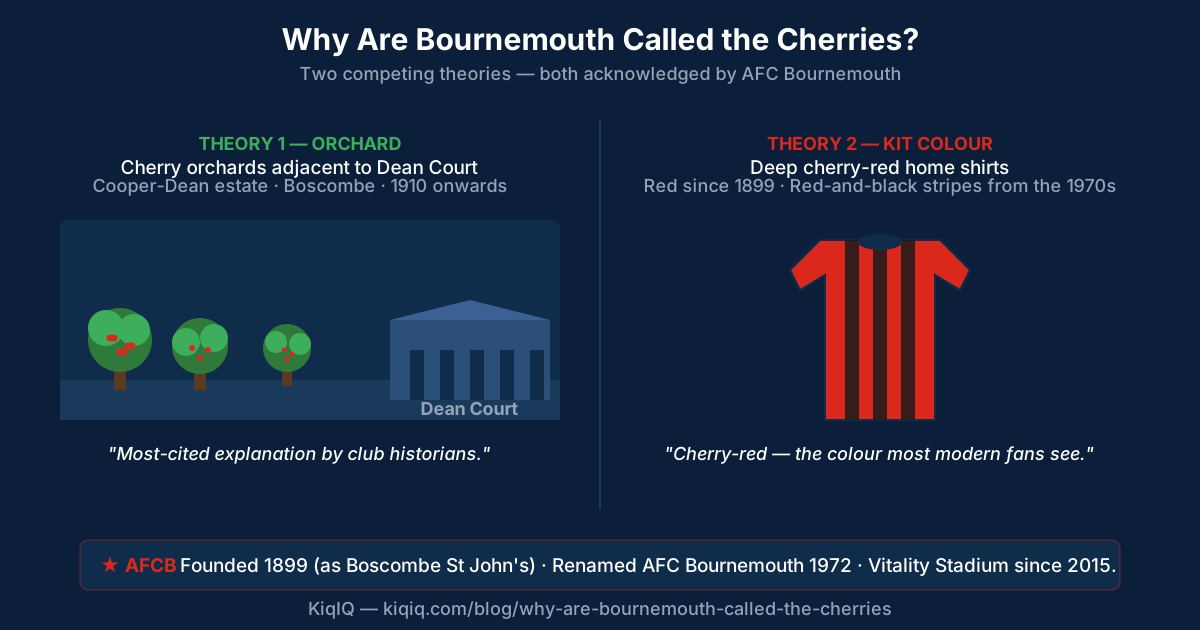
AFC Bournemouth are nicknamed "the Cherries" for one of two reasons — and the club itself acknowledges both. The most-cited theory is the cherry orchard that sat adjacent to the club's original Dean Court ground on the Cooper-Dean estate. The competing theory is the cherry-red colour of the club's home shirts. The orchard explanation is the one most often quoted by the club and local historians; the kit-colour explanation is the simpler one most modern fans know.
Theory 1 — the cherry orchard at Cooper-Dean
AFC Bournemouth's first permanent home was Dean Court, on land owned by the Cooper-Dean family in the King's Park area of Boscombe. The club moved there in 1910 under its earlier name, Boscombe FC.
Local accounts — repeated by the club's own historians and Bournemouth Echo write-ups across the decades — describe cherry orchards on the Cooper-Dean estate adjacent to or surrounding the ground. The nickname "the Cherries" is said to have stuck from supporters and local press references to the orchard setting in the years immediately after the move.
This is the explanation that appears in the club's official history materials and in most published accounts of the nickname's origin. It treats the nickname as a piece of geography — what the ground was next to — rather than a description of the kit.
The Cooper-Dean estate has been continuously associated with AFC Bournemouth for more than 110 years. Vitality Stadium still sits on Cooper-Dean land.
Theory 2 — the cherry-red shirts
The second theory is simpler: the nickname comes from the deep-red, cherry-coloured shirts the club has worn for most of its history. AFC Bournemouth's home colours have been red — usually paired with black or white — since the early 20th century, with red-and-black stripes becoming the iconic look in the 1970s.
This explanation is intuitive but harder to date. The kit-colour theory is more often cited by modern fans, who associate "the Cherries" with the visible cherry-red of the strip rather than with an orchard most match-going supporters never saw. The two theories are not mutually exclusive: it is plausible that the orchard origin took hold first and was reinforced by a kit colour that fit the same word.
The club's own record
AFC Bournemouth's official position has been to acknowledge both theories without picking a winner. The club's published history materials and Vitality Stadium tour content reference the cherry orchards adjacent to Dean Court as the origin most commonly cited, while noting the cherry-red kit as a long-standing alternative explanation.
Local historian write-ups in the Bournemouth Echo over the years have leaned toward the orchard theory as the older and better-attested origin. The kit-colour theory works as a memorable shorthand for modern fans and is technically true — the shirts are cherry-red — but most heritage sources treat the orchard as the historically primary explanation.
A quick history of the club name
The club has been through three names. The nickname predates the current name by decades:
- 1899 — Boscombe St John's Lads' Institute FC. Founded by members of a local church-affiliated youth institute.
- 1923 — Bournemouth & Boscombe Athletic FC. Adopted on election to the Football League Third Division South.
- 1972 — AFC Bournemouth. Renamed to put "AFC" at the front, partly so the club appeared near the top of alphabetical league tables. The Cherries nickname was already well-established by this point.
How the Cherries fit the wider tradition of UK club nicknames
British football nicknames mostly fall into one of four origin categories. The Cherries sits across two of them:
- Geography or local-industry references. The Cherries (orchards), Stoke "the Potters" (Staffordshire pottery), Sheffield United "the Blades" (steel), Luton "the Hatters" (hat-making), Ipswich "the Tractor Boys" (East Anglian agriculture).
- Heraldry and town crests. Derby "the Rams" (county arms), Leicester "the Foxes" (county crest), Sunderland "the Black Cats" (Wearmouth-area folklore + 19th-century battery name).
- Kit colours. Liverpool "the Reds", Chelsea "the Blues", Manchester City "the Sky Blues", Newcastle "the Magpies" (black-and-white). The Cherries can be read as a kit-colour nickname under this heading.
- Animals or mascots. Norwich "the Canaries", Crystal Palace "the Eagles", Sheffield Wednesday "the Owls".
Vitality Stadium today
AFC Bournemouth still play on the original Cooper-Dean site. Dean Court was rebuilt in 2001 as a smaller modern ground — the current capacity is around 11,300, the lowest in the Premier League. It was renamed Vitality Stadium under a sponsorship agreement that began in 2015.
Plans to expand or replace Vitality Stadium have been discussed several times under successive owners — most recently under Black Knight Football Club / Bill Foley's ownership group, who took over in late 2022. As of the 2025-26 season the club continues to play at the original site, with redevelopment options under review.
Frequently asked questions
- Why are AFC Bournemouth called the Cherries?
- AFC Bournemouth are called the Cherries for one of two reasons. The most commonly cited explanation is the cherry orchard adjacent to Dean Court on the Cooper-Dean estate, where the club has played since 1910. The second explanation is the cherry-red colour of the club's home shirts. The orchard theory is the one usually quoted by the club and local historians.
- When did the Cherries nickname start?
- The Cherries nickname is generally dated to the years after Bournemouth's 1910 move to Dean Court — the ground on the Cooper-Dean estate that was reportedly adjacent to cherry orchards. The nickname appears in local press references and supporter accounts from the early decades of the 20th century, well before the club's 1972 rename to AFC Bournemouth.
- Where do AFC Bournemouth play their home matches?
- AFC Bournemouth play at Vitality Stadium — the modern name for Dean Court since the 2015 sponsorship agreement. The ground is on the same Cooper-Dean estate site where the club has played since 1910. Capacity is approximately 11,300, making it the smallest stadium in the Premier League. The club has explored expansion or relocation but continues to play on the original site.
- Is the Cherries nickname official?
- Yes. "The Cherries" is the long-standing official nickname of AFC Bournemouth, used by the club itself, in matchday programmes, by Premier League and EFL communications, and in supporter materials. The cherry motif appears on the club's badge in stylised form. Both the orchard origin and the kit-colour origin are referenced in the club's published history materials.
- Why do AFC Bournemouth wear red and black?
- AFC Bournemouth's red-and-black striped shirts are inspired by AC Milan, adopted in the early 1970s under chairman John Bond and later popularised by manager Harry Redknapp's tenure. Before the stripes, Bournemouth (then Bournemouth & Boscombe Athletic) wore solid red shirts. The cherry-red colour predates the stripes and is the older link to the Cherries nickname's kit-colour theory.
References
- AFC Bournemouth — Official Site — AFC Bournemouth
- Premier League — AFC Bournemouth club page — Premier League
- Vitality Stadium — Stadium Information — AFC Bournemouth
- Bournemouth Echo — AFC Bournemouth coverage archive — Bournemouth Echo
Ask KiqIQ a follow-up
Get a live, data-driven answer powered by api-football + KiqIQ's Poisson model. Try one of these prompts or write your own.
Part of pillar
Football Culture
See every article in this knowledge pillar →
Related
Reviewed by a KiqIQ editor before publication. Spotted an error? Email editor@kiqiq.com — we follow our Corrections Policy.