
The Republic of Ireland Football Pyramid: League Structure and the New National Third Tier
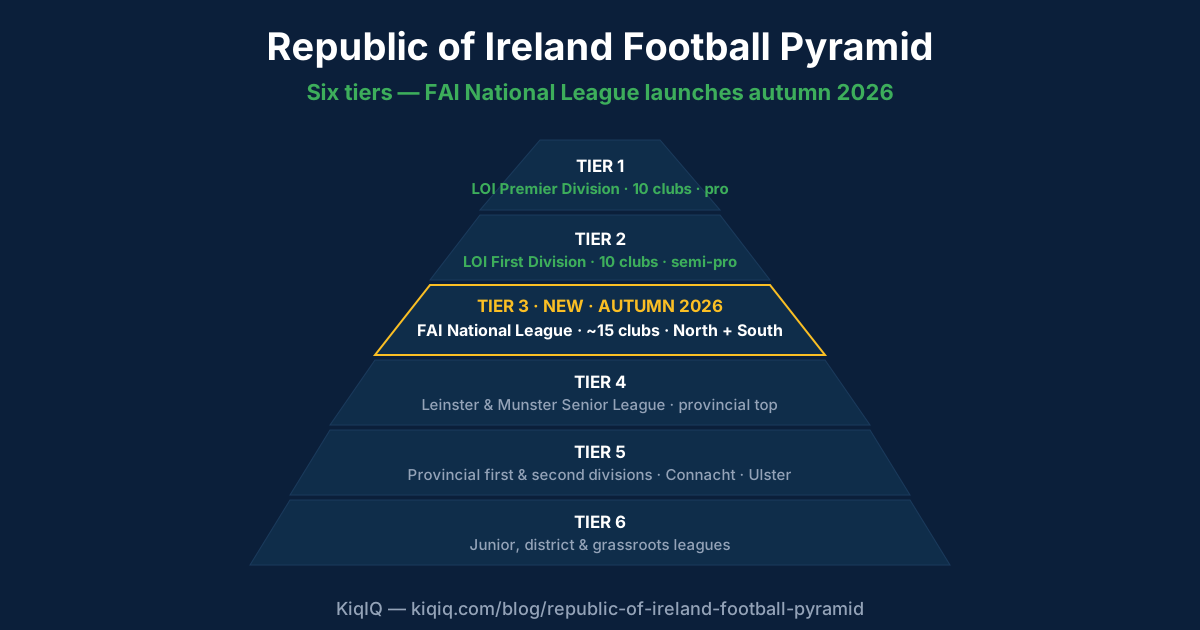
Irish football's domestic pyramid runs from the League of Ireland Premier Division down through provincial, junior and grassroots tiers — with a new FAI National League launching in autumn 2026 to connect the levels.
 Tap to enlarge
Irish football has historically had a wide grassroots base, a small professional top, and a structural gap between them. Below the League of Ireland's two professional divisions, the country has operated a patchwork of provincial senior leagues — Leinster, Munster, primarily — with no automatic promotion ladder into the professional pyramid. The Football Association of Ireland's decision to launch an FAI National League in autumn 2026 as a new Level 3 is the most significant structural change to the domestic pyramid in a generation. Here's how the pyramid sits today and where the new tier fits.
The professional levels (Tiers 1-2)
The top of the Irish pyramid is the League of Ireland Premier Division — ten clubs, full professional contracts at the larger sides, a summer-to-autumn season aligned with the Nordic and Baltic football calendars rather than the traditional European autumn-to-spring. Champions enter the UEFA Champions League qualifying rounds; mid-table clubs typically compete for Conference League qualification.
Below it sits the First Division (Tier 2) — ten clubs, semi-professional in most cases, with promotion to the Premier Division via direct champion promotion plus a playoff. Both divisions are run by the League of Ireland under FAI oversight, with a single transfer window aligned to the European norm.
The FAI National League (Tier 3 from autumn 2026)
The new third tier launches in autumn 2026 and is expected to comprise around 15 clubs, split into planned North and South divisions to manage travel logistics. Its purpose is structural: connect the professional League of Ireland system to the intermediate provincial game, providing a competition rung that previously didn't exist. The FAI has confirmed the format will allow promotion and relegation between Tier 3 and the First Division above, ending the long-standing closed-shop nature of professional Irish football.
For clubs in the intermediate game, the National League represents a viable competitive pathway upward for the first time — a club competing well in the Leinster Senior League can now theoretically progress through a recognised pyramid rather than being structurally capped at the provincial level. For the FAI, the National League is also a player-development pipeline: a wider competitive base allows more players to be exposed to higher-tempo football than the provincial leagues consistently provide.
The FAI National League launches autumn 2026 with ~15 clubs in planned North and South divisions. First time the Irish pyramid has a structural connection between the professional and provincial levels.
Provincial and intermediate football (Tiers 4-6)
Below the new Tier 3 sits the existing intermediate game — primarily the Leinster Senior League and the Munster Senior League at the Premier Division and First Division levels. These were historically the highest non-LOI competitions in their respective regions and have produced clubs that have made successful FAI Cup runs against League of Ireland sides.
Tiers 4-6 in the pre-2026 numbering correspond to provincial senior first divisions, second divisions, and lower divisions of the same provincial systems. Each province (Leinster, Munster, Connacht, Ulster) operates its own structure with its own promotion-and-relegation rules. The lack of cross-provincial standardisation is one of the historical features the FAI National League is partly designed to address.
Junior, district and grassroots tiers
Below intermediate football sits the wide network of junior and district leagues. The Athletic Union League (AUL), United Churches League, Munster Junior League, Wexford Football League, Combined Counties League, Wicklow District League, North Eastern Football League, Carlow & District League and Waterford leagues are among the most established. Many further local leagues operate across all four provinces.
Tiers 7-12 in any nominal pyramid count are largely a convention — the Irish grassroots game has no single national ladder. Promotion and relegation happen within individual league systems rather than between them across provinces. Below organised league football sits amateur, community, and 5/7-a-side competitions, which form the recreational base of the Irish game.
Why the new structure matters
Until the FAI National League launches, there has been no automatic promotion pathway from grassroots Irish football into the professional pyramid. The League of Ireland operated effectively as a closed system, with new club entries decided administratively rather than by promotion from below. That structure was unusual within European football — most national pyramids have continuous promotion-and-relegation from the top to at least Tier 5.
The 2026 reform doesn't fully open the bottom of the pyramid — provincial-to-national progression remains administratively complex below Tier 3 — but it ends the closed-shop nature of professional Irish football for the first time. The longer-term ambition, as articulated in FAI strategic documents, is a continuous pyramid from the Premier Division down to the grassroots, with merit-based progression at every level. Tier 3 is the first structural building block.
- Tier 1: League of Ireland Premier Division (10 clubs, professional).
- Tier 2: League of Ireland First Division (10 clubs, semi-pro).
- Tier 3 (new, autumn 2026): FAI National League (~15 clubs, North + South).
- Tier 4-6: Provincial senior leagues (Leinster, Munster primarily).
- Below: Junior districts, grassroots, recreational competitions.
Frequently asked questions
- What is the top division of football in the Republic of Ireland?
- The League of Ireland Premier Division — 10 clubs, full professional, with a summer-to-autumn season. Champions enter the UEFA Champions League qualifying rounds; mid-table clubs compete for Conference League qualification.
- What is the FAI National League?
- A new third-tier competition launching in autumn 2026, expected to include around 15 clubs split into planned North and South divisions. Its purpose is to connect the professional League of Ireland system to the intermediate provincial game, providing the first formal promotion pathway between the levels.
- How many tiers does the Republic of Ireland football pyramid have?
- Two professional tiers (Premier Division and First Division), one new national tier from autumn 2026 (FAI National League), three to four levels of provincial senior football below that, and a wide network of junior, district and grassroots leagues. There is no single nationally-standardised ladder below the provincial senior leagues — local pyramids operate independently.
- Can a grassroots club get promoted to the League of Ireland?
- Historically no — the League of Ireland operated as a closed administrative system with no automatic promotion from below. The FAI National League launching in 2026 ends the closed-shop structure by introducing a Tier 3 that can promote into the First Division. Promotion from provincial leagues into Tier 3 itself remains administratively complex but is the long-term intent.
References
- Football Association of Ireland — League structure — FAI
- League of Ireland — Premier and First Divisions — League of Ireland
Ask KiqIQ a follow-up
Get a live, data-driven answer powered by api-football + KiqIQ's Poisson model. Try one of these prompts or write your own.
Part of pillar
Football Culture
See every article in this knowledge pillar →
Related
- Scottish Premiership hub →
- Most successful English football clubs →
- Pillar: Football Culture →
- South Korea National Football Team Players: The Taegeuk Warriors' Post-Son Generation →5 min read
- The Champions League Anthem, Starball and the Cultural Rituals of European Football →6 min read
- Japan National Team Shirt History: Samurai Blue and Modern Design Heritage →6 min read
Reviewed by a KiqIQ editor before publication. Spotted an error? Email editor@kiqiq.com — we follow our Corrections Policy.