
Rangers FC Shirt History: The Royal Blue, Light Blue Trim, and Glasgow Identity
Rangers FC shirt history: the royal blue home, the manufacturer arc from Umbro to Adidas via Hummel and Castore, the 1972 Cup Winners' Cup era, the 2010s sponsor turbulence.
 Tap to enlarge
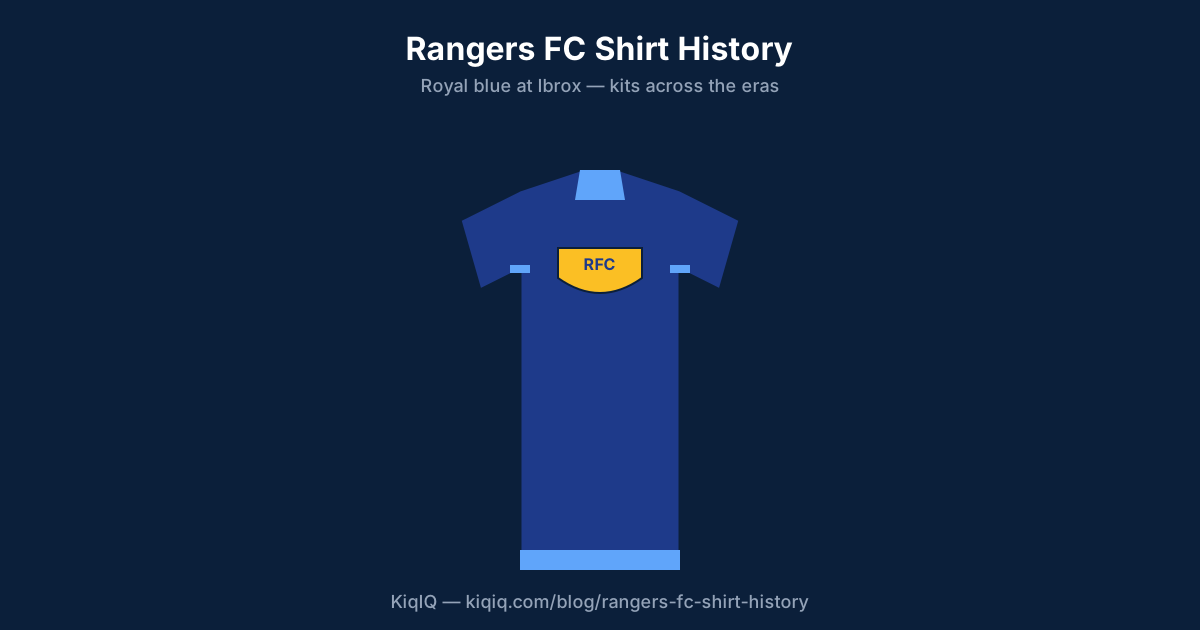
Rangers FC's home shirt has been royal blue, with white shorts and white or black socks, for almost the entire history of the club. Founded in 1872 by four Glasgow teenagers, the club's kit identity has cycled through Umbro, Admiral, Hummel, Nike, Puma, Castore, and Adidas across the decades, with the royal blue itself as the unbroken constant. The shirt sits at the centre of Glasgow's footballing visual culture and is one of the most-recognised club kits in world football.
The 1872 founding and royal-blue heritage
Rangers FC was founded in March 1872 by four teenagers (Peter and Moses McNeil, Peter Campbell, and William McBeath) rowing on the River Clyde and is one of the oldest football clubs in Scotland. The royal-blue colour scheme has been the club's home identity from the earliest seasons, with the shirt typically paired with white shorts and (across the modern era) white or black socks. The specific royal-blue shade has stayed close to the same Pantone reference across manufacturer eras, with only subtle variation between cycles.
A current example is a 2023-24 Rangers pro-authentic home shirt, an example of the modern player-issue spec that has become a recognised collector category alongside standard fan-issue shirts.
The 1972 Cup Winners' Cup era and the Umbro templates
Rangers' major European triumph is the 1972 European Cup Winners' Cup, won 3-2 against Dynamo Moscow at the Camp Nou in Barcelona, with Colin Stein and a Willie Johnston brace scoring the goals. The shirt worn that night, a relatively plain royal-blue Umbro template with white V-neck collar and minimal detailing, sits at the centre of Rangers heritage shirt collecting. Original match-worn examples from the 1971-72 European campaign rarely surface, and reissues and reproductions have continued to circulate through the decades.
The Umbro relationship with Rangers extended across multiple periods of the club's modern history, with the brand producing the templates worn during several Scottish league title campaigns and notable European nights. The Umbro diamond sleeve detailing of the late 1980s and early 1990s sits on a generation of collected Rangers shirts from the Souness and Walter Smith Nine-in-a-Row era.
Admiral, Hummel, and the 1980s design language
Through the 1980s Rangers cycled across several manufacturers including Admiral and Hummel, each of which produced templates that are now heritage items in the dedicated Scottish collector market. The Admiral templates of the early 1980s carry the distinctive shoulder-stripe layout that the brand used across multiple British clubs of the era. The Hummel templates introduced the chevron sleeve detailing that defined the brand's late-1980s output.
The Souness Revolution (1986 onwards) coincided with a kit-marketing scale-up that transformed Scottish football commercially. Graeme Souness's arrival as player-manager brought a recruitment budget and a brand profile that pushed Rangers shirts into wider international circulation than the club had previously achieved. The 1986-1991 templates from this era are among the most-collected Rangers shirts of the modern period.
The 1972 Cup Winners' Cup Umbro shirt is the heritage anchor of Rangers shirt collecting. The 1986-1991 Souness-era templates are the most-collected modern items.
Nike, Puma, Castore, Adidas: the modern manufacturer cycle
From the late 1990s onwards Rangers worked with Nike (across multiple title-winning campaigns), then Umbro again, then Puma, then a controversial spell with Castore (2020-2023) that produced kit-quality complaints and a public falling-out with the manufacturer over fan complaints about fading and seams. The Castore relationship ended early. Adidas became the kit manufacturer from 2023-24 onwards, returning the club to one of the global Big Three manufacturers after a sequence of smaller-brand experiments.
The Adidas templates have continued the conserved royal-blue home design with the brand's standard Three Stripes sleeve detailing and a modernised fit. Away kits have ranged across white, red, black, and orange variants across the various manufacturer eras, with the home royal-blue identity untouched through each transition. The home shirt is one of the most-conserved kit-design heritage anchors in world football.
Sponsor history and the modern collector market
Rangers' shirt sponsor history has rotated through several major partners including McEwan's Lager (a long-running 1980s and 1990s sponsorship that defined a generation of collected shirts), CIS, Carling, Tennent's, 32Red, and others through the 2000s and 2010s. The sponsor logos themselves are part of how collectors date individual Rangers shirts, with the McEwan's sponsorship in particular sitting at the centre of Souness and Walter Smith-era heritage shirts.
Rangers shirts have a significant international collector following because the club is one of a small group of historically-successful European clubs whose visual identity has remained consistent across more than a century. The combination of design continuity, manufacturer rotation (which keeps each season visually distinct), and notable sponsor eras produces a layered collector taxonomy that rewards detailed knowledge. The pro-authentic player-issue versions of recent seasons sit at the premium end of the modern Rangers collector market.
- 1872-1960s: Royal blue established from the earliest seasons; manufacturer arrangements informal across early decades.
- 1972 Umbro Cup Winners' Cup template: Heritage anchor of Rangers shirt collecting.
- 1980s Admiral and Hummel: Shoulder-stripe and chevron-sleeve templates from the manufacturer-template era.
- 1986-1991, Souness Revolution: Commercial scale-up; most-collected modern Rangers shirts.
- 2020-2023, Castore: Kit-quality controversy and early termination of the manufacturer deal.
- 2023 onwards, Adidas: Return to a Big Three manufacturer with the conserved royal-blue home design.
Frequently asked questions
- What colours does Rangers FC play in?
- Rangers FC play in royal blue at home, with white shorts and white or black socks. The royal-blue identity has been the club's home design constant since the earliest seasons after the 1872 founding, with the specific shade staying close to the same reference across manufacturer eras. Away kits have varied across white, red, black, and orange variants across the various Umbro, Admiral, Hummel, Nike, Puma, Castore, and Adidas eras.
- Who makes Rangers FC shirts now?
- Adidas has manufactured Rangers's kits from the 2023-24 season onwards, after a manufacturer cycle that included Castore (2020-2023, terminated early following kit-quality complaints), Puma, Hummel, Umbro, and others across earlier eras. Adidas has continued the conserved royal-blue home design with its standard Three Stripes detailing, returning Rangers to one of the global Big Three manufacturers after several seasons with smaller-brand suppliers.
- What is the famous Rangers Cup Winners' Cup shirt?
- Rangers won the 1972 European Cup Winners' Cup against Dynamo Moscow at the Camp Nou in Barcelona, with the team wearing an Umbro royal-blue template with a white V-neck collar and minimal detailing. The shirt is the heritage anchor of Rangers shirt collecting, with original match-worn examples from the 1971-72 European campaign extremely rare on the secondary market. Reissues and reproductions have circulated across the decades.
- Why did Rangers and Castore split?
- Rangers and Castore ended their kit-manufacture deal earlier than the original contract envisaged after a series of public fan complaints about kit quality (fading royal blue, seams, sizing inconsistencies) across multiple seasons of the partnership. The deal was terminated, and Adidas took over from 2023-24 onwards, returning Rangers to a global Big Three manufacturer. The Castore-era shirts remain in collector circulation but at a more cautious valuation than other modern Rangers kits.
References
- Rangers FC, official club site — Rangers FC
- Football Shirt Culture Magazine, Scottish football archive — Football Shirt Culture
- Classic Football Shirts, Rangers editorial archive — Classic Football Shirts
- SPFL, Rangers club page — Scottish Professional Football League
- Historical Football Kits, Rangers archive — Historical Football Kits
- Rangers 2023-24 pro-authentic home shirt, Mystery Shirt Club (affiliate) — Mystery Shirt Club
Key terms in this article
Ask KiqIQ a follow-up
Get a live, data-driven answer powered by api-football + KiqIQ's Poisson model. Try one of these prompts or write your own.
Part of pillar
Football Culture
See every article in this knowledge pillar →
Related
Reviewed by a KiqIQ editor before publication. Spotted an error? Email editor@kiqiq.com — we follow our Corrections Policy.