
How to Sketch a Football — Step-by-Step Drawing Guide
Sketching a football starts with a circle, a central pentagon, and the truncated-icosahedron pattern of 12 pentagons and 20 hexagons. We walk through every step, the geometry behind it, and how to shade for a believable sphere.
 Tap to enlarge
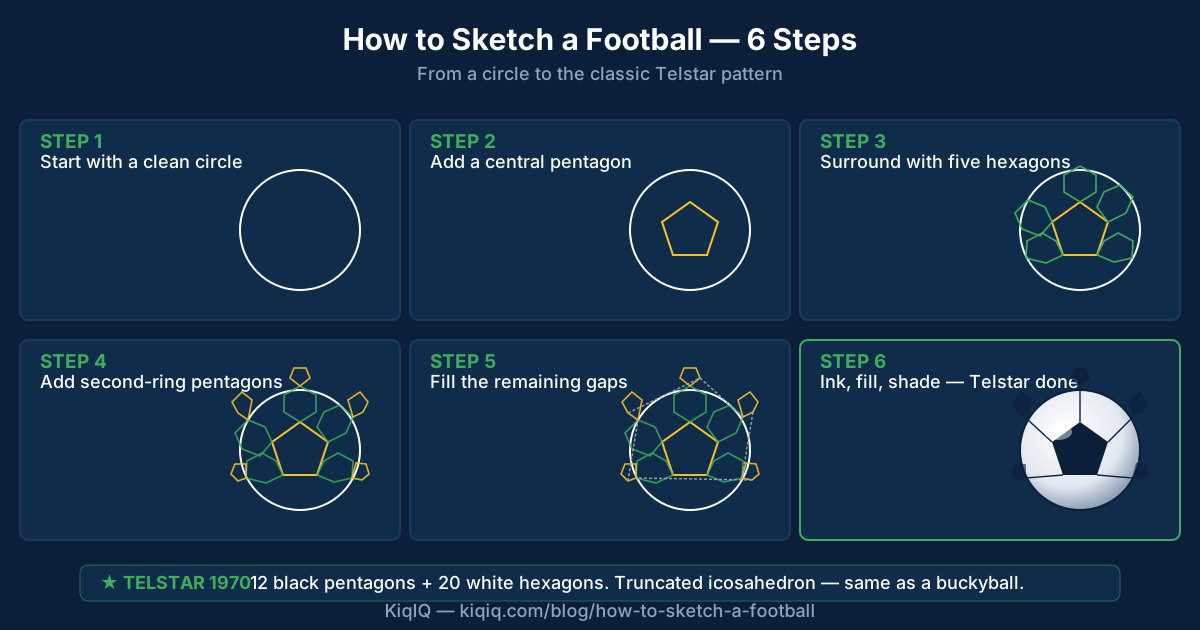
Sketching a football is mostly about getting one piece of geometry right: the truncated icosahedron — a sphere made of 12 black pentagons and 20 white hexagons, the pattern Adidas introduced with the 1970 Telstar at the Mexico World Cup. Start with a circle, place a single pentagon in the centre, surround it with five hexagons, and let the symmetry do the rest. We walk through six clean steps, the geometry of why each panel sits where it does, and the shading tricks that make the ball read as a sphere rather than a flat shape.
What you're actually drawing — the truncated icosahedron
A traditional football is a truncated icosahedron: take a 20-sided icosahedron, slice the corners off, and you get a 32-faced shape with 12 regular pentagons and 20 regular hexagons. Every pentagon is surrounded by 5 hexagons; every hexagon touches 3 pentagons and 3 hexagons.
This is the pattern Adidas used for the Telstar 1970 — "television star" — designed to be visible on the black-and-white TV broadcasts of the 1970 Mexico World Cup. Black pentagons against white hexagons gave the ball maximum contrast on low-resolution sets. The pattern stuck for decades, even though modern Premier League and Champions League balls now use thermally-bonded panels in different shapes (Adidas Tango, Brazuca, Al Rihla, Pro Connected).
When someone says "draw a football", they almost always mean the Telstar pattern. The geometry below assumes that.
Truncated icosahedron: 12 pentagons + 20 hexagons = 32 panels, 90 edges, 60 vertices. Same shape as a buckminsterfullerene (C₆₀) molecule.
Step 1 — start with a clean circle
Use a compass or trace around a coin or bowl. The circle is the outline of the sphere as you see it from the front — every panel will sit inside this circle.
The cleaner your circle, the easier everything else is. If you're working freehand, build it up with a few light pencil arcs and connect them, rather than trying to commit a perfect circle in one stroke.
Step 2 — place a central pentagon
Mark a point at the centre of the circle. This will be the centre of the front-facing pentagon — the panel pointing directly at the viewer.
Draw a small regular pentagon centred on that point. A regular pentagon has five equal sides at 108° interior angles. If you're freehanding, draw a small upward-pointing equilateral triangle first, then "open" it into a pentagon by extending the bottom edge — easier than starting with five equal sides.
Keep the pentagon small. As a rule of thumb: the pentagon's width should be roughly 25-30% of the circle's diameter. Larger pentagons compress the surrounding hexagons; smaller pentagons leave room for the curvature to read.
Step 3 — surround it with five hexagons
Each side of the pentagon shares an edge with a hexagon. So you draw five hexagons, one for each pentagon edge, with each hexagon sharing exactly one side with the pentagon.
Three things to keep in mind:
- Match edge lengths. The shared edge between the pentagon and each hexagon must be the same length. Eyeball this carefully — uneven edges break the symmetry.
- Slight curvature. Because the football is a sphere, the hexagons further from the centre should appear slightly compressed in the direction of the curve. The hexagons at the top, bottom, and sides of the central pentagon stretch and tilt outward as they wrap around the ball.
- Don't commit hard lines yet. Stay in light pencil — you'll adjust the outer hexagons as the second ring goes in.
Step 4 — add the second ring of pentagons
Each of the five hexagons you just drew has six sides. One of those sides touches the central pentagon. The opposite side touches another pentagon in the second ring.
Draw five small pentagons, one for each hexagon's outer edge. These are the partial pentagons you see at the edges of a real football — usually only half-visible, since they sit at the curve of the sphere where the surface starts to roll away from the viewer.
Keep these pentagons the same size as the central one. Their visible portions get smaller as they near the outline of the circle, mimicking foreshortening.
Step 5 — fill the gaps with hexagons
Between each pair of second-ring pentagons sits a hexagon. These outer hexagons fill the remaining visible surface of the ball, with their edges touching both pentagons in the second ring and the surrounding hexagons.
By the time you've placed the second-ring pentagons and the connecting hexagons, the front-facing half of the ball is complete. The back half is hidden — you don't draw it. The visible pattern from the viewer's angle typically shows roughly 8-12 panels in full or part plus the curving outline.
Step 6 — ink, fill, and shade
Now make it read as a football. Three finishing moves:
- Ink the panel edges. Trace your final pentagon and hexagon edges with a pen or darker pencil. Erase any construction lines. Edges should be slightly thicker on panels closer to the silhouette of the ball — this implies depth.
- Fill the pentagons black, leave the hexagons white. Classic Telstar contrast. If you're drawing a modern ball (Adidas Brazuca, Al Rihla, Premier League Nike Flight) the pattern changes — but for a recognisable cartoon football, black pentagons + white hexagons is the visual shorthand the brain recognises instantly.
- Add shading. A football is a sphere, so it needs a single light source. Pick a light direction (typically top-left), then add a soft gradient of grey on the opposite side of the ball, plus a small white highlight near the light source. Even on a Telstar pattern, shading on top of the pentagons and hexagons sells the sphere.
Common mistakes to avoid
Three frequent errors that flatten an otherwise good sketch:
- Hexagons drawn as squares. A hexagon has six sides, not four. If you're in a hurry, you'll often shortcut to squares. Slow down and confirm six clean sides on each hexagon.
- Pentagons that drift in size. Once one pentagon is wrong, the hexagons can't lock in around it. Use the central pentagon as the reference and match every other pentagon's width to it.
- No curvature. A flat panel pattern looks like a wallpaper sample, not a ball. Compress and tilt the panels closer to the circle's edge to imply the sphere curving away from the viewer.
A quick alternative — the modern ball
If you want a modern Premier League or World Cup ball look rather than a Telstar, the panel patterns are simpler to draw:
- Adidas Telstar 18 / Brazuca / Al Rihla. Six identical panels arranged in a propeller pattern. Far easier than the truncated icosahedron — three panels visible on the front face, organised around a central seam meeting at three points.
- Nike Flight (Premier League). Four large panels in an asymmetric AeroSculpt design. Mostly white with coloured graphic accents.
- Mitre / classic British leather ball. 18 panels in a hexagonal grid, all the same colour. Simpler than a Telstar but less recognisable as "a football".
Frequently asked questions
- How do you draw a football step by step?
- Draw a clean circle, then place a small regular pentagon in the centre. Surround the pentagon with five hexagons, one on each side. Add five more pentagons in a second ring, one per hexagon. Fill the remaining gaps with outer hexagons. Ink the edges, fill the pentagons black, leave the hexagons white, and shade the sphere with a soft gradient and a single highlight.
- How many panels does a traditional football have?
- A traditional football has 32 panels — 12 black pentagons and 20 white hexagons — arranged in a truncated-icosahedron pattern. This is the design Adidas introduced with the Telstar 1970 ball at the Mexico World Cup. The pattern was chosen for visibility on black-and-white TV broadcasts. Modern professional balls (Brazuca, Al Rihla, Nike Flight) use fewer, thermally-bonded panels in different shapes.
- Why does a football have pentagons and hexagons?
- The pentagon-and-hexagon pattern is the truncated icosahedron — a polyhedron where every pentagon is surrounded by five hexagons, and every hexagon touches three pentagons and three hexagons. The shape approximates a sphere extremely well using flat panels. The same geometry exists in the buckminsterfullerene (C₆₀) carbon molecule, which is why it's nicknamed the buckyball.
- How big should the pentagon be when drawing a football?
- The central pentagon should be roughly 25-30% of the circle's diameter. Larger pentagons compress the surrounding hexagons and make the ball look stylised; smaller pentagons leave room for the curvature to read and give the sphere depth. Keep all 12 pentagons the same size as the central one — uneven pentagons break the symmetry the eye expects.
- Do modern professional footballs still use the Telstar pattern?
- Most modern professional footballs no longer use the Telstar truncated-icosahedron pattern. The 2014 Adidas Brazuca used six propeller-shaped panels; Al Rihla (Qatar 2022) used 20; the Premier League's Nike Flight uses just four large AeroSculpt panels. Thermally-bonded construction replaced stitched hex-and-pent panels in the late 2000s. The Telstar pattern survives mainly as the visual shorthand for "football" in cartoons, logos, and emoji.
References
Ask KiqIQ a follow-up
Get a live, data-driven answer powered by api-football + KiqIQ's Poisson model. Try one of these prompts or write your own.
Part of pillar
Fundamentals
See every article in this knowledge pillar →
Related
Reviewed by a KiqIQ editor before publication. Spotted an error? Email editor@kiqiq.com — we follow our Corrections Policy.