
3-6-1 Formation: Midfield-Heavy Possession Setup
The 3-6-1 stacks three CBs and six midfielders behind a lone striker — a midfield-overload formation built around possession dominance.
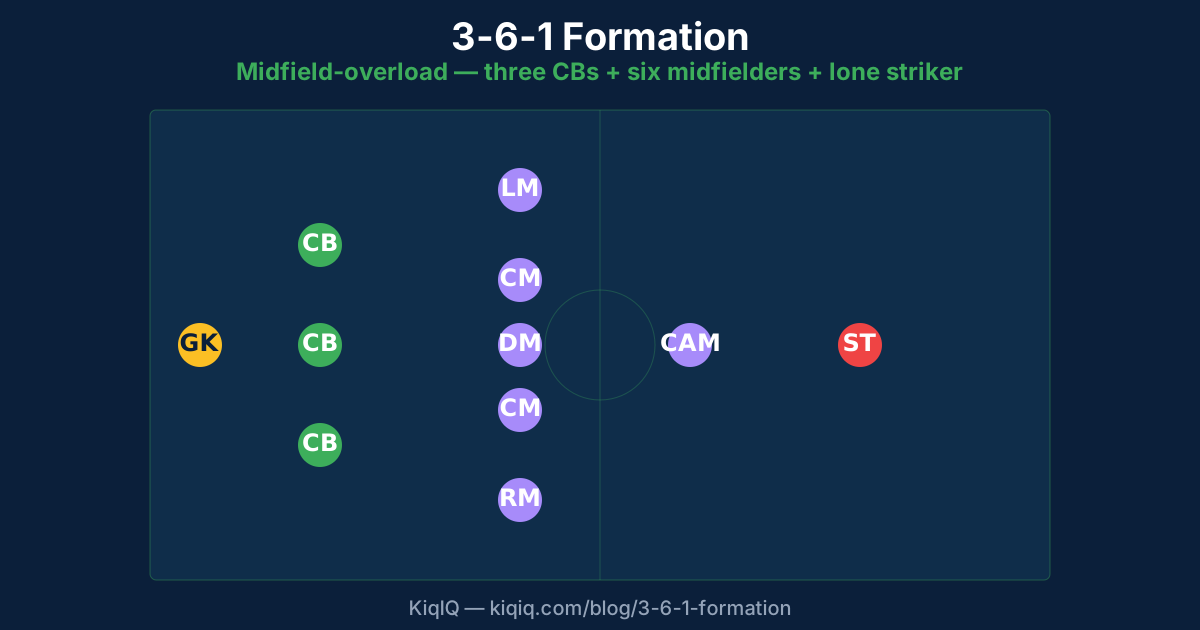 Tap to enlarge
The 3-6-1 uses three centre-backs and six midfielders behind a lone striker — a midfield-overload formation built around possession dominance. The six midfielders are typically structured as 2 wing-backs + 2 CMs + 2 attacking midfielders. Rarely used as a starting formation but appears in possession-dominant teams' attacking phases.
The 3-6-1 structure
The 3-6-1 is not a stable defensive shape — it is what a 3-4-2-1 or 3-5-2 turns into when the team commits to a sustained attacking phase and the wing-backs push high. On the team-sheet you will almost never see a manager line up in a literal 3-6-1; on a stats overlay heat-map of an in-possession phase, you will see it constantly. The label exists to describe the moment, not the starting eleven.
- 3 CBs. Standard back three, with the wide CBs split wide to cover for advancing wing-backs.
- 6 midfielders. 2 wing-backs (high and wide) + 2 CMs (one holding, one progressing) + 2 attacking midfielders sitting between opposition lines.
- 1 lone striker. Target / pressing forward, often dropping to combine with the attacking midfielders rather than running in behind.
When it works
The 3-6-1 shape is most useful against a deep, compact opposition block. Six players in the midfield band create numerical superiority everywhere across the width of the pitch — the opposition cannot match up man-for-man without either pulling defenders out of position or vacating the wide channels.
- Possession-dominant teams. Six midfielders create midfield numbers that are essentially impossible to outnumber.
- Vs deep-block opposition. The midfield overload forces defenders to choose between covering depth or width. Either choice opens space the attacking team can exploit.
- Specific match-ups. Against a three-CM opposition midfield, six versus three is a structural mismatch the deeper team cannot fix without abandoning shape elsewhere.
- Late-game game-state. Teams chasing a goal often shift into 3-6-1 by pushing wing-backs and tucking the strikers into midfield slots.
Strengths and weaknesses
The 3-6-1 is a high-control, low-flexibility shape. It dominates territory when the team has the ball; it is brittle the moment possession is lost. Most modern coaches treat it as an in-possession phase rather than a defensive structure, switching shape on the turnover.
- Strength. Possession control; the midfield band is virtually impossible to outnumber.
- Strength. High-press capability — six midfielders give the team enough bodies to trigger pressing actions across the whole width of the pitch.
- Strength. Width without losing midfield density, because the wing-backs provide width while the four central midfielders provide density.
- Weakness. Striker isolation; the lone CF often runs out of attacking options when the build-up is slow.
- Weakness. Defensive transition vulnerability if all six midfielders push high simultaneously and the back three is left exposed to a counter.
- Weakness. Cross supply quality; with only one striker in the box, even good crosses often find nobody to attack the ball.
Frequently asked questions
- What is the 3-6-1 formation?
- 3-6-1 is a football formation with 1 GK, 3 centre-backs, 6 midfielders (typically 2 wing-backs + 2 CMs + 2 CAMs), and 1 striker. It is a midfield-overload formation built around possession dominance.
- When does 3-6-1 work?
- Best for possession-dominant teams playing against deep-block opposition. The six midfielders create unbeatable midfield numbers (6 vs 3 in most opposition midfields). Rarely used as a starting formation; more common in possession-dominant teams' attacking phases, or in late-game scenarios when a team is chasing a goal.
- What is the main weakness of 3-6-1?
- Striker isolation — the lone CF often runs out of attacking options. Defensive transition vulnerability if all 6 midfielders push high simultaneously. Forwards in 3-6-1 systems also score fewer goals per 90 than in 3-5-2 / 4-3-3 systems where CFs have more direct support.
- Which teams have used 3-6-1?
- Pep Guardiola's Manchester City has shifted into 3-6-1 patterns during sustained build-up phases, particularly against five-at-the-back opposition. Roberto De Zerbi's Brighton used 3-6-1 patterns in their attacking third. It is almost always an in-possession structure rather than a starting formation.
References
- Spielverlagerung — 3-6-1 Analysis — Spielverlagerung
- IFAB Laws of the Game — IFAB
- Perfect Soccer Skills — 3-6-1 — Perfect Soccer Skills
Key terms in this article
Ask KiqIQ a follow-up
Get a live, data-driven answer powered by api-football + KiqIQ's Poisson model. Try one of these prompts or write your own.
Try the calculators
Apply the concepts from this article with KiqIQ's free calculators.
Part of pillar
Tactical Intelligence
See every article in this knowledge pillar →
Related
Reviewed by a KiqIQ editor before publication. Spotted an error? Email editor@kiqiq.com — we follow our Corrections Policy.