
2-3-2-3 Formation: The Box-Midfield In-Possession Shape
The 2-3-2-3 is the in-possession shape Pep Guardiola popularised at Manchester City — a box midfield, two CBs, and a front three. Almost never the out-of-possession setup.
 Tap to enlarge
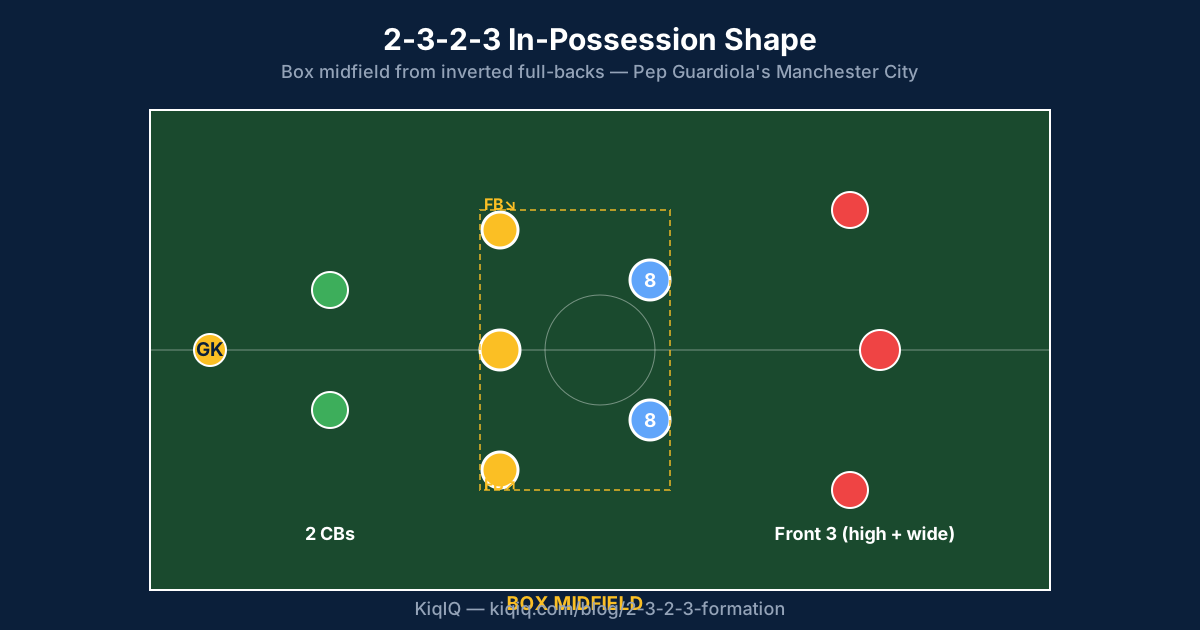
The 2-3-2-3 is an in-possession formation rather than a defensive setup. It's the shape that emerges when a 4-3-3 inverts both full-backs into midfield to form a box midfield, leaving two centre-backs at the back, three midfielders across the lower box edge, two #8s along the upper box edge, and a front three. Pep Guardiola popularised it at Manchester City. Out of possession, the team transitions back to a 4-3-3 or 4-1-4-1.
The 2-3-2-3 structure (in possession)
- 2 CBs. The full-backs invert, leaving only two CBs holding the back line.
- 3 midfielders (lower box edge). A central #6 flanked by two inverted full-backs forming the lower edge of the box midfield.
- 2 #8s (upper box edge). Two attacking-leaning central midfielders ahead of the #6.
- Front 3. Two wide forwards (often inverted wingers) + a #9 — usually the same shape the team has out of possession.
Why coaches build a 2-3-2-3
Box midfields create permanent diagonal passing options for whoever has the ball. From any midfield slot, there are at least three options at different vertical heights and angles — the box geometry guarantees it. Conventional 4-3-3 build-ups can flatten into a horizontal line; a box midfield rules that out.
The shape also disconnects the front three from build-up duties. With the box absorbing build-up responsibility, the wide forwards stay as high as possible, pinning the opposition full-backs and stretching the back line. The #9 stays central, isolating the centre-backs.
Most relevant: rest defence. With two CBs + a #6, the team has three pre-organised defenders for the moment possession is lost. That allows the upper-box players (the two #8s + inverted full-backs) to gegenpress freely without breaking shape.
When 2-3-2-3 works
- Possession-dominant matches. Box midfields shine over long possession phases — they need touches to express the geometric advantage.
- Squad has inverted full-back capability. Inverting requires a full-back comfortable in central midfield (Cancelo, Stones-as-FB, Trent on certain phases). Niche profile.
- Front three press well. With only two CBs at the back, the front three has to cap opposition build-up so transitions don't kill the team.
- Aggressive counter-press is available. Rest defence is two CBs + #6; counter-press is non-negotiable to compensate.
Strengths and weaknesses
- Strength — diagonal passing geometry. A box midfield always has three angles available; possession is structurally easier to retain.
- Strength — front-three pinning. Wide forwards never drop into build-up, keeping the opposition back line stretched.
- Strength — rest defence. Two CBs + #6 = pre-organised counter-attack defenders.
- Weakness — out-of-possession only nominal. When the team loses the ball before the inverted full-backs recover, it's a 2v3 or 2v4 against the opposition front line. Catastrophic if the press is bypassed.
- Weakness — squad-fit very narrow. Needs full-backs that can play CM, two ball-playing CBs, and a #6 with the lateral awareness to cover for a full-back's missed inversion.
- Weakness — rare and recognisable. Opponents specifically prepare for the inversion; a team that runs only 2-3-2-3 is easier to plan against than one that mixes 4-3-3 and 2-3-2-3 dynamically.
In-possession vs out-of-possession shapes
The 2-3-2-3 is rarely a starting formation in the team-sheet sense. It emerges from a nominal 4-3-3 the moment the team has the ball and the full-backs step inside. As soon as possession is lost, the inverted full-backs sprint back to the touchline and the team becomes a 4-3-3 or 4-1-4-1 again. Punditry often calls it a "morphing" or "fluid" 4-3-3.
This is a useful watch-cue: track the full-backs in the first phase of build-up. If they slot inside next to the #6, the team is running a 2-3-2-3 in possession.
Modern examples
Pep Guardiola's Manchester City regularly used 2-3-2-3 build-ups, with John Stones inverting from full-back during possession phases and a back two of Rúben Dias + Akanji or Aké. Mikel Arteta's Arsenal evolved a similar pattern with Zinchenko inverting from left-back. Roberto De Zerbi's Brighton experimented with comparable in-possession box-midfield variants.
Seeing it in international football is rarer because national-team training time is too short to drill the inversions cleanly. Club football is where 2-3-2-3 lives.
Frequently asked questions
- What is a 2-3-2-3 formation?
- The 2-3-2-3 is an in-possession formation that emerges when a 4-3-3 inverts both full-backs into midfield, forming a box midfield. The shape is two centre-backs, three midfielders across the lower box edge, two #8s on the upper box edge, and a front three. Out of possession, the team reverts to a 4-3-3 or 4-1-4-1.
- Who uses the 2-3-2-3 formation?
- Pep Guardiola popularised it at Manchester City with John Stones inverting from full-back during possession phases. Mikel Arteta's Arsenal evolved a similar variant with Zinchenko, and Roberto De Zerbi's Brighton experimented with related box-midfield shapes. It is almost exclusive to club football because the inversions require extensive drilling.
- What is the difference between 2-3-2-3 and 4-3-3?
- The two are the same nominal shape. A 4-3-3 with both full-backs inverting in possession becomes a 2-3-2-3 — the box midfield is what changes. Out of possession, both shapes are identical. The 2-3-2-3 is a description of the in-possession positional structure, not a different starting formation on the team sheet.
- Why is 2-3-2-3 vulnerable to counter-attacks?
- With only two CBs and one #6 in the rest-defence structure, a team that loses possession before the inverted full-backs recover is in a 2v3 or 2v4 against the opposition forwards. Successful 2-3-2-3 sides compensate with aggressive counter-pressing and a forward line that caps opposition build-up. Without those, the shape leaks goals on transition.
References
- Spielverlagerung — Box midfields and inverted full-backs — Spielverlagerung
- The Athletic — Pep Guardiola tactical column — The Athletic
- StatsBomb — Positional play and rest-defence data — StatsBomb
Key terms in this article
Ask KiqIQ a follow-up
Get a live, data-driven answer powered by api-football + KiqIQ's Poisson model. Try one of these prompts or write your own.
Part of pillar
Tactical Intelligence
See every article in this knowledge pillar →
Related
Reviewed by a KiqIQ editor before publication. Spotted an error? Email editor@kiqiq.com — we follow our Corrections Policy.